


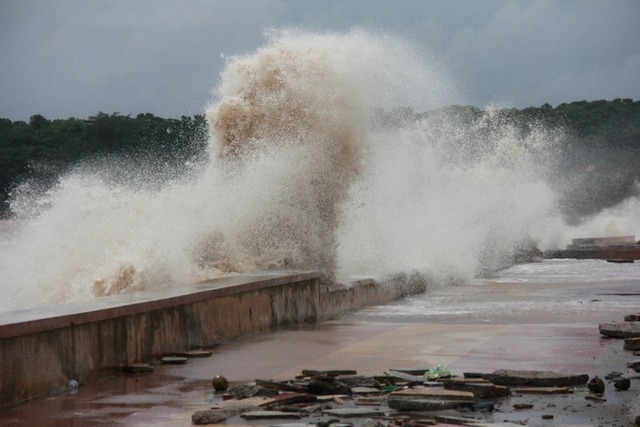
Vietnam will brace for fewer storms this year than the long-term average, but powerful storms remain a significant risk.
El Niño and La Niña are the warm and cool phases of a natural climate pattern across the tropical Pacific known as the El Niño-Southern Oscillation, or ENSO.
The National Center for Hydro-Meteorological Forecasting reported on Wednesday that ENSO is currently in its warm phase, with sea surface temperature anomalies in the central Pacific at 1.3 degrees Celsius during the second week of July.
Over the next three months, El Niño is expected to strengthen, with a 90-percent chance of reaching strong to very strong levels.
From November 2026 to January 2027, the probability rises to 95 percent.
Due to El Niño’s influence, the number of storms and tropical depressions in the East Vietnam Sea through next January is likely to be lower than the long-term average.
Between August and October this year, about 6.8 storms may enter the East Vietnam Sea, with 2.7 of them making landfall.
From November to January, approximately 2.8 storms could develop over the maritime area, with 1.1 hitting land.
Although fewer storms are anticipated this season, the national weather agency warned that powerful storms may occur.
The agency added that heatwaves may intensify in central Vietnam, particularly from Thanh Hoa to Hue and along the south-central coast from August to September.
The number of hot days in the central region will exceed both the long-term average and the same period in 2025.
From November, cold air will possibly increase in strength and frequency, but the number of severe cold days will remain below average.
Nationwide average temperatures are expected to be 0.5-1.5 degrees Celsius higher than normal, with October 2026 to January 2027 seeing increases of 1-2 degrees Celsius or more in some areas.
Rainfall patterns are also expected to shift, with moderate to heavy rains likely across the country from August to October, and concentrated rainfall in central Vietnam from November to January.
The agency cautioned that El Niño will reduce overall rainfall but still trigger extreme floods.
Sudden surges in water inflows could rapidly fill reservoirs, especially small and medium ones, forcing operators to switch from drought management to flood control in a short time. This poses risks to infrastructure safety.
The Ministry of Agriculture and Environment has urged local authorities to direct reservoir managers and investors to conduct regular safety checks, limit water storage in unsafe or damaged reservoirs, and prepare flexible operation scenarios for heavy rainfall events.








Max: 1500 characters
There are no comments yet. Be the first to comment.