


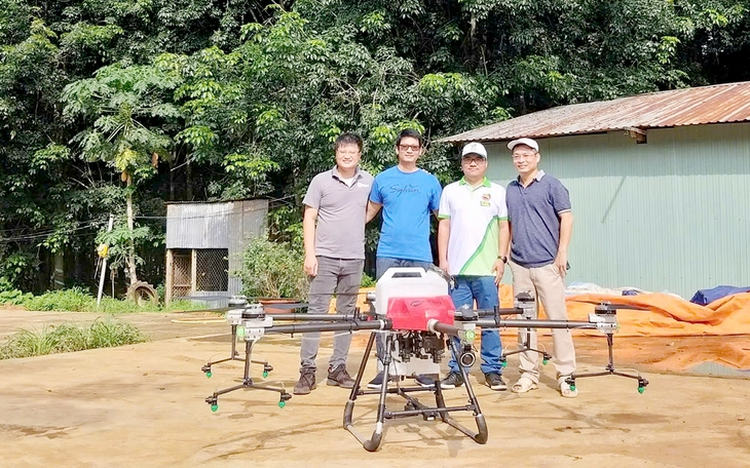
Hoang (L, 2nd) checks a drone before spraying pesticides on rubber trees in Dong Nai Province, southern Vietnam. Photo: Supplied
Hoang, 37, from Phu Nghia Commune in Dong Nai Province, is one of them.
After years of studying and working in France, he could have stayed on with a stable job and a comfortable life.
Instead, the longer he lived abroad, the more he found himself thinking about the land where he grew up, and about how farming in Vietnam remained labor-intensive and increasingly vulnerable to rising costs.
Bringing modern agriculture home
In 2008, he won a scholarship to study automation engineering at Grenoble University, one of France's leading engineering institutions.
After graduating, he joined French utility EDF and later Technip Energies, working on major industrial projects and established a strong professional career.
Yet even at his most settled, the idea of returning never really left him.
When he came back to Vietnam, Hoang began renovating his family's 50-hectare farm, locally referred to as a garden, which grows rubber, pepper, and avocado crops.
His aim was to redesign the production model using automation, digital monitoring, and clean energy, reducing manual labor and improving long-term efficiency.
"The hardest challenge at the beginning was the operating cost," he recalls.
"Some months, electricity bills reached VND100 million [US$3,826]. With such a large farm and an extensive irrigation system, continuing like that would not be sustainable."
He began experimenting with solar power, prioritizing systems that could be produced domestically and adapted to Vietnam's climate and operating conditions.
The place now runs on an off-grid solar system with hundreds of panels and inverters converting direct currents into three-phase 380-volt alternating currents, generating enough power to operate high-capacity irrigation pumps across the farm.
Investment costs averaged about VND35 million ($1,339) per hectare for an 8kWp system, with a break-even period of around one to one and a half years.
Hoang first installed solar panels in 2020, starting with a small grid-connected system of about 20 panels.
As the system proved effective, he expanded it gradually until the farm could operate independently from the public electricity network.
Beyond lowering operating costs, the system also improved reliability. Irrigation can continue during peak demand periods without disruption, an important factor during the dry season.
Letting systems do the work
With electricity stabilized, Hoang turned his attention to irrigation and fertilization.
He built elevated water storage tanks, pumping water from nearby ponds and streams to create natural pressure.
Combined with automated controls, this allows watering to run consistently across the farm.
He later installed an automatic fertilizer injection system. Solid and liquid fertilizers are fully dissolved using high-capacity pumps, then precisely mixed and delivered through smaller pipes to each tree's roots.
"If fertilizer is not dissolved properly, it will clog the pipes and damage the system," Hoang said.
"I had to test many times before finding a method that works reliably."
As automation expanded, the need for manual labor declined. Workers no longer carry heavy fertilizer sacks or drag irrigation hoses across the fields.
Their work now focuses on monitoring pipes and valves, detecting leaks and repairing damage early.
"Agriculture depends heavily on labor, discipline, and weather," Hoang said.
"Automation helps farmers reduce risks and manage production more effectively."
Farming from above
In steep, hilly areas of the farm where vehicles cannot reach, Hoang introduced drones to spray pesticides. For rubber trees in particular, ground spraying often fails to reach the upper canopy.
"When spraying from the ground, the pesticide only affects the lower part of the tree," he said.
"Using drones allows us to spray from the top down, distributing more evenly."
The method has helped control powdery mildew and leaf yellowing, two common issues in rubber plantations, while reducing labor intensity in difficult terrains.
Alongside these changes, Hoang continues to explore new applications of technology.
One project under development involves wearable hats integrated with EEG sensors – devices that monitor brainwave activity – to measure workers' concentration levels.
"When workers are focused, five hours of work can produce results similar to eight hours under normal conditions," he said.
"If trials go well, we plan to introduce about 5,000 devices next year."
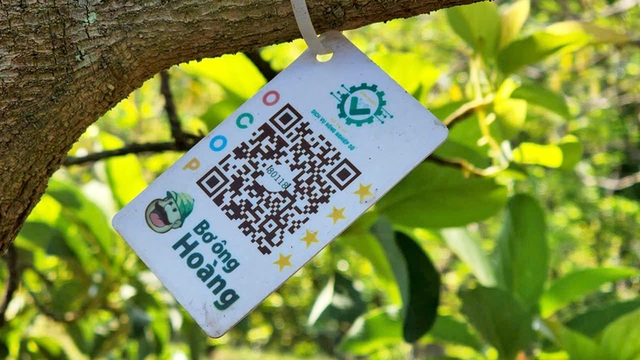
Each crop has its own electronic logbook, linked to a QR code that records every stage of care. Photo: Supplied
From farm to market
"In Europe, agricultural products are not just sold, they are explained," Hoang said.
"I believe Vietnamese agriculture can do the same, and perhaps even do better if it is done properly from start to finish."
For Hoang, production is only part of the equation. He believes transparency plays a decisive role in accessing demanding markets.
Drawing on his experience in Europe, he developed an electronic logbook system using QR codes for traceability.
Each crop is assigned a digital record documenting irrigation, fertilization, harvesting, and transportation. Consumers can scan the code to view the full production history.
"When people understand where the product comes from and how it was produced, they trust it more," Hoang said.
Thanks to close monitoring at every stage, Hoang's pepper and organic avocado meet testing requirements for the U.S. and European markets.
Each year, hundreds of tonnes of produce from the farm is distributed through major supermarket chains and exported overseas.
His avocado brand, Ong Hoang, meets VietGAP standards, Vietnam's national framework for good agricultural practices that focuses on food safety, environmental protection, and traceability.
His pepper plantation has also received organic certification from the United States Department of Agriculture (USDA), one of the world's most widely recognized accreditation bodies.
Beyond export markets, Hoang is nurturing an experimental model aimed at urban consumers.
Through mobile applications, people living in cities would be able to follow different stages of cultivation, from planting to harvest, and gradually form a sense of connection with the agricultural products they consume.
He hopes the model of modern, safe, and sustainable agriculture can be shared gradually, seeing it as another way of contributing to his home country.
Beyond the harvest
Hoang is also quietly researching ways to quantify carbon credits from agricultural models that use renewable energy and organic fertilizers.
He is also collaborating with the University of Science in Ho Chi Minh City to pilot the use of nanotechnology in sustainable pepper cultivation.
Nano-silver biological products are being tested to strengthen plants and reduce leaf yellowing and wilting, longstanding problems for pepper growers.
The project has received support from Dong Nai Province's Department of Science and Technology, creating opportunities to scale up the model and expand local agricultural products into more demanding markets.
"I want people to see that modern agriculture is possible here," Hoang said.
"If technology is applied properly and consistently, farmers in Vietnam can as well compete."








Max: 1500 characters
There are no comments yet. Be the first to comment.