


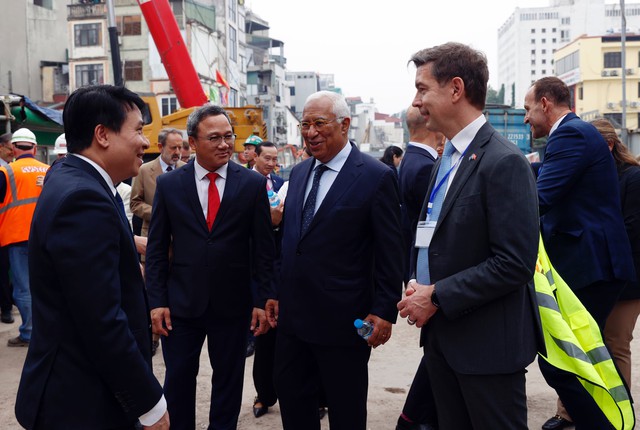
European Council President António Costa visits the underground section of Hanoi’s metro line No. 3 project, January 29, 2026. Photo: Pham Hai
Metro line No. 3 stretches 12.5 kilometers, including 8.5 kilometers of elevated track from Nhon to Cau Giay and four kilometers underground from Cau Giay to Hanoi Station.
The line will serve 12 stations, with eight elevated and four underground, aimed at easing traffic congestion, improving public transport, and enhancing the city’s environment.
The line also serves as a demonstration of international cooperation in sustainable urban transport and supports Vietnam’s green transition commitments.
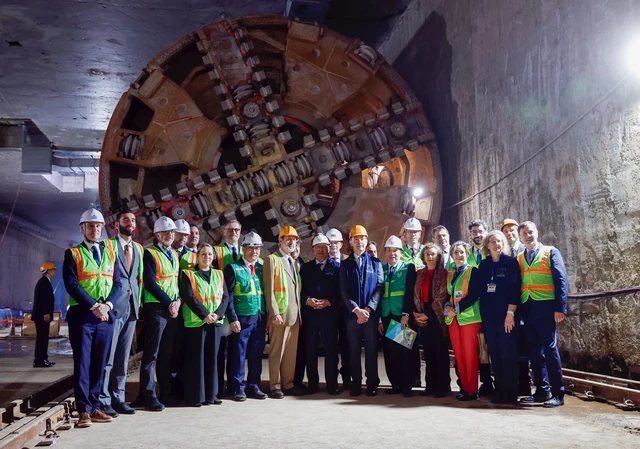
European Council President António Costa speaks with engineers working on Hanoi’s metro line No. 3 project, January 29, 2026. Photo: Pham Hai
The project has received significant financial support from France, including more than €500 million (US$598 million) in concessional loans provided by the French Treasury and the French Development Agency.
The Asian Development Bank and the European Investment Bank’s global arm, EIB Global, also contributed widely to its funding, with the Asian Development Bank providing $407.8 million and EIB Global contributing €141 million ($169 million).
According to the European Union, once completed, metro line No. 3 is expected to help reduce carbon dioxide emissions by an estimated 33,150 metric tons per year.
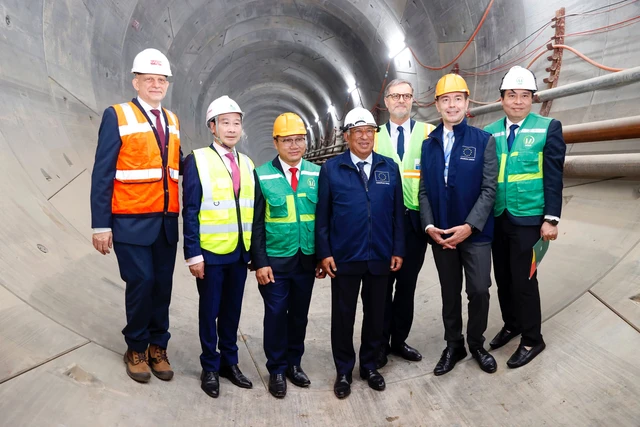
European Council President António Costa expressed hope that metro users would clearly feel the significance of the Vietnam-EU comprehensive strategic partnership. Photo: Pham Hai
After receiving an overview of the project, Costa expressed satisfaction at witnessing firsthand the results of cooperation between Vietnam and European partners.
“Last year, the EU and Vietnam celebrated 35 years of partnership, and today we have officially elevated our relationship to a new level.
“This should not be merely a name or a title, but must be reflected through concrete actions by the EU in Vietnam,” he said.
According to Costa, joint efforts involving the European Investment Bank, EU member states, and Vietnam will deliver tangible benefits to the daily lives of Vietnamese people.
“Metro lines will create a mode of transport that is more convenient, more affordable, and more environmentally friendly.
“Every day, thousands of people will directly use this system and thereby clearly experience the meaning of the comprehensive strategic partnership between Vietnam and the EU,” Costa said.
Costa is paying an official visit to Vietnam from Wednesday to Thursday, at the invitation of State President Luong Cuong.
Earlier the same day, Cuong and Costa co-chaired a press meeting to announce the outcomes of their talks, officially declaring the upgrade of Vietnam-EU relations to a comprehensive strategic partnership.
Vietnam has become the first ASEAN country to establish a comprehensive strategic partnership with the EU, and this also marks the first time Vietnam has achieved this level of relations with a bloc of nations.








Max: 1500 characters
There are no comments yet. Be the first to comment.