


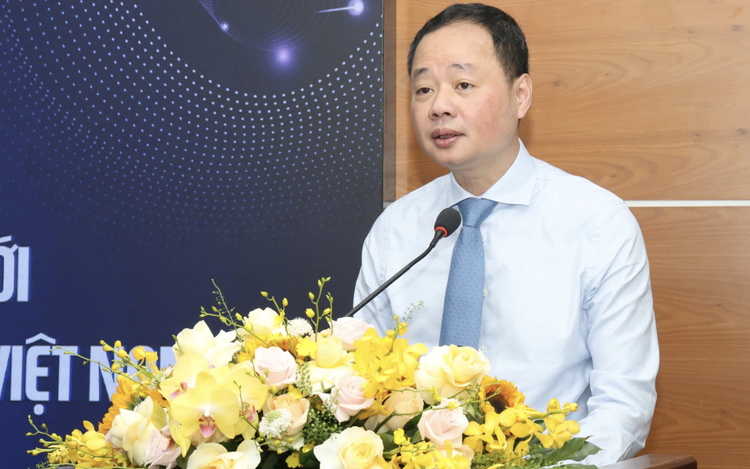
Prof. Dr. Tran Hong Thai, head of the Vietnam Academy of Science and Technology, speaks at a national scientific conference in Ho Chi Minh City, June 19, 2026. Photo: Khac Hieu / Tuoi Tre
The conference was jointly organized by Vietnam National University-Ho Chi Minh City and the Vietnam Academy of Science and Technology.
Speaking at the event, Prof. Dr. Tran Hong Thai, head of the academy, said that quantum technology emerges as one of the most strategic emerging fields, with the potential to fundamentally transform computing, communications, sensing, materials science, information security, defense, and other high-tech industries.
He noted that second-generation quantum technology is moving beyond laboratory research and is increasingly centered on three major pillars, including quantum computing, quantum communications, and quantum sensing.
The technology is becoming directly linked to competitiveness, technological sovereignty, data security, and national position in the digital era.
“Quantum technology is an extremely challenging field, but it is not beyond Vietnam’s reach,” he stressed.
“It is true that Vietnam is behind the leading powers, but being behind does not mean we cannot participate, nor does it mean we should remain on the sidelines.”
The door remains open for countries that are able to identify suitable development directions, focus on their resources effectively, organize their scientific workforce strategically, and consistently build capabilities over the long term, prof. Thai said.
He affirmed that Vietnam should pay close attention to quantum technology.
As quantum computers become powerful enough to perform advanced calculations, many of the encryption systems currently protecting financial information, citizen data, digital transactions, and critical national infrastructure could face significant security risks, he explained.
Quantum technology also carries strategic importance for national defense, security, digital economy, and national competitiveness.
He emphasized that national technological capacity must be built through skilled human resources, strong research infrastructure, and the ability to absorb, master, and develop technologies locally.
He added that the world has already entered a new phase of competition in quantum technology.
Countries and regions including the United States, China, the European Union, Japan, South Korea, Singapore, Taiwan, India, and Russia have all launched strategic programs and long-term investment plans in the field.
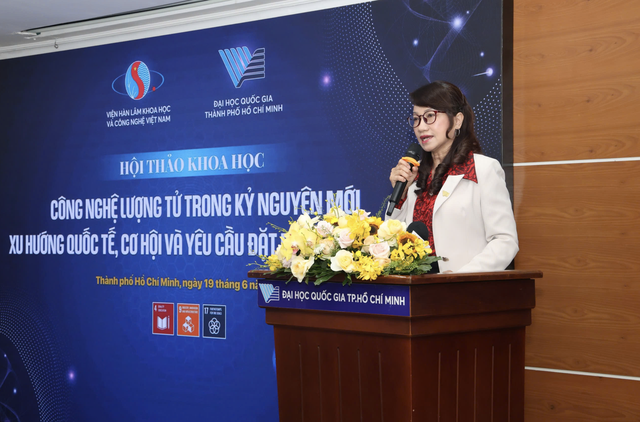
Prof. Dr. Nguyen Thi Thanh Mai, director of Vietnam National University-Ho Chi Minh City, speaks at the conference. Photo: Khac Hieu / Tuoi Tre
Prof. Dr. Nguyen Thi Thanh Mai, director of Vietnam National University-Ho Chi Minh City, said quantum technology is gradually evolving from a scientific research discipline into a strategic technological capability with far-reaching implications for national security, economic growth, scientific advancement, and competitiveness.
Vietnam should focus on identifying concrete actions that will provide the country with sufficient momentum, foundational capacity, and technological autonomy to gradually master quantum technologies, reduce dependence on external sources, and participate more deeply in global strategic technology value chains.
One of the biggest obstacles is the shortage of qualified human resources, she noted.
Quantum technology requires expertise across multiple fields, including physics, mathematics, computer science, electronics, materials science, and other related areas.
Vietnam needs a clear training roadmap, while also attracting overseas Vietnamese scientists and experts to contribute to education and research efforts.
She also stressed the importance of concentrating resources on areas capable of delivering early impact.
Post-quantum cybersecurity should be treated as an urgent priority because of its direct relevance to protecting the country's digital sovereignty.
Other promising research directions include quantum simulation, quantum software, sensing technologies, and precision measurement systems.
These fields could help address practical challenges in the development of advanced materials, next-generation batteries, semiconductors, pharmaceuticals, logistics, transportation, clean energy, environmental monitoring, land subsidence management, and smart city initiatives.








Max: 1500 characters
There are no comments yet. Be the first to comment.