


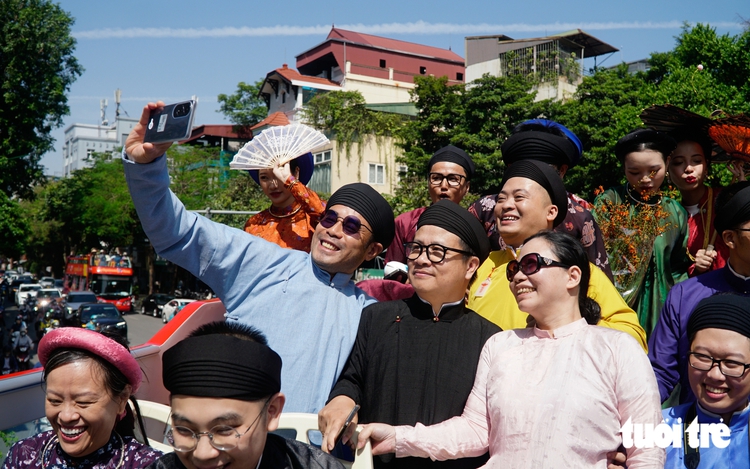
Vietnam's Ministry of Home Affairs has proposed two options for the 2027 Lunar New Year holiday. Photo: Nguyen Hien
In most Western countries, the arrival of a new year is a tidy, one-day affair: you toast at midnight, nurse a hangover on the first, and are back at your desk by the second. In Vietnam, however, Tet is a relatively long holiday by default — the nation's Labor Code officially mandates a five-day break for the Lunar New Year.
But here is where the curious math begins: those five days are rarely just five days.
Depending on the year—and who you ask—this can be a welcome 'administrative bonus' or a logistical nuisance.
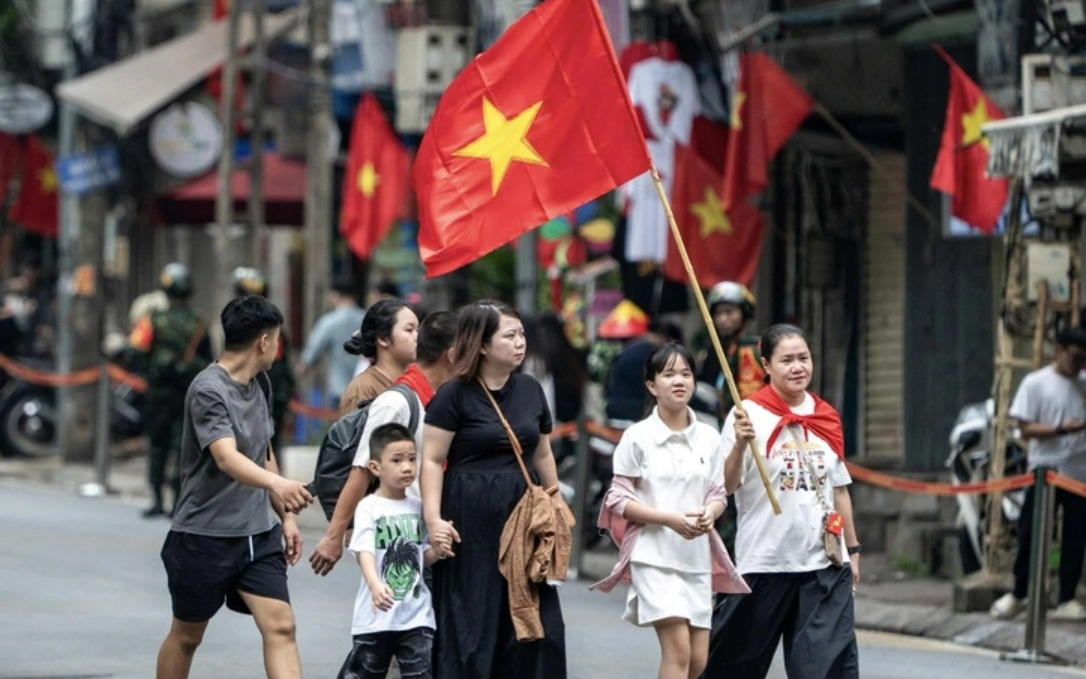
Because Tet is often the only opportunity for millions of migrant workers to return to distant provinces, a mere work-week is rarely deemed sufficient for the 'Great Reunion'.
Consequently, the government enters an annual ritual of 'weighing in' and 'collecting opinions' from various ministries to stitch these five days together with surrounding weekends.
By utilizing a maneuver known as "workday swapping"—trading a stray Friday for a future Saturday—the state can effectively stretch the holiday into a marathon.
The current debate over Tet 2027, falling in early February, is a perfect case in point.
While the astronomical dates are fixed, the Ministry of Home Affairs is currently mulling over two distinct visions: a standard seven-day or a sweeping ten-day stretch.
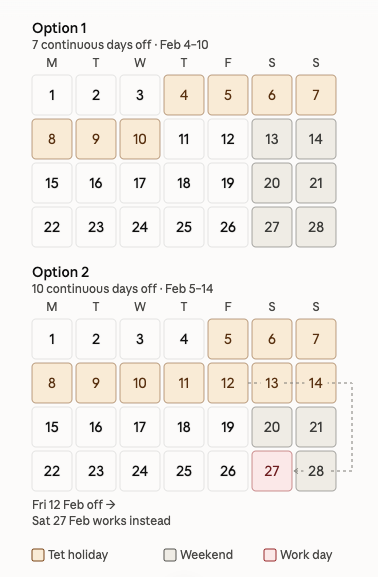
A 7- or 10-day Tet? The Vietnamese have to wait and see.
This 'request-and-approve' model has yielded a patchwork of results over the last twelve years, with holiday lengths vacillating between seven and nine days based on the Prime Minister's final stroke of the pen.
Experts have long argued for a fixed set of principles to govern this calculation, noting that the annual suspense leaves businesses in a lurch and makes booking travel a high-stakes gamble for the public.
Some observers even find the perennial debate a 'waste of time,' suggesting the schedule should be codified years in advance.
As the 2027 proposal sits on the scales, the usual battle lines are drawn.
On one side are the proponents of the ten-day break, who argue for increased consumption and a much-needed emotional recharge for the workforce.
On the other, manufacturers and export-driven businesses worry about silent factory floors and disrupted international supply chains.
Until a permanent rule is established, the Vietnamese people will continue their modern tradition: checking the news as autumn fades, waiting to find out exactly how much time they will have to celebrate the arrival of spring.
It is a reminder that in Vietnam, even time itself is subject to the delicate balance of tradition, labor, and the ultimate wisdom of the state.
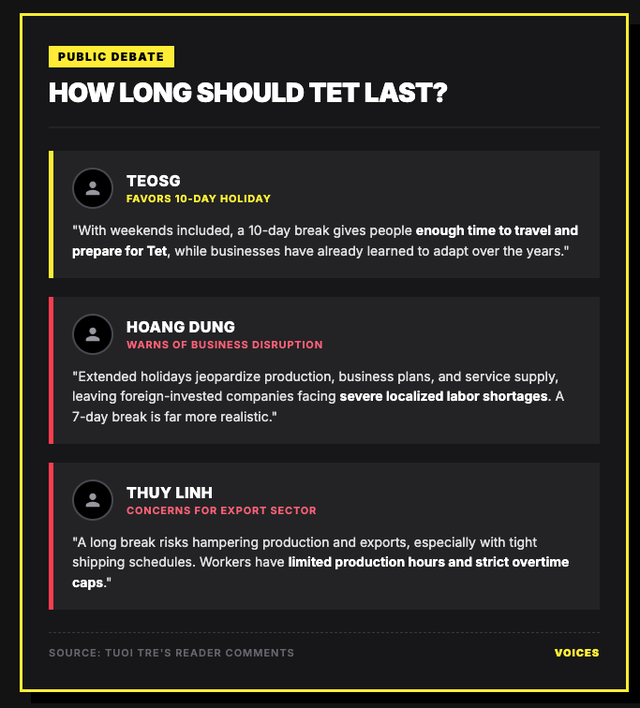
What the readers say









Max: 1500 characters
There are no comments yet. Be the first to comment.