


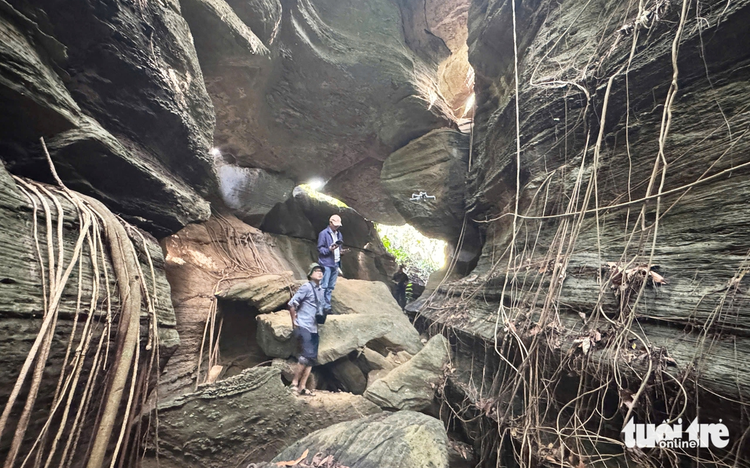
A view of Hang Doi in Da Nang City, central Vietnam. Photo: Le Trung / Tuoi Tre
The cave complex is located in Hamlet 3, Thanh Binh Commune in Da Nang, an area formerly part of Tien Phuoc District in Quang Nam Province before Quang Nam was amalgamated into Da Nang as part of Vietnam's adminstrative restructuring in July last year.
Hang Doi is a metamorphic rock complex composed of dolomitic marble formations, including caves, cliffs, and stalactites belonging to the Kham Duc geological formation, believed to have taken shape several hundred million years ago.
According to geological studies, the cave complex was formed between 530 million and 158 million years back.
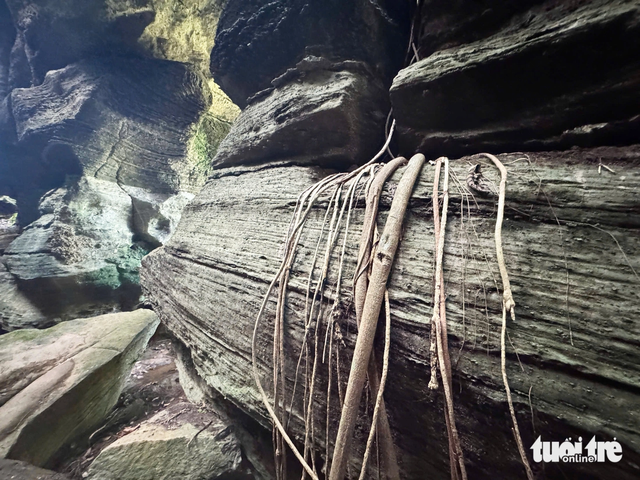
Rock formations at Hang Doi
Rocks belonging to the Kham Duc and Nui Vu formations are exposed across a wide area and are characterized by distinct colors, foliated structures, micro-folding, boudinage formations, slip surfaces, and gently inclined foliation planes.
Researchers consider Hang Doi a rare geological exposure in tropical regions because the original bedrock remains clearly visible.
In many other areas, including Lao Cai Province, Nghe An Province, and parts of the Central Highlands, similar bedrock formations have been heavily weathered.
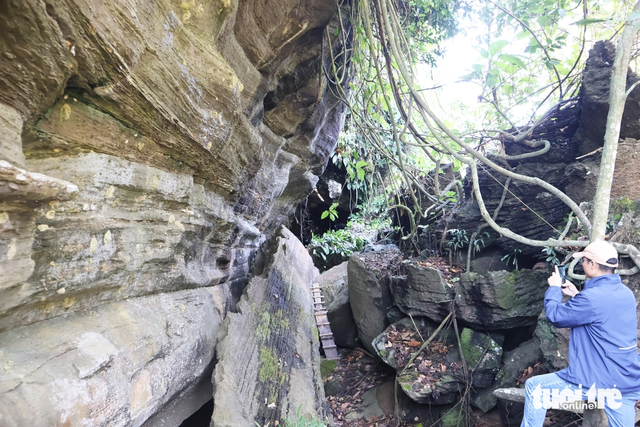
The path leading to Hang Doi
The cave complex features natural stone arches and cliffs, with layers of rock weaving through dense tree canopies and thick vines.
Some caves contain deep and narrow passages extending into the mountains.
Vertical rock walls ranging from two to five meters in height form natural arches and open-air cave systems of varying shapes and sizes.
The rock formations at Hang Doi include dark amphibolite-plagioclase schist, plagioclase-amphibolite schist, and fine-grained plagioclase-quartz-biotite schist, in some cases containing garnet.
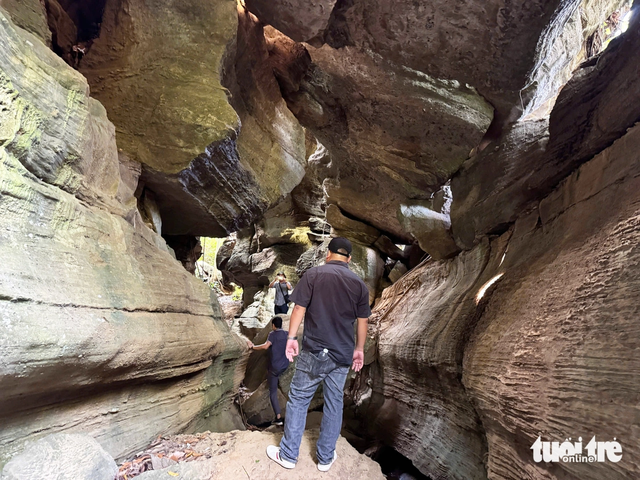
Visitors explore Hang Doi
At the center of the complex is a large cave known as Nang Tien, or Fairy Cave, which extends about 20 meters into the mountain.
The cave ranges from 1.4 to two meters in height and between one and five meters in width.
The cave is also home to bats. During Vietnam's resistance war against French colonialism, revolutionary groups reportedly collected bat guano there to produce gunpowder.
Today, local residents still use bat guano as fertilizer for crops, a practice believed to have inspired the name Hang Doi, which means Bat Cave.
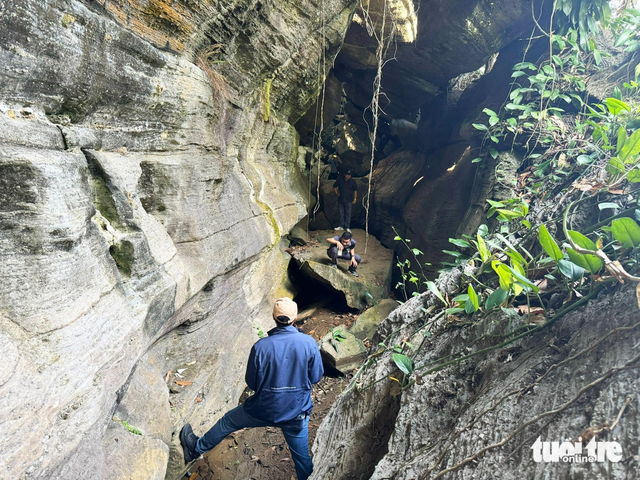
Exploring the beauty of Hang Doi
Another cave located to the right of the entrance can be accessed from both ends and contains numerous branching passages.
It is known as Dong Thien, or Heaven Cave, because parts of the cave are open to the sky.
The cave stretches for hundreds of meters, with many passages extending deep into the mountains and remaining largely unexplored.
Dense mineral veins running across the rock walls create an atmosphere many visitors describe as mysterious and surreal.
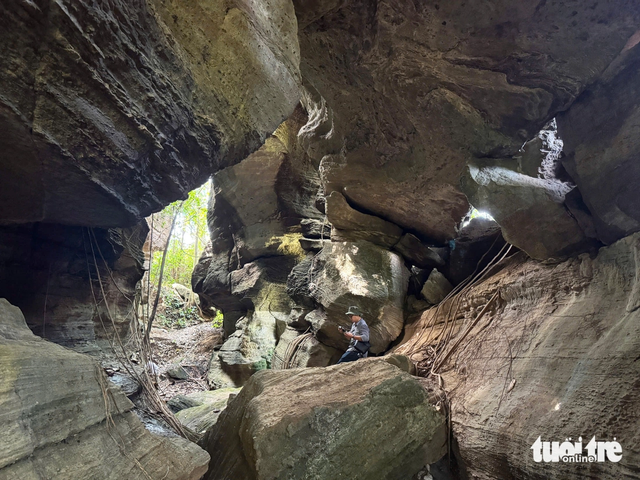
At the center of the complex is a large main cave, also known as Nang Tien or Fairy Cave.
Some compare the landscape of Hang Doi to 'Jurassic Park,' citing fossil-like formations and rocks resembling prehistoric creatures.
The Hang Doi ecosystem is also regarded as an example of high natural complexity and biodiversity.
Vegetation in the area includes hardwood trees, vines, and medicinal plants.
Researchers have discovered new plant species in the area, including Oxalis barrelieri L. of the Oxalidaceae family.
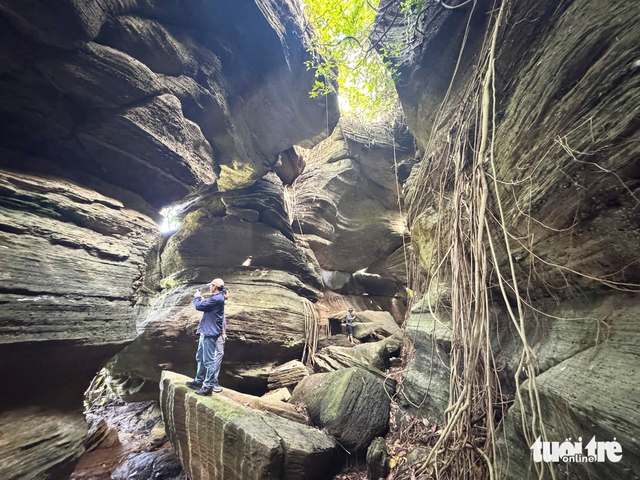
The mysterious beauty of Hang Doi
Tourism development plans
In July 2025, authorities in Thanh Binh Commune received provincial recognition for Hang Doi as a provincial-level scenic and historical site.
Nguyen Dinh Tu, vice-chairman of the Thanh Binh Commune People's Committee, said the locality is planning to establish a protected zone covering about two hectares of the site and has begun installing boundary markers.
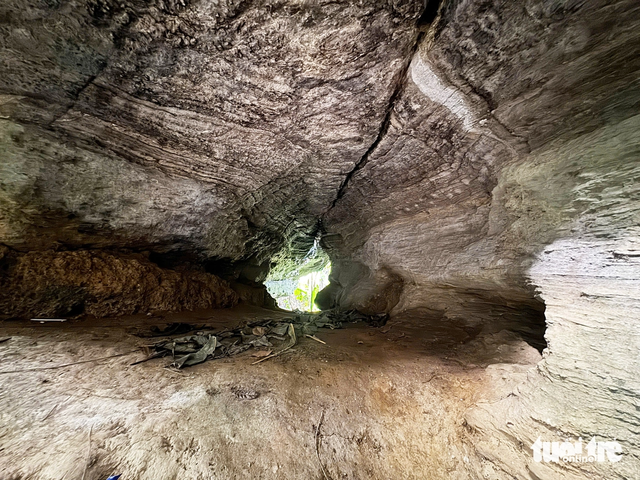
A cave within the Hang Doi complex
Under the commune's tourism development plan, Hang Doi is being promoted alongside two national heritage sites, Loc Yen ancient village, and the Huynh Thuc Khang memorial house, as well as six provincial-level heritage sites.
Using local resources, authorities are scheduled this June to clean and improve pathways inside Hang Doi while finalizing a tourism development proposal aimed at ensuring sustainable tourism operations linked to the commune's heritage network.
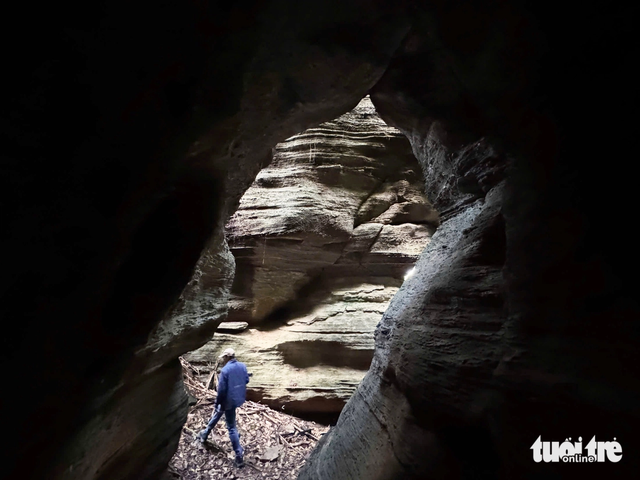
Hang Doi is an ancient cave formed between 530 million and 158 million years ago.
The commune also plans to improve infrastructure connecting tourism routes and attractions.
Local authorities have proposed that Da Nang authorities provide support and funding to expand transportation links between heritage and scenic sites.
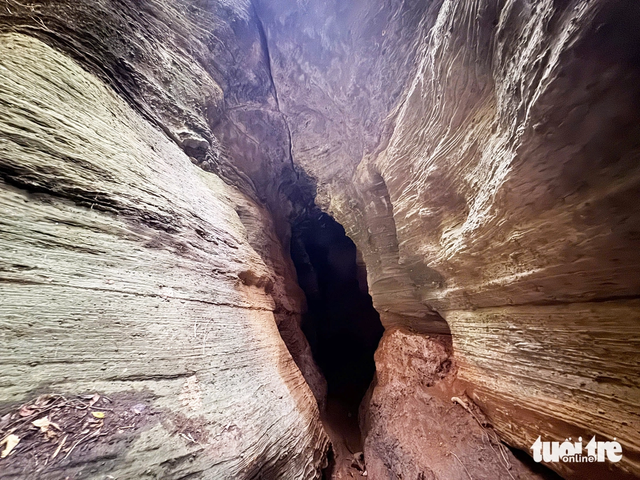
A small cave inhabited by bats
One planned route would connect Hang Doi to O O Waterfall, located about five kilometers away, where no road currently exists.
Preparatory work for the road project has already begun as part of broader plans to develop an interconnected tourism area and strengthen the local tourism economy.
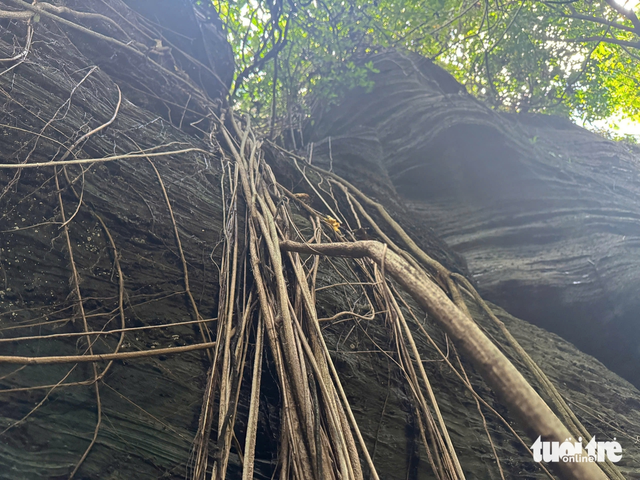
Dense tree roots inside Hang Doi








Max: 1500 characters
There are no comments yet. Be the first to comment.