


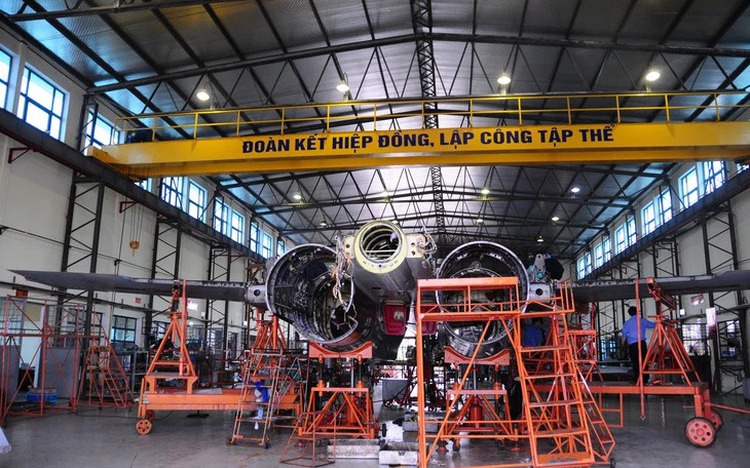
A fighter jet is being processed in the first of 10 workshops at Factory A32 in Da Nang City, central Vietnam. Photo: B.D. / Tuoi Tre
Operating under the Air Defense-Air Force Service, the aerial branch of the Vietnam People’s Army, the facility is one of the country’s key military aviation maintenance hubs.
Here, aging fighter jets are systematically ‘rejuvenated’ through thousands of tightly controlled repair and inspection steps.
Intricate fighter jet ‘rejuvenation’ process
After years in operation, many older-generation fighter jets reach the limits of their designed flight hours and must either be retired or undergo life-extension overhauls.
Some are sent to Factory A32 for structural upgrades that allow them to remain in service.
At the factory, aircraft undergo what engineers describe as a 'major surgery,' moving through multiple workshops where they are dismantled, inspected, repaired, and rebuilt for further use.
Lieutenant Colonel Trinh Van Minh, deputy head of the factory’s technical department, said it can take days or even weeks to fully understand the system because of its scale and complexity, as he guided Tuoi Tre (Youth) reporters through the maintenance areas.
He said the factory operates 10 main workshops, with workshop No. 1 considered the heart of the facility.
At around 9:00 am, a military towing vehicle pulled a fighter jet from its hangar as technicians secured cables to guide its movement.
Shortly after, a Su-30MK2, tail number 8581, appeared on the apron.
The aircraft stood in a posture engineers likened to a ‘coiled king cobra,’ motionless yet poised, with factory director Colonel Pham Ba Nguyen confirming it was undergoing its first life-extension package.
In another hangar, two fighter jets had been almost completely stripped down, with only their fuselages fixed on heavy support frames, while the wings, landing gear, and other components were arranged on specialized racks.
Tight control over thousands of maintenance steps
In addition to life-extension work, Factory A32 is the only unit within the Air Defense-Air Force Service tasked with receiving and repairing multiple types of fighter jets from combat regiments.
Factory officers describe the repair process in medical terms, with fighter jets treated as 'patients' and technical personnel acting as 'doctors' restoring operational capability.
Each aircraft must pass through multiple production lines and thousands of inspection and maintenance steps before returning to service.
The process can take several months or even years, depending on workload.
Inside workshop No. 1, production team leader Lieutenant Colonel Nguyen Van Dung and his colleagues, many of them young engineers, work from morning until late afternoon, often covered in oil and grease as they dismantle aircraft.
Dung said the factory’s 10 workshops operate as an integrated system with clearly defined responsibilities and closely coordinated teams.
Workshop No. 1 handles structural disassembly, hydraulic systems, and wiring networks, which he compared to the aircraft’s skeleton.
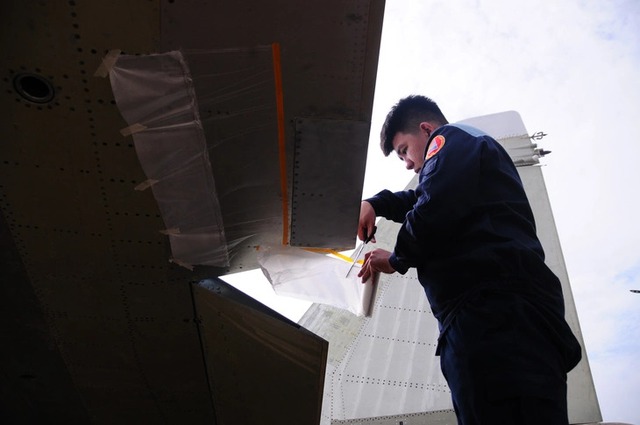
A technician at Factory A32 works on the fuselage of a Su-30MK2 fighter jet in Da Nang City, central Vietnam. Photo: B.D. / Tuoi Tre
After years of training flights and harsh operating conditions, aircraft undergo structural assessment before components are transferred to specialized workshops.
Workshop No. 2 is responsible for engines, workshop No. 3 for mechanical systems and onboard equipment, and workshop No. 4 for communications and radar systems.
Workshops No. 5, 6, and 7 handle weapons systems, aircraft assembly, and testing for Su-27, Su-30 and Su-22 fighter jets, respectively.
Fire-control and electronic warfare systems are assigned to workshop No. 8, while workshop No. 9 manages ground support equipment and workshop No. 10 focuses on precision machining and aviation material production.
Precision, discipline, zero tolerance for error
Extended observation at A32 highlights the extraordinary precision required to maintain modern fighter aircraft, where every component plays a critical role in flight performance.
Inside workshop No. 1, heavy steel frames hold Su-27 and Su-30MK2 aircraft in place as technicians work methodically, with each component carefully removed, recorded, and catalogued.
According to Lieutenant Colonel Trinh Van Minh, a single fighter jet contains around 1,600 major assemblies and tens of thousands of parts, requiring strict procedures to eliminate any risk of error.
Specialized teams handle disassembly, installation, classification, and inspection, with every component assigned a serial number and tracked through detailed documentation.
Lieutenant Colonel Dung stressed that all maintenance work must strictly follow technical procedures, noting that even the smallest screw must be handled and inspected with absolute care.
He added that no component is insignificant, as every part contributes to the aircraft’s safe and stable operation.
Through this structured and disciplined system, Factory A32 continues to stand as one of the world’s modern military aircraft maintenance facilities, capable of extending the service life of fighter jets.
The factory is set to celebrate its 60th anniversary in June this year.








Max: 1500 characters
There are no comments yet. Be the first to comment.