


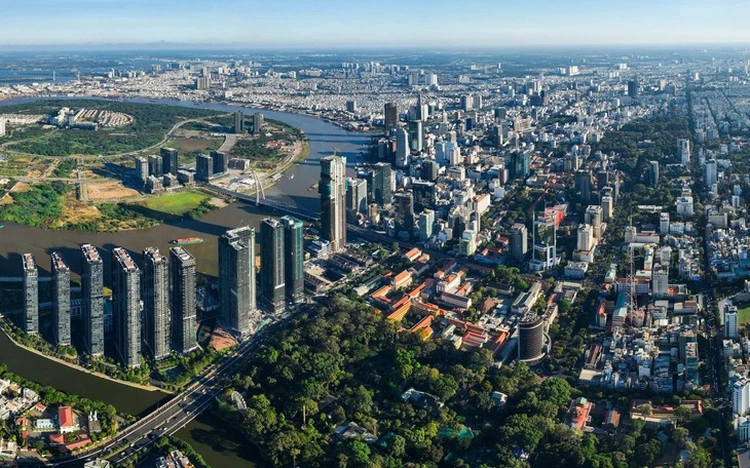
UOA, a Malaysian investor, speaks highly of Vietnam’s investment climate as the country positions itself as an emerging financial and technology hub. Photo: Van Trung
Dickson Kong, head of investment at Malaysia’s United Overseas Australia Ltd (UOA), told Tuoi Tre News that Vietnam is gradually positioning itself as an emerging financial and technology hub, opening up significant opportunities for international investors.
UOA has been present in Vietnam for many years. What factors in the country’s real estate market have attracted and sustained a leading developer like UOA over time?
UOA has ventured into Vietnam market since 2017. We see long-term, strategic potential in Vietnam’s growth, especially in Ho Chi Minh City. The city is evolving rapidly, and the demand for high-quality office space is growing. Our developments, such as UOA Tower and Millennial Tower, are positioned to meet that demand, and our recent prime commercial site acquisition is part of a broader plan to deepen our footprint in this market.
The recent amalgamation of Ho Chi Minh City with surrounding areas, along with urbanization led by access to education and job opportunities, is creating a much larger, more dynamic metro region. This kind of organic growth fuels long-term demand for office, commercial, and lifestyle spaces.
In addition, the government's initiatives toward creating an International Financial Center signal a broader shift toward a service-oriented economy with significant investment in high-tech industries and infrastructure, contributing to the market's long-term potential. That is going to attract both talent and capital, and we are establishing a foothold to support and benefit from that ecosystem as it matures.
Recently, UOA has made notable investment moves, including the acquisition of a prime land plot worth US$68 million on Vo Thi Sau Street in Ho Chi Minh City. Does this signal a broader, long-term expansion strategy in Vietnam?
Yes, our recent acquisition of the office project in former District 1 reflects our long-term expansion strategy in Vietnam. Investing in a prime, high-value site demonstrates our commitment to landmark Grade-A office projects and addressing the shortage of premium office space in Ho Chi Minh City.
Ho Chi Minh City has nearly twice the population of Kuala Lumpur—over 14 million—yet less than a third of its office space. We see this as huge pent-up demand for quality office supply, which is why we are optimistic about the economy.
According to Savills Research, as of the last quarter of 2025, Ho Chi Minh City’s total office stock stood at 2.96 million square meters. While another 234,000 square meters is expected by 2028, most of this new supply will be dominated by Grade B developments, followed by Grades C and A.
Furthermore, the site is in former District 1, part of it will be integrated into the International Financial Center in the Thu Thiem New Urban Area, a master-planned district aimed at establishing Ho Chi Minh City as a regional financial hub.
For UOA, the gap between demand and limited Grade-A office supply reinforces its long-term strategy and gives the group a competitive edge. Office developments are very capital-intensive, allowing us to leverage the group’s strengths and proven track record in Malaysia as one of the largest office landlords.
UOA has said Vietnam is emerging as a regional financial and technology hub. What specific opportunities and challenges does the company see as it looks to grow alongside this trend?
Vietnam is positioning itself as a rising financial and technology hub, driven by strong digital adoption, increasing foreign investment, and a young, capable workforce. This creates significant opportunities in areas like fintech, tech manufacturing, and startup innovation, all supported by proactive government policies.
At the same time, the country must navigate several challenges, including evolving regulatory frameworks, infrastructure, a shortage of senior-level tech talent, and geopolitical pressures. Under foreign direct investment (FDI) perspectives, exchange-rate stability emerges as a critical factor for sustaining Vietnam’s economic momentum and attracting long-term foreign investment.
With extensive experience across multiple markets, how does UOA assess the opportunities and challenges in Vietnam’s residential property sector for foreign investors today?
We are optimistic about the residential market in Ho Chi Minh City. However, we feel that it is harder for foreigners to enter the sector, given the dominance of the domestic developers.
There are still restrictions on foreign ownership, particularly in the housing sector. Foreigners can buy only a 50-year lease, whereas locals own freehold tenure in the same project. There is also a 30-percent quota for foreign buyers in each residential development, who must pay a 10-percent premium and are not eligible for a mortgage.
In the resale market, foreign owners may sell to either foreigners or locals — a foreign buyer purchases the remaining lease, while a local buyer can convert the property to freehold.
Nevertheless, Vietnam remains an attractive real estate market for us.








Max: 1500 characters
There are no comments yet. Be the first to comment.