


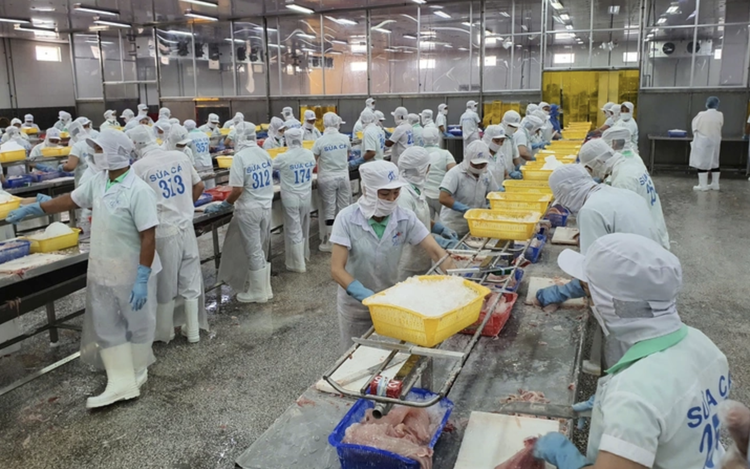
Employees are at work at a seafood processing factory in Vietnam’s Mekong Delta region. Photo: Trung Chanh
Labor shortages are expected to worsen as more industrial parks are developed, heard a dialogue with local businesses and an awards ceremony honoring outstanding enterprises held by the municipal People’s Committee on Tuesday.
Speaking at the event, Nguyen Van Hao, chairman of the Can Tho Business Association, said companies in the city are facing a growing shortage of workers and technical staff.
With more industrial parks set to open, the businesses are competing fiercely for workers, in some cases raising wages to attract laborers.
Although many enterprises are investing in technology to streamline manufacturing and processing and reduce their reliance on labor, Hao stressed that automation could not eliminate the need for people.
“Without people, production cannot be carried out either,” he said.
He noted that localities across Vietnam had sent skilled workers to countries offering higher incomes.
Meanwhile, Cambodia has a substantial labor pool that could help address shortages in the delta.
“Can Tho City should introduce clear policies to recruit workers from abroad to serve the delta as a whole and the city in particular,” he said.

Nguyen Van Hao, chairman of the Can Tho Business Association, proposes recruiting foreign workers for Can Tho City and the Mekong Delta. Photo: Chi Quoc / Tuoi Tre
Nguyen Phuong Lam, director of the Mekong Delta branch of the Vietnam Chamber of Commerce and Industry (VCCI), said he strongly supported and sympathized with Hao’s proposal.
Lam recalled that at a midyear review of the agricultural sector held in Ho Chi Minh City in June, businesses across the Mekong Delta reported labor shortages, particularly in the seafood industry.
Some companies raised the possibility of recruiting workers from Africa and neighboring countries where incomes are lower than in Vietnam.
However, Vietnam does not currently have a policy specifically encouraging the recruitment of foreign unskilled workers, Lam said.
Instead, the country’s foreign labor policies primarily focus on attracting highly qualified personnel, particularly experts holding university degrees or higher.
He cited international restaurants in Ho Chi Minh City as examples of businesses seeking workers from other countries who have stronger foreign-language skills.
Yet obtaining visas for foreign employees remains difficult and subject to strict regulations.
The challenges become even more complicated when factories seek to employ dozens or hundreds of foreign workers, he said.

Nguyen Phuong Lam, director of the Mekong Delta branch of the Vietnam Chamber of Commerce and Industry. Photo: Trung Pham
Bringing migrant workers home, investing in technology
While a national policy on recruiting foreign workers remains absent, Lam outlined two measures businesses and local authorities could pursue to ease labor shortages in the short term.
The first is to encourage workers who have left the Mekong Delta to return home for employment.
For much of the past decade, inadequate transport infrastructure has hampered investment and business development in the region, limiting its ability to attract and retain workers.
However, improvements in transport connectivity have helped accelerate the region’s recovery, Lam said.
Can Tho has reported increases in both the number of newly established businesses and registered investment capital, while other localities across the delta have shown similar trends.
Annual statistics indicate that more than one million workers leave the region each year to seek employment, whether overseas or in other localities, according to Lam.
“If jobs are available in their hometowns, they will certainly return,” he said.
The second measure is for firms to modernize production lines, equipment, and technology to reduce their dependence on manual labor.
Lam emphasized that recruiting foreign workers is a major national policy issue involving assessments of labor supply and other resources, and falls under the authority of the Ministry of Home Affairs.








Max: 1500 characters
There are no comments yet. Be the first to comment.