


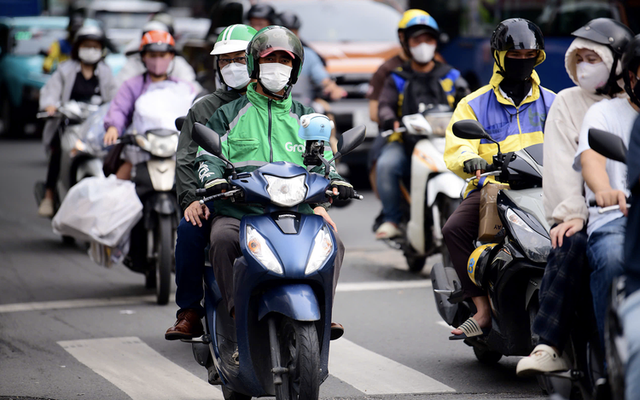
A Grab driver transports a passenger in Ho Chi Minh City. Photo: Quang Dinh / Tuoi Tre
For many ride-hailing drivers in Vietnam, what begins as a flexible way to earn extra income has become a full-time livelihood.
Yet the freedom to choose when to work offers little assurance of stable earnings or adequate social protection.
Recent disputes over platform fees, including complaints by Grab drivers about declining take-home earnings, have brought these concerns into sharper focus.
More jobs, but not necessarily better livelihoods
Ride-hailing and delivery platforms have become an important source of income for many Vietnamese workers. Yet easy access to work does not necessarily guarantee a reliable income.
Dr. Nguyen Nhat Minh, a lecturer in digital economics at RMIT University Vietnam, described these platforms as a buffer against unemployment, providing income opportunities for those struggling to find work or facing financial difficulties.
Their appeal is evident in a survey presented at a recent workshop jointly organized by Vietnam Social Security and the World Bank.
Among nearly 4,900 workers surveyed across four digital platforms, 94 percent considered platform work their main job, while 80 percent had been doing it for at least a year.
Flexibility was the leading reason for joining these platforms, followed by income opportunities.
Average net monthly earnings ranged from VND7.4 million (US$287) to VND9.7 million ($376), depending on the platform.
However, easy access to work does not guarantee steady earnings, particularly as more workers compete for a limited number of bookings.
"Platforms do not automatically create enough work for everyone. If demand for rides and deliveries grows more slowly than the number of drivers, each driver may receive fewer trips and spend more time waiting," Minh said.
As competition grows, drivers may have to spend more time on the road to secure enough bookings, although longer working hours do not necessarily translate into higher earnings.
A separate survey cited by the Vietnam General Confederation of Labor found that more than 46 percent of ride-hailing and delivery drivers surveyed in Ho Chi Minh City worked eight to 10 hours a day, while around 35 percent worked more than 10 hours.
For Dr. Huynh Thanh Dien, an economist and lecturer at Nguyen Tat Thanh University, the trade-off extends beyond working hours and uncertain income.
He warned that the relatively low barriers to entry could become a long-term trap, particularly for young graduates attracted by flexible schedules and earnings that may initially exceed those of entry-level jobs in their trained fields.
While conventional employment may offer modest starting salaries, it allows workers to accumulate professional skills and experience that can lead to higher earnings and career advancement.
Those who spend years driving, by contrast, may find it increasingly difficult to return to their trained professions, he argued.
Dien also pointed to the physical toll of prolonged driving and exposure to road accidents, warning that inadequate insurance and social protection could leave workers vulnerable when illness or injury interrupts their income.
The risk, he suggested, is that workers may trade not only their time but also their health and long-term career prospects for the income and flexibility they gain today.
The gray area
Beyond unstable earnings, platform workers face another concern: limited social protection and uncertainty over who should be responsible for their welfare.
A World Bank survey found that 78 percent of respondents had not participated in social insurance in the previous six months.
Similarly, a survey of 400 ride-hailing drivers in Ho Chi Minh City by the SocialLife Research Institute found that 82.4 percent lacked social insurance, while 87.3 percent had no unemployment insurance.
These gaps raise questions about the legal status of platform workers.
Although drivers are generally classified as independent partners, many depend heavily on digital platforms for customers and income without receiving the protections available to formal employees.
Dr. Huynh Thanh Dien of Nguyen Tat Thanh University argued that the relationship should be assessed based on how work is actually organized, rather than how companies describe it.
Drivers may own their vehicles and receive payment per trip, but platforms provide the applications through which they access customers and receive bookings, he explained. Payment per trip, he added, does not necessarily rule out an employment relationship.
"The nature of the relationship needs to be examined, instead of relying solely on the label of partner," Dien asserted.

A Grab driver picks up a passenger in Vietnam. Photo: Quang Dinh / Tuoi Tre
He warned that without clearly defined obligations, platform companies could benefit from workers' services while leaving them to bear the risks of accidents, declining health and inadequate social protection.
If those risks eventually become a burden on the state, society would effectively be absorbing part of the costs of the companies' business models, he argued.
Vietnam's 2019 Labor Code recognizes that an employment relationship can exist regardless of a contract's title if the work involves payment, management, and supervision.
However, specific guidance on applying these principles to digital platform work remains limited.
In October, the government proposed expanding mandatory social insurance coverage to certain platform workers with regular work and stable income, potentially extending protection beyond conventional employment arrangements.
For Dien, the priority is to clarify when platform workers should be recognized as employees and what obligations companies should assume for wages, insurance, and other protections.
He argued that targeted amendments to existing labor regulations could help close these gaps without requiring an overhaul of the entire legal framework.
Giving workers real choices
A more sustainable platform economy depends on giving workers greater bargaining power and genuine alternatives, both within and beyond digital platforms.
In September, some drivers protested the company's flexible app-fee mechanism, saying their take-home share had fallen from a previously fixed 70-75 percent to around 50-70 percent, depending on the trip.
The dispute brought attention to a broader issue facing platform workers: their limited influence over fees and working conditions set by platform operators.
Minh of RMIT University Vietnam argued that workers need genuine alternatives to negotiate better terms.
"A partner can only negotiate effectively when they have genuine alternatives," he said.
Minh called for greater competition between platforms, restrictions on unreasonable exclusivity arrangements, and greater transparency in fees, earnings, and account suspensions. He also suggested exploring collective bargaining mechanisms suited to platform workers.
Yet the ability to switch platforms offers limited protection when workers have few viable employment alternatives outside the platform economy.
For those dependent on daily earnings, taking time off to retrain or seek other jobs can mean sacrificing income they cannot afford to lose, reinforcing their dependence on platform work.
Minh therefore urged cooperation between the government and platform operators to support retraining, job placement and social protection, giving workers opportunities to pursue more stable employment.
Ultimately, a sustainable platform economy should not only create income opportunities but also give workers a genuine choice over their future livelihoods.


Max: 1500 characters
There are no comments yet. Be the first to comment.