



Panelists discuss chip war, AI, and Vietnam’s strategic bet at the Vietnam Vanguard Summit 2026, held in Ho Chi Minh City, January 8, 2026. Photo: Tieu Bac / Tuoi Tre News
The panel, titled ‘Tech and Geopolitics - Chip War, AI, and Vietnam’s Strategic Bet,’ was part of the Vietnam Vanguard Summit 2026, which convened more than 400 senior leaders and decision-makers for a full day of high-level discussions on Vietnam’s growth trajectory and strategic choices.
The gap between global tech giants and small players like Vietnam would not be significant, said Nguyen Ba Quynh, senior vice-president and head of APJ Markets, Hitachi Digital Services.
It takes just a few months for companies in Vietnam to build an AI application and serve their clients, he said.
He stressed that he was seeing opportunities for further AI growth in Vietnam rather than challenges.
“In the coming years, we will see a very fast pace in AI development,” said Dr. Le Quang Dam, CEO at Marvell Technology Vietnam.
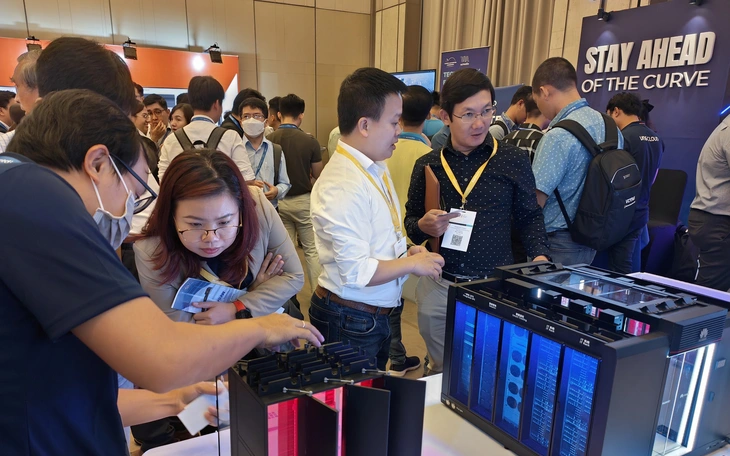
“I strongly believe that we have both the opportunity and the capacity to advance AI development in software and hardware."
Vietnam boasts a strong pool of engineers capable of developing both AI software and hardware, including processors, connectivity, and storage solutions, he explained.
It is clear that Vietnam has the capability and opportunity to expand its AI development, with the National Cybersecurity Association (NCA) helping drive progress.
Regarding the semiconductor industry, Dam recalled that 25 years ago, when semiconductors were discussed in Vietnam, almost no one believed it was possible.
“They said there was no way that Vietnamese engineers had the technical expertise to design ICs or fabricate chips,” he said.
However, it was not true, he said, adding that in 2000, Vietnam did have a few IC design companies.
There were some small companies established by some Vietnamese, with a few coming back from the U.S. and France.
The number of companies active in IC design in Vietnam has increased multiple times.
Vietnam has about 60 or 70 IC design companies now.
As for the number of tech employees, he said that there were about 20 engineers in 2000.
Today, that number has grown to more than 10,000, he said.
“Among them, I think, about 6,000 are working in IC design,” Dam elaborated.
“We have engineers working on design for testability (DFT) and others developing system-on-chip and overall chip architecture.”
Vietnamese engineers are keen to learn new technologies, so their expertise can span the entire IC design process.








Max: 1500 characters
There are no comments yet. Be the first to comment.