


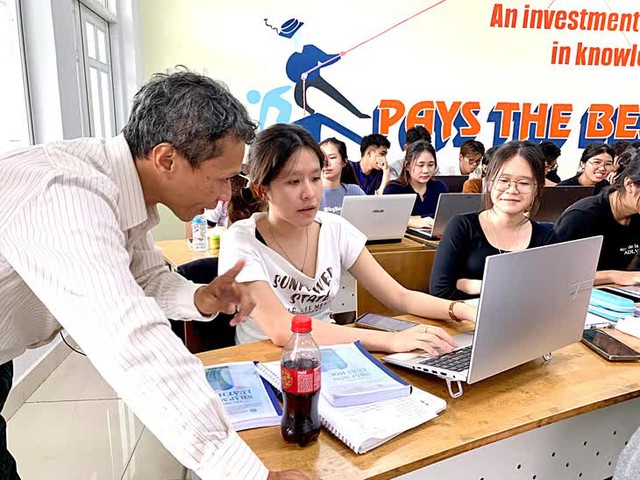
A lecturer discusses ideas with college students in Vietnam. Photo: Tran Huynh / Tuoi Tre
At recent education and workforce development forums, the phrase ‘high-quality human resources' has been widely discussed, often associated with strong expertise, creative thinking, technological adaptability, and global integration.
Yet An said that foreign language proficiency is often overlooked, despite being critical for career success.
The lecturer recalled cases where his students excelled academically but struggled in international work environments.
One former student, now working in engineering, shared his experience after being assigned to a project involving foreign partners.
Despite understanding the technical issues, he was limited to minor tasks owing to his weak English skills and could not directly engage in professional discussions.
“I understand the work, but I’m not confident enough to speak,” the former student said.
Such stories are not rare.
An added that many professionals with strong technical abilities lose opportunities for advancement given their weak foreign language skills.
In higher education, students who rely solely on Vietnamese textbooks may graduate, but those who can read international materials gain broader perspectives, access to cutting-edge research, and awareness of global trends.
Foreign language ability is equally vital in the workplace.
Engineers unable to communicate directly with foreign experts face barriers to new technologies.
Researchers who cannot read international studies fall behind in their fields.
Entrepreneurs without language skills struggle to expand into global markets.
These realities highlight that foreign language proficiency is no longer a supplementary skill but an integral part of professional competence in a globalized world.
Despite this, many students still treat language learning as a requirement for graduation rather than a tool for their future careers.
An argued that universities should integrate foreign language training into professional development, focusing on practical use such as reading specialized documents, presenting research, and working in multicultural environments.
The lecturer also recommended encouraging students to participate in international conferences, exchange programs, and collaborative projects to practice language skills in real-world contexts.
In an increasingly connected world, geography is no longer the main barrier between nations, but communication is.
A professional without foreign language skills is like someone holding a key but unable to open the door.
Building a high-quality workforce means preparing individuals not only with technical expertise but also with the ability to step confidently into the global arena.








Max: 1500 characters
There are no comments yet. Be the first to comment.