


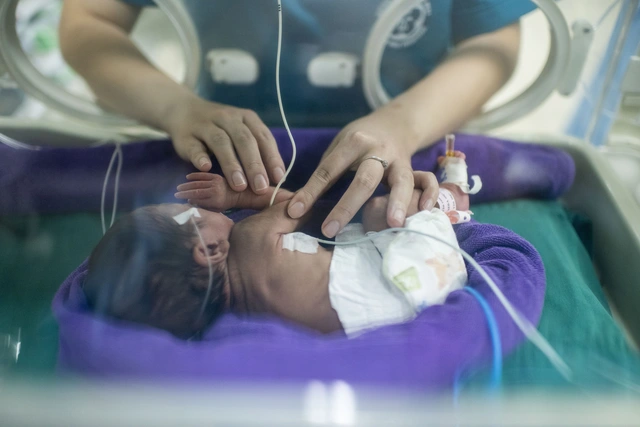
A medical employee cares for a premature baby at Bach Mai Hospital in Hanoi. Photo: Bong Vu
In warm incubators, some newborns are so small that an adult hand can cradle their entire bodies.
Many are born weeks early, weighing just over one kilogram, some less than that.
Their lungs are underdeveloped, their immune systems fragile, and their survival depends on constant monitoring and specialized care.
Among them are babies whose mothers are living with HIV. From the first moments of life, these children appear to carry an extra burden, not only medical, but social.
Not every child born to an HIV-positive mother carries the virus.
Modern medicine provides highly effective regimens to prevent mother-to-child transmission.
With proper treatment during pregnancy and after birth, the risk can be reduced to very low levels.
Yet the challenges these children may face extend beyond health concerns.
Social stigma, fear and misunderstanding about HIV persist in parts of the community.
Whispered comments, wary glances and invisible barriers can follow them into school and social life, shaping their childhood in ways unrelated to their medical condition.
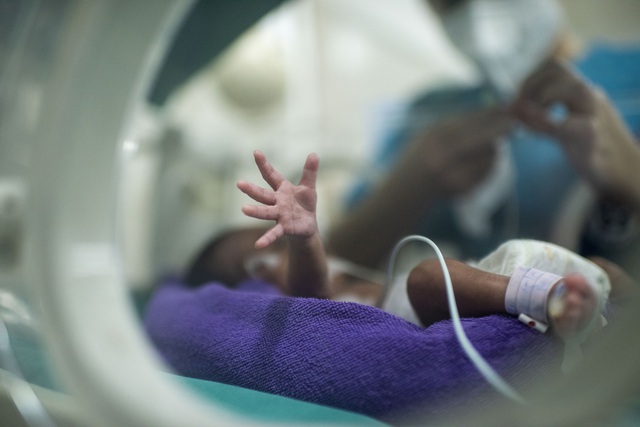
A 600-gram infant receives special care at the Hanoi-based Bach Mai Hospital at midnight. Photo: Bong Vu
Being born prematurely is already a disadvantage, requiring families with financial stability, knowledge, and patience to provide long-term care.
But not every family can provide that stability. When one or both parents are living with HIV, treatment costs, psychological strain and economic pressure can weigh heavily.
Mothers often carry guilt and fear of judgment. But when they stand before the incubator, watching their tiny child fight for each breath, those feelings fade. Maternal instinct burns strong, filled with sacrifice and resilience.
The babies themselves know nothing of the battles ahead. They simply fight to live.
A 900-gram infant can still grip a doctor’s finger tightly.
Another, dependent on a ventilator for weeks, survives infections, jaundice, and brain hemorrhage with remarkable strength.
Each milestone like removing a breathing tube, drinking milk unaided, or gaining a few grams is celebrated as a victory.
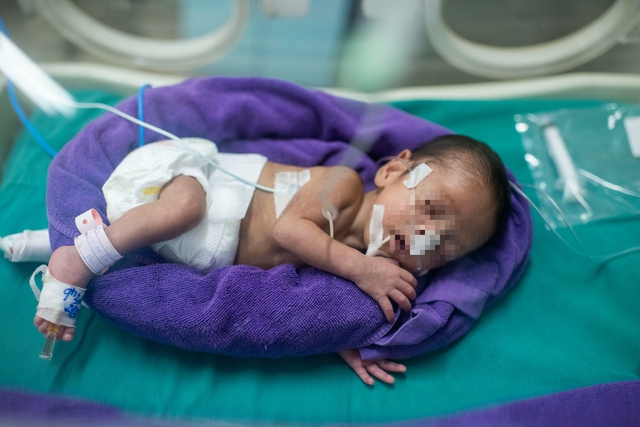
A premature baby weighing 600 grams is nurtured in the neonatal unit at Bach Mai Hospital in Hanoi. Photo: Bong Vu
Yet challenges remain after discharge.
These children enter life with more risks than their peers, facing questions about illness, identity, and difference.
If stigma persists, it becomes a heavy, invisible barrier.
What they need is not only medicine and regular checkups, but compassion.
Communities must understand that HIV is not the end, nor a reason to deny any child the right to love.
Every day in that neonatal ward, silent battles unfold.
And every day, fragile newborns prove a simple truth: life always finds a way.
Though born into imperfect circumstances, their determination never falters.
Sometimes, the smallest children teach the greatest lesson in courage.








Max: 1500 characters
There are no comments yet. Be the first to comment.