


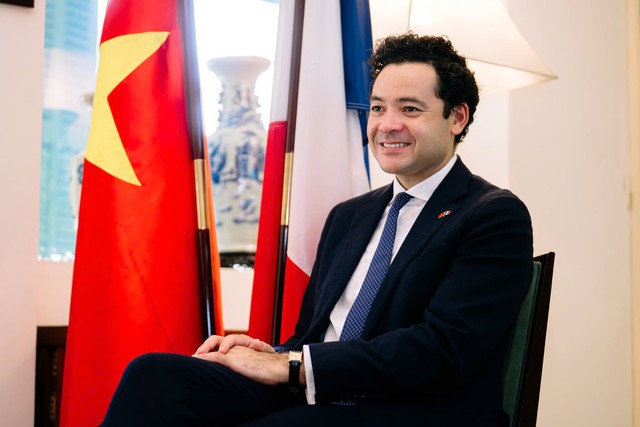
French Consul General in Ho Chi Minh City Etienne Ranaivoson. Photo: Thanh Hiep / Tuoi Tre
As part of efforts to contribute to Vietnam's development of digital finance, and digital assets in particular, the French Consulate General in Ho Chi Minh City is organizing a series of events, including seminars, discussions, and networking sessions focused on such assets.
Scheduled to take place from May 27 to 29 in Ho Chi Minh City and Da Nang, the events will feature participation from the Paris Europlace Financial Association and France’s Financial Markets Authority, in coordination with the Vietnam International Financial Center, with the aim of sharing French experience in the field of digital assets.
Digital finance becomes part of everyday life
In your view, why should Vietnamese people take a greater interest in digital finance and the management of digital assets, at a time when the economy is becoming increasingly digitalized?
When we talk about digital assets, we are not referring only to cryptocurrencies. The term also covers e-wallets, online accounts, digitized documents, and even photos stored in the cloud. These assets are now part of daily life and can carry genuine value.
Vietnam is undergoing a rapid digital transformation, which is already clearly visible in everyday life. QR-code payments, e-wallets, and mobile banking services are now widely used, from major urban retailers to small neighbourhood shops and street vendors.
In France, digital financial services have also become part of everyday life. People widely use banking apps to check their accounts, make instant transfers, pay contactlessly with their phones, and manage their savings online. They also benefit from access to an increasingly globalized financial ecosystem, allowing them to invest easily in shares and various digital assets directly from their smartphones. The use of crypto-assets such as Bitcoin, stablecoins, and NFTs is also growing.
In the context of Vietnam’s digital financial market, it is not about encouraging everyone to invest in digital assets. What really matters is that people understand how to use them safely and responsibly. I believe it is important for Vietnamese people to take a greater interest in digital finance and assets.
France’s experience in advancing digital finance
Security and user protection are major concerns in digital service use. Could you please elaborate on how France manages and regulates this area?
[Digital financial] innovations also come with risks: scams, cyberattacks, data breaches, and poorly understood investments.
France is therefore seeking to strike a balance between innovation and user protection. The authorities support the development of financial technologies while at the same time strengthening transparency and security requirements. For example, crypto-asset platforms must comply with registration and regulatory oversight obligations.
The French Financial Markets Authority (AMF) and the Prudential Supervision and Resolution Authority (ACPR), for instance, regularly publish and update blacklists of websites and entities offering financial services or investment products in France without proper authorization.
Cybersecurity is another major priority. Financial institutions are required to comply with strict standards to protect personal data and prevent cyberattacks, particularly under the EU’s Digital Operational Resilience Act (DORA) on digital operational resilience in the financial sector.
Lastly, France has made financial education a key priority. The Educfi program, led by the French state and the Bank of France, helps citizens, especially young people, to better understand money management, the risks linked to scams, and the right habits to adopt in an increasingly digital financial environment.
In your opinion, what expertise, initiatives or concrete solutions could France offer to support Vietnam in fostering this sector?
France can share with Vietnam its practical experience in building a modern financial ecosystem that is both innovative and firmly regulated.
This cooperation can build on a long tradition of legal exchanges between the two countries. Vietnam’s Civil Code was inspired by the French Civil Code. Even today, in emerging areas such as artificial intelligence, Vietnam continues to look closely at the European approach as it seeks to develop a legal framework that supports innovation while protecting users.
France can also provide concrete technological solutions through innovative companies such as Ledger, a global leader in digital-asset security, and Thales, a major player in cybersecurity and digital payments.
Beyond its expertise in technology and regulation, France can also contribute to training the workforce and to the development of a financial ecosystem built on security and sustainable innovation.
Thank you for your time!










Max: 1500 characters
There are no comments yet. Be the first to comment.