


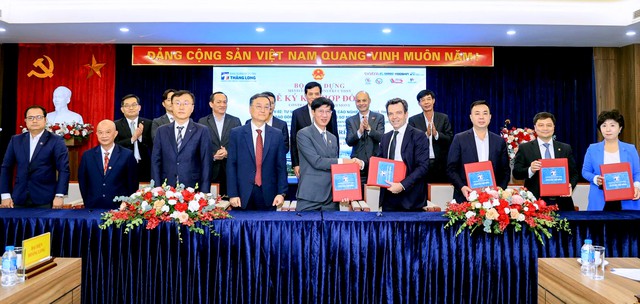
The Thang Long Project Management Board and a consultancy consortium sign the contract for package TV-02, covering surveys, a feasibility study, front-end engineering design (FEED), and the preparation of bidding documents for Vietnam’s North-South high-speed railway project. Photo: Ministry of Construction
Led by France’s SYSTRA, the consortium includes three South Korean firms – Sambo Engineering, Yooshin Engineering Corporation, and Korea National Railway (KNR) – and four Vietnamese firms – TEDI, TEDI SOUTH, TRICC, and HOANG LONG.
Speaking at the signing ceremony, Dinh Cong Minh, director of the Thang Long Project Management Board, said the railway would span about 1,541 kilometers, with 23 passenger stations and five freight stations.
It will feature double tracks with a standard gauge of 1,435 millimeters, a design speed of 350 kilometers per hour, and an axle load of 22.5 metric tons.
The railway is a national key project of exceptional scale and strategic significance, expected to play a vital role in Vietnam’s socioeconomic development in the years ahead.
Minh said the consultancy package, which includes a feasibility study and front-end engineering design (FEED), would provide a crucial basis for investment approval, technology selection, technical standards, cost estimates, and contractor selection for subsequent packages.
He urged the consortium to promptly mobilize personnel and experts, draw up a detailed implementation plan, and leverage its international experience to ensure the quality and timely completion of the consultancy work.
A consortium representative said the group aimed to strengthen Vietnam’s railway industry through close cooperation, hands-on training, and active participation by Vietnamese experts and organizations.
The consortium also pledged to develop realistic implementation plans, prepare rigorous cost estimates, carefully assess alternatives, identify risks early, and provide well-founded recommendations to Vietnamese authorities.
Quality, progress remain top priorities
Deputy Minister of Construction Bui Xuan Dung said this was Vietnam’s first high-speed railway project of such scale and technical complexity, making the preparatory phase critical to its feasibility, quality, and investment efficiency.
He called on the consortium to establish a professional management structure, mobilize key personnel, and set clear deadlines for each deliverable.
Survey data must be comprehensive, accurate, and reliable to support route alignment, engineering design, and investment cost estimates.
The deputy minister also stressed the need to structure bidding packages appropriately to ensure competition, transparency, and compliance with Vietnamese law.
The feasibility study and FEED must incorporate advanced technologies and technical standards suited to local conditions, ensuring safety, operational efficiency, and effective long-term maintenance.
The consortium was also urged to prioritize technology and expertise transfer to help Vietnamese engineers gradually master high-speed railway technology.
He said timely completion of package TV-02 was a top priority, with clear milestones, defined responsibilities, and regular progress monitoring.
“All parties must strictly honor their contractual commitments and refrain from shifting responsibility. Accelerating progress must go hand in hand with maintaining quality,” he emphasized.


Max: 1500 characters
There are no comments yet. Be the first to comment.