



People cycle along a dedicated bike lane on Mai Chi Tho Avenue in An Khanh Ward, Ho Chi Minh City, Vietnam. Photo: Tri Duc / Tuoi Tre
Editor's note: The following opinion was submitted to Tuoi Tre (Youth) newspaper by Dr. Nguyen Minh Hoa of the University of Social Sciences and Humanities, Ho Chi Minh City.
The piece was translated from Vietnamese into English and edited by Tuoi Tre News, the daily's English edition, for clarity, consistency, and coherence.
Earlier attempts to carve out dedicated bicycle lanes were made in Hanoi and Hue.
Together, the three cities' initiatives reflect a commendable effort to move toward greener urban transport and lower emissions.
In practice, however, the results have been modest.
Success has been limited, and long-term sustainability remains uncertain.
One reason is design. Bicycle lanes marked only by symbolic paint on sidewalks are difficult to maintain.
Pedestrians easily encroach on them.
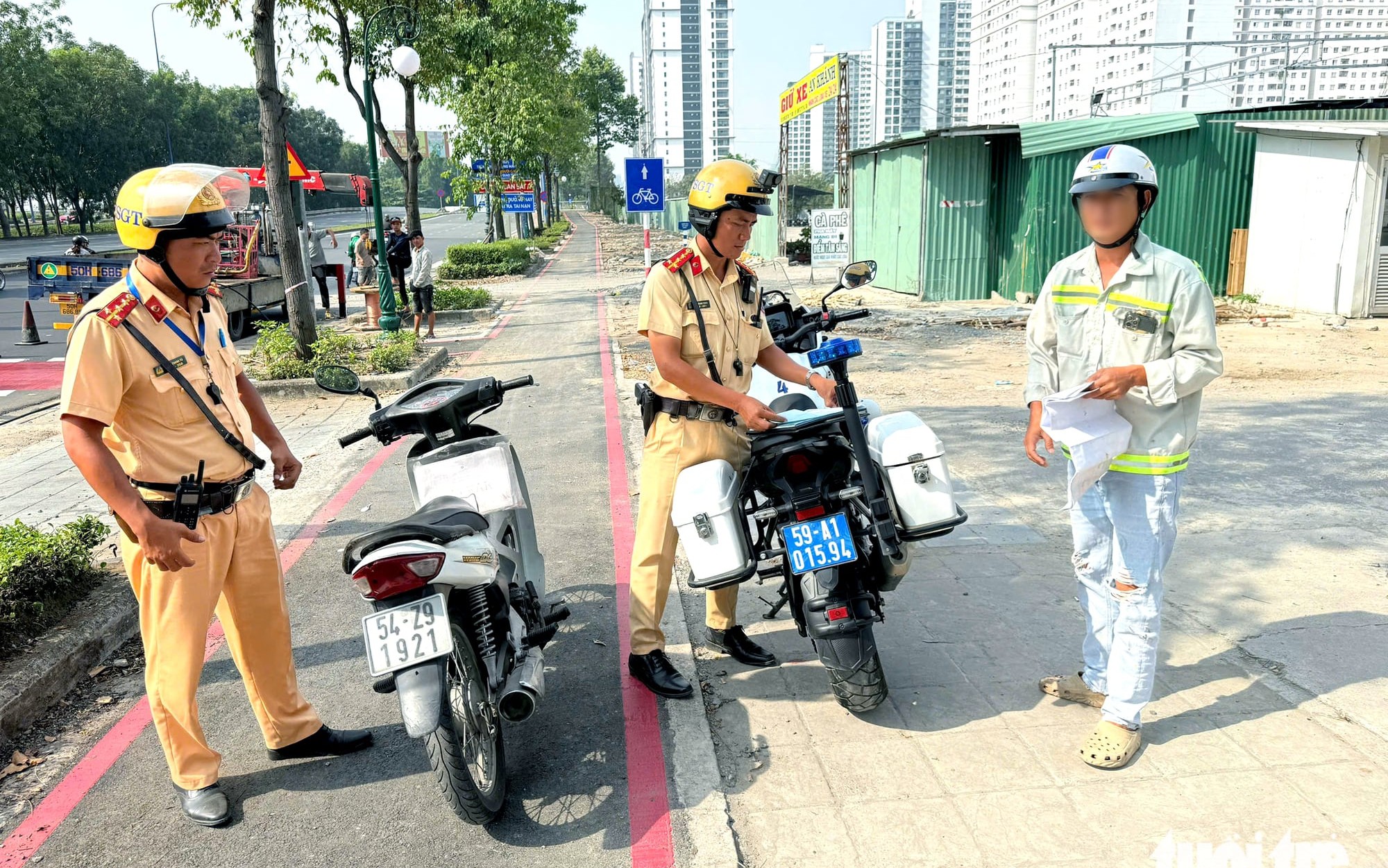
On Mai Chi Tho Avenue, the bicycle lane, though clearly marked with signs and a reddish-brown surface, is frequently taken over by motorbikes.
Enforcement alone cannot fix a problem rooted in how streets are planned and used.
Around the world, cities widely regarded as bicycle capitals such as Copenhagen in Denmark, Amsterdam in the Netherlands, and Helsinki in Finland did not arrive there by chance.
These cities adopted clear bicycle strategies.
Urban planning, transport planning, residential design, and service networks were all aligned to support cycling as a daily mode of transport.
In Copenhagen, dedicated bicycle routes are connected into a continuous network stretching some 546 kilometers, allowing cyclists to travel across most of the city by bike.
With a population of about 700,000, Copenhagen has nearly 900,000 privately owned bicycles.
Including public rental bikes, the total approaches 1.2 million, compared with only about 120,000 cars.
Singapore offers another example.
It has built roughly 500 kilometers of cycling paths and aims to expand the national network to 800 kilometers within the next five years.
Because of its historical development and urban form, Ho Chi Minh City is unlikely to become a full-fledged bicycle city in the way Copenhagen is.
Still, it can expand cycling infrastructure and make bicycles a common and practical means of transport.
That mindset needs to be embedded across public agencies, regulators, businesses, and residents.
It must be reflected consistently in spatial planning, transport master plans, and local-level development decisions.
In the near term, priority should be given to creating clearly defined bicycle zones with dedicated lanes in areas such as the Quang Trung Software Park, the Saigon Hi-Tech Park, the National University urban area, and well-planned areas like Phu My Hung, Thu Thiem, Van Phuc, and the planned Can Gio coastal urban area.
Industrial parks and newer urban developments in the former Binh Duong Province and in the old Vung Tau City could also serve as suitable starting points.
At the same time, bicycle lanes should be kept well away from expressways, ring roads, and freight corridors used by high-speed or heavy vehicles, where cycling poses serious safety risks.
Ho Chi Minh City should also introduce clear rules requiring land allocation for bicycle transport, including lanes and parking, as a condition for approving new urban developments, residential projects, and inner-city roads, whether newly built or upgraded.
This should apply to upcoming projects such as Binh Quoi–Thanh Da, the Tan Cang–Cu Chi urban corridor along the Saigon River, and other developments emerging after administrative mergers.
A single bike lane and a functioning bicycle system are two very different things, reflecting two very different mindsets.
Green cities and green transport cannot be built on impulse.
They require sustained, long-term planning and commitment, especially in an era of increasingly unpredictable climate change.








Max: 1500 characters
There are no comments yet. Be the first to comment.