


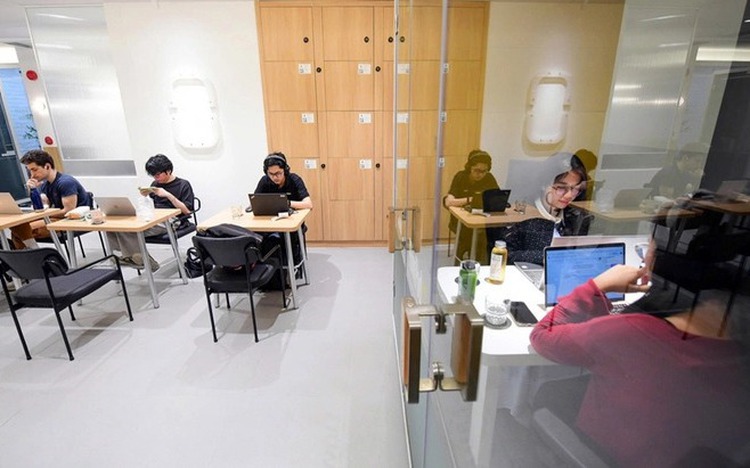
Coffee co-working spaces have emerged as a new coffee culture trend in Vietnam. Photo: Quang Dinh / Tuoi Tre
The trend has also been observed globally, where cafés in major cities have evolved beyond serving beverages into places for co-working, meetings, and social connection, often described as 'third space' alongside the home and office.
The concept, introduced by American sociologist Ray Oldenburg, highlights the role of public spaces in encouraging interaction and community engagement.
Café with private pods
Vu Minh, 24, who works remotely for a foreign company from Ho Chi Minh City, said he visits nearby cafés to work four to five days a week.
“My company doesn’t have an office in Vietnam, and I find working from home ineffective,” Minh told Tuoi Tre (Youth) newspaper.
“Going to a café gives me more space, and sometimes it’s also convenient for meeting friends or partners."
To meet such demand, many cafés in large urban centers are repositioning themselves not merely as beverage outlets, but as spaces for work, networking, and relaxation.
According to observations in Ho Chi Minh City, the co-working space café model emerged years before becoming a mainstream trend.
Doan Long, owner of Daily Coffee in the city’s Vuon Lai Ward, said he has pursued the ‘private pod café’ concept since 2017.
“At that time, major beverage chains were starting to expand in Ho Chi Minh City, but I chose not to compete directly with them,” Long said.
“I positioned the café toward students, offering more affordable prices and a place where they could rest, study, work, or gather with friends.”
Daily Coffee, which operates nearly around the clock, attracts not only customers who work for hours at a time, but also late-night visitors who rest there overnight before heading to work the next morning, Long said.
Nguyen Dinh Quy, founder of WorkFlow Space, said his coffee chain targets what he calls the ‘self-directed working generation,’ freelancers, independent professionals, and startup founders who can choose their own working hours and locations.
“They need somewhere comfortable like a café, but with a certain level of professionalism similar to a co-working space,” Quy said.
Customers purchase space, not just drinks
According to a recent report by iPOS, Vietnam’s mid-range beverage segment includes outlets with average drink prices between VND30,000 (US$1.15) and VND70,000 ($2.7).
In 2025, the share of customers spending more than VND35,000 ($1.33) per drink rose from 47.7 percent to 57.5 percent, indicating that the market is increasingly driven by demand for experience, space, and self-expression instead of the product itself.
For many customers, the experience of staying at the café is now considered essential.
Khanh Van, 24, an office worker in Ho Chi Minh City, said cafés charging above VND50,000 ($1.9) per drink are expected to provide comfortable seating for longer stays.
Long said Daily Coffee’s drinks started at VND29,000 ($1.1) in 2017, while offering air conditioning and seating designed for extended stays.
Nearly a decade later, the cheapest drink on the menu now starts at VND49,000 ($1.86).
“Our customers are usually between 18 and 35 years old and willing to spend within that range,” Long said.
“They may visit once or twice a week, but some stay for eight to ten hours.”
He added that pricing depends on customer needs, but operators must ensure revenues can cover maintenance and operational costs.
Investments in seating, interior space, and staffing for long-stay customers are substantial, while cleaning and operations often continue almost 24 hours a day.
At WorkFlow Space, Quy said the chain also offers packages with additional services such as private workrooms and meeting rooms.
The brand approaches customers through a membership-based model, encouraging them to treat café spending as part of their daily work-related expenses.
“This model has a different customer lifecycle compared with milk tea chains because it is tied to work needs and personal development,” Quy said.
“At first, it may appeal to a niche audience, but the customer base is more sustainable in the long term.”
Multi-purpose cafés
Quy said migration toward megacities such as Hanoi and Ho Chi Minh City has put pressure on public amenities, creating opportunities for cafés to serve multiple functions.
“Whether it’s dating, meeting business partners, or working, many people’s default saying now is simply: ‘Let’s go for coffee,’” he said.
A market report by Q&ME, a market research company, found that customers in Vietnam spend at least VND63,800 ($2.42) on average per café visit, while consumers generally prioritize two key factors when choosing a venue: quality drinks and a comfortable atmosphere.








Max: 1500 characters
There are no comments yet. Be the first to comment.