


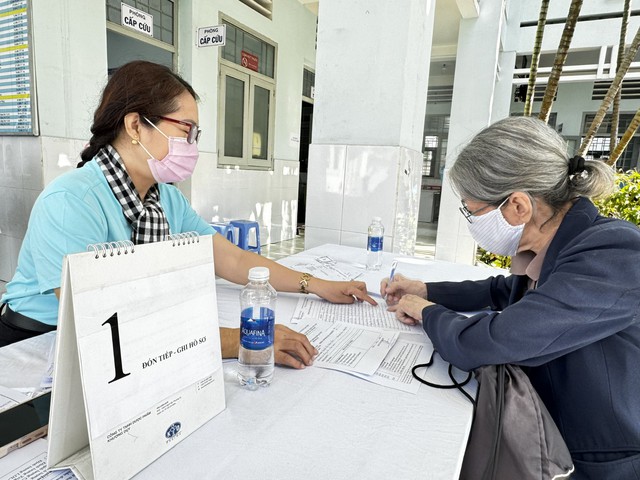
A staff member assists an elderly resident to fill out a form at a medical facility in Ho Chi Minh City. Photo: Thu Hien / Tuoi Tre
Editor’s note: The following commentary was written by Darren Chua, a Singaporean manager of multi-asset portfolios, who has lived and worked in both Singapore and Vietnam since 2013. Drawing on over a decade of regional experience to analyze the intersections of finance, demographics, and market opportunity in the ASEAN region, he shares perspectives on considering the ageing population as 'silver opportunity.'
In Vietnam, there is a timeless proverb: 'Gung cang gia cang cay' -- the older the ginger, the spicier it is. It is a reminder that age is not a sign of fading, but of increasing potency and wisdom. As a Singaporean reading about Vietnam’s strategic pivot toward a 'silver economy,' I believe this proverb should be the foundation of a new national mindset.
Not long ago, Singapore viewed its rapidly ageing population with apprehension, calling it the 'Silver Tsunami.' Today, we have reframed that narrative. We no longer see a crashing wave, but a vast, untapped 'Silver Reservoir' of experience.
The recent calls by Vietnamese Prime Minister Pham Minh Chinh to treat the elderly as a precious resource for Vietnam's 'silver economy' resonate with our own journey.
However, shifting a national mindset is only the first step. To truly unlock this 'spiciness,' Vietnam must move from rhetoric to high-impact, practical infrastructure.
Honoring the foundation
Our founding father, Lee Kuan Yew, reminded us that we owe our success to those who came before. He once noted, “Singapore depends on the strength and influence of the family to keep society orderly and maintain a culture of thrift, hard work, filial piety and respect for elders and for scholarship and learning.”
Vietnam is at a similar turning point. The nation’s 60+ population is expected to grow from 14.2 million in 2024 to nearly 18 million by 2030. Similarly, late President Ho Chi Minh famously described the elderly as an "invaluable treasure of the nation." To protect this treasure, we must adapt our modern infrastructure to match our traditional values.
Reimagining social housing: The HDB model
Vietnam can consider updating its Social Housing Program (Nha o xa hoi) to include Assisted Living Flats, similar to Singapore’s 'Community Care Apartments.' These homes allow seniors to live independently with a vital safety net:
Built-in safety: Grab bars, slip-resistant flooring, and wheelchair-accessible bathrooms as standard features
24-hour care: Integrated emergency monitoring and basic health checks built into the building’s services
Flexible services: Options for laundry, meal delivery, and shared caregiving
This model is a practical solution for the modern Vietnamese family. While filial values remain strong, work commitments or family friction often make living under one roof difficult.
In the West, they say 'absence makes the heart grow fonder'; in Vietnam, the humorous equivalent 'xa thom gan thoi' (from afar it smells fragrant, but up close it stinks) captures the reality that a bit of space can actually preserve the fragrance of a relationship.
By providing these units, the state takes the physical burden of care off children, allowing family time to be about emotional connection rather than difficult chores.
Digital salvation: Revitalizing a legacy
Perhaps it is time to 'revive and revitalize' the spirit of the Hoi Phu Lao Cuu Quoc (Elders' national salvation association). In 1941, this group used its wisdom to protect the nation’s independence.
As the group’s successor, Hoi Nguoi Cao Tuoi Viet Nam (Vietnam Association of the Elderly), marks its growing influence in society, it is the perfect moment to pivot toward a 'digital salvation.'
While physical strength may decline, digital literacy is the great equalizer. Equipping seniors with digital skills transforms them into a high-value workforce. An 'old ginger' with 40 years of experience in law, accounting, or engineering can contribute immensely via a laptop.
Vietnam can consider 'intergenerational mentorship' programs, where retired experts can impart their knowledge to young workers digitally. This keeps seniors socially connected and prevents a national 'brain drain.'
A call to action for business leaders
While the government provides the framework, the private sector is the engine of this transition:
Investors: Look at 'Silver-Tech.' With 18 million customers on the horizon, it is a multi-billion dollar market.
Developers: Adopt 'Universal Design.' Every new home should be senior-ready by default, featuring wider doorways and non-slip tiles to prevent injuries.
HR leaders: Pivot to 'Digital-First' roles for seniors. Their discipline and institutional knowledge can stabilize your younger teams without requiring manual labor.
The way forward
Singapore’s journey taught us that ageing is not a 'problem' to be solved; it is a new stage of growth. Vietnam’s seniors built the foundation of the country’s current success. By modernizing social housing and prioritizing digital upskilling, we ensure that the 'Old Ginger' of Vietnam remains spicy, purposeful, and respected for generations to come.









Max: 1500 characters
There are no comments yet. Be the first to comment.