


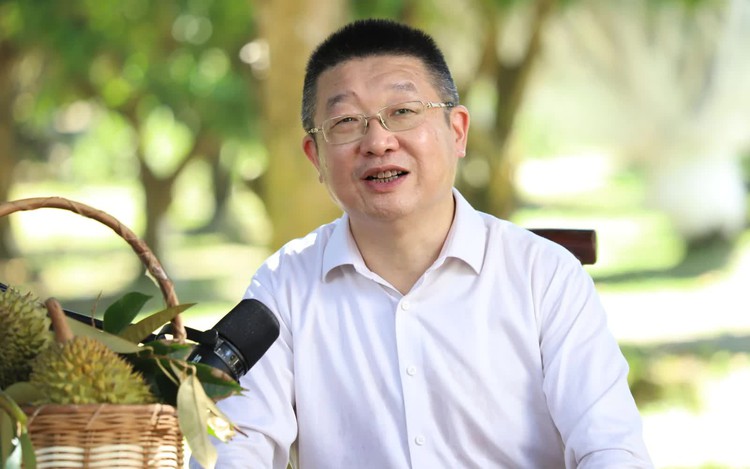
Chinese Consul General Tang Li has a story to tell about Vietnamese durians. Photo: Chi Quoc / Tuoi Tre News
The meeting took place at a pivotal moment for regional diplomacy – amid the 2026 APEC Economic Leaders' Meeting in Shenzhen, and just ahead of Vietnam taking over the APEC hosting baton for 2027 in Phu Quoc, a touristic island administered by An Giang Province.
Against this backdrop of high-level regional connectivity and deepening bilateral ties, Consul General Tang shared his reflections on everyday life in southern Vietnam, the concrete 'sweet fruits' of cross-border trade and infrastructure, and the shared vision driving Vietnam-China cooperation into a new era.
This interview has been edited for length and clarity.
'Sweet fruits' in trade and Mekong Delta connectivity
Mr. Consul General, the high-level consensus between our two Parties and countries has opened a new chapter for the Vietnam-China Comprehensive Strategic Cooperative Partnership. Guided by these macro-level directions, what specific measures are you and your colleagues taking to bring visible and tangible benefits to the business community and people of Ho Chi Minh City and the southern provinces?
Close exchanges between our top leaders – including General Secretary and President Xi Jinping's April 2025 historic visit to Vietnam, and General Secretary and State President To Lam's visit to China this past April as well as his trip for the 33rd APEC Economic Leaders' Meeting in Shenzhen – are accelerating the development of a higher-level China-Vietnam Community with a Shared Future.
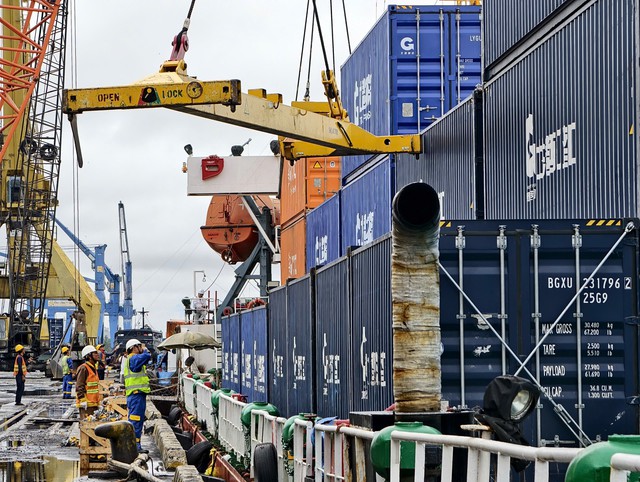
China is Vietnam's largest trading partner. Photo: Chi Quoc / Tuoi Tre News
As 2026 marks the start of China's 15th Five-Year Plan and Vietnam's implementation of the 14th National Party Congress Resolution, the Chinese Consulate General is translating high-level consensus into tangible results across three areas:
Trade and investment platforms: Our supply chains are deeply integrated, with bilateral trade reaching US$290 billion in the first 10 months of 2026, up 39.3 percent year on year. We actively connect enterprises across southern Vietnam – a key engine of national growth and a leading destination for Chinese investment.
Infrastructure connectivity: Following the Pinglu Canal's opening on September 16, the maiden container vessel Beigang Nanning Borun arrived at Can Tho Port on September 23 with 252 TEUs from Nanning, opening a new river-sea logistics corridor between southwest China and Vietnam's Mekong Delta.
Sci-tech innovation: Combining China's strengths in AI, the digital economy, green energy, and smart manufacturing with southern Vietnam's dynamic market and industrial base, we are fostering joint research, talent development, and industrial upgrading.
Southern Vietnam and the Mekong Delta produce specialties hugely popular in China, such as durian, dragon fruit, bird's nest, and pangasius. For them to move beyond raw exports and sustainably enter Chinese supermarkets and e-commerce platforms, what specific support is the Consulate General providing on technical standards, customs clearance, and direct business promotion?
There is an old Chinese saying: "Food is the paramount necessity of the people." Agricultural cooperation connects the fields on one end and millions of households on the other; it is one of the warmest, most down-to-earth areas of China – Vietnam pragmatic cooperation, and one that brings the most direct benefits to both peoples.
Southern Vietnam, particularly the fertile Mekong Delta – known as the Land of Fish and Rice – abounds in specialties like durian, dragon fruit, mango, coconut, pangasius, and black tiger shrimp that are hugely popular in China.
During a recent trip home for consultations, I saw Vietnamese durians, coconuts, and seafood were readily available in local supermarkets. With over 20 Vietnamese fruits and vegetables now having official market access, China's vast consumer base and Vietnam's abundant agricultural resources are remarkably complementary.
According to statistics from the Vietnamese Ministry of Agriculture and Environment, in the first 10 months of 2026, Vietnam's exports of agricultural, forestry, and aquatic products reached $63.02 billion, a year-on-year increase of eight percent.
Of this total, the Chinese market accounted for 25.1 percent, with exports to China surging 19 percent year on year – ranking first in growth rate among Vietnam's major export markets.
Vietnam's fruit and vegetable exports totaled $8.32 billion, up 17.8 percent year on year, with China continuing to maintain its position as Vietnam's most important export market for fruits and vegetables, making up 64.8 percent of total fruit and vegetable exports.
The durian orchard where I am right now is a very vivid example. In the first nine months of 2026, Vietnam's durian export value exceeded $3.45 billion, with nearly $3.3 billion exported to China – representing close to 96 percent.
Each durian not only reflects Chinese consumers' appreciation of Vietnam's high-quality agricultural products but also symbolizes the deepening of bilateral agricultural cooperation.
To move Vietnam's quality agricultural products steadily from the fields onto Chinese shelves and e-commerce platforms, we are focusing on two efforts:
Standards and customs: Working with Vietnamese authorities to align technical standards, implement signed protocols, and deploy smart customs and digital traceability to speed up clearance. Through 'green channels' and digital tracking, durian clearance times have already dropped from 8–11 days to under six days.
Direct market access: Connecting Vietnamese exporters directly with major Chinese distributors, e-commerce platforms, and logistics hubs to cut out middlemen and deliver fresher, higher-value products.
From Shenzhen to Phu Quoc: A new era of regional cooperation
With China hosting APEC in 2026 and Vietnam taking over in 2027, what new momentum will this back-to-back handover create for bilateral cooperation in supply chains and digital trade, and what opportunities will it open for hubs like Ho Chi Minh City in regional connectivity?
As consecutive APEC hosts in 2026 and 2027, China and Vietnam are undertaking a remarkable relay of Asia-Pacific cooperation, which also brings vital opportunities to deepen the building of the China-Vietnam Community with a Shared Future and promote regional common prosperity.
This year marks China's return as APEC host for the first time in 12 years. General Secretary and President Xi Jinping will attend the APEC Economic Leaders' Meeting and related events in Shenzhen to chart a new blueprint for Asia-Pacific cooperation.
Centered on the theme 'Building an Asia-Pacific Community to Prosper Together,' China will focus on the three priority areas of Openness, Innovation, and Cooperation to drive regional cooperation toward fruitful outcomes. The heads of state of China, Russia, and the United States will hold meetings in Shenzhen, drawing worldwide attention.
Vietnam will receive the baton as the 2027 APEC host. From the Shenzhen Special Economic Zone to the Phu Quoc Special Zone, this handover embodies the shared responsibility and commitment of China and Vietnam in working hand in hand to promote open cooperation and common prosperity across the Asia-Pacific.
As the locomotive of Vietnam's economic development, Ho Chi Minh City boasts prominent advantages in resources, location, industry, and innovation capacity, with bright development prospects.
We stand ready to actively support Ho Chi Minh City in accelerating the development of an international financial center, enhancing its connectivity, green development, and innovation capabilities, and strengthening cooperation in infrastructure fields such as artificial intelligence, smart cities, and rail transit – building platforms for pragmatic cooperation between Chinese enterprises and Ho Chi Minh City, and helping the city become a vital hub connecting the Asia-Pacific and global markets.
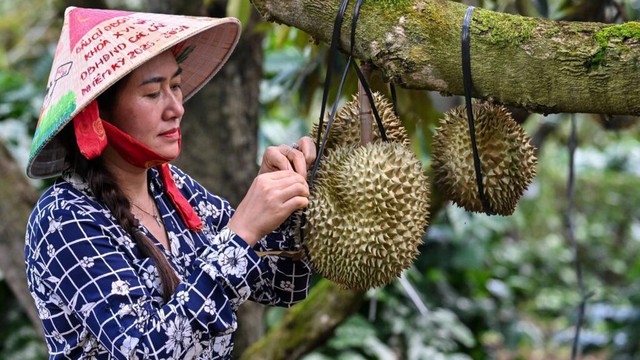
Vietnam became China's biggest supplier of durian by volume in 2025. Photo: AFP
Mr. Consul General, you have previously shared the pleasure of shopping at street stalls and communicating through eye contact and body language, as well as your deep fondness for Vietnamese pho – even going so far as to guide Chinese chefs in preparing pho to host visiting delegations. What impressions have these very simple, down-to-earth experiences given you of the country and people of Vietnam?
Thank you very much to Tuoi Tre for interviewing me in Can Tho. I have been serving in Ho Chi Minh City for one year and five months now. My impression of Vietnam has evolved from that of a familiar neighbor in my childhood to a much more concrete and personal appreciation of its warm and lovable people.
As the Chinese saying goes: "Amity between the people holds the key to sound state-to-state relations, and heart-to-heart communication holds the key to amity between the people."
I have always believed that to truly understand a country, one must walk into its ordinary streets and alleys, experiencing its national spirit and cultural heritage through the everyday lives of its people – what they wear, eat, how they live, and how they travel.
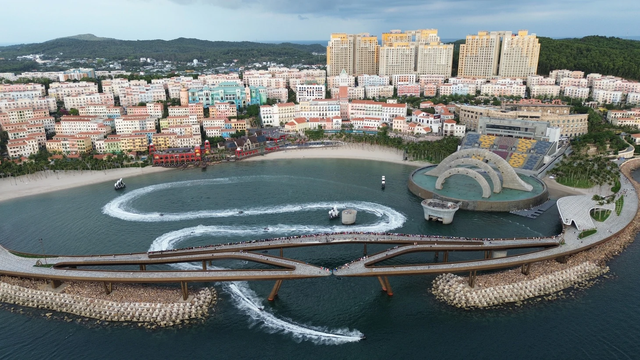
A view of Vietnam's Phu Quoc Island, which will host APEC 2027. Photo: Chi Cong / Tuoi Tre News
Vietnam's national development is full of promise, and the nation is ushering in a new era of ascent. What is most precious is that the people are hardworking and kind-hearted, believing in the future and actively creating it. Being stationed in Vietnam is a very special chapter in my life, and the admirable qualities of the Vietnamese nation and its people have left a deep impression on me.
Ultimately, diplomatic work is about working with people. Everything we do to promote high-level exchanges, trade and investment, and local-level cooperation is aimed at ensuring that the people of both countries live happier lives.
I hope to help more Chinese friends get to know a real, multidimensional, and vibrant Vietnam, and to let more Vietnamese friends feel the sincerity and friendliness of the Chinese people. I believe these simple bonds forged in the streets, alleys, and across dining tables will eventually converge into a warm, enduring stream of friendship between China and Vietnam across generations.
Thank you very much, Mr. Consul General, for your time and thoughtful insights.


Max: 1500 characters
There are no comments yet. Be the first to comment.