


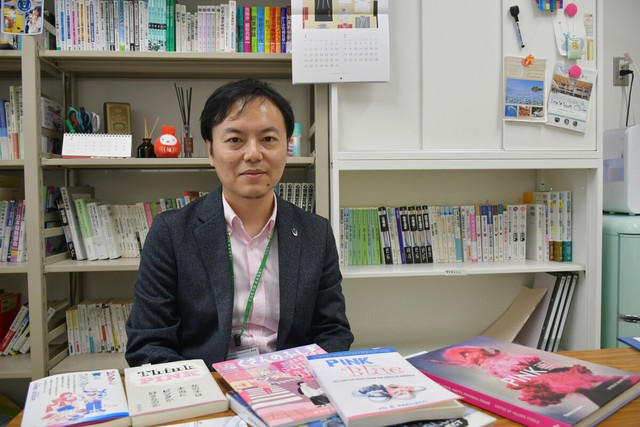
Kunio Ishii, an associate professor at Tokyo Kasei University, speaks during an interview in Tokyo, Japan, February 17, 2026. Photo: Jiji Press
The trend is often cited as an example of gender bias.
"I hope we can create a society in which everyone is free to choose their favorite color without being constrained by gender," said Kunio Ishii, an associate professor of social psychology at Tokyo Kasei University.
According to Ishii, the association of certain colors with gender emerged in the first half of the 20th century.
One possible origin can be traced to two paintings exhibited in the 1920s at the Huntington Library, an educational and research institution in California.
The paintings portrayed a boy dressed in blue and a girl wearing a dress adorned with a pink ribbon.
One theory suggests that the exhibition was well received, prompting department stores to adopt gender-specific colors as a marketing strategy.
Over time, the pairing of blue with boys and pink with girls became firmly established in Western countries before eventually spreading to Japan.
A search for "toys for girls" on online shopping sites yields a long list of pink-themed products, including beads, makeup sets and similar items.
As a result, girls are surrounded by pink objects from an early age, even before they become consciously aware of gender expectations.
Ishii noted that this environment "sends a message to children that pink belongs to girls and that girls are expected to choose pink."
There are, however, growing efforts in Japan to move away from gender-based color stereotypes.
School satchels, once available only in black or red, now come in a much wider variety of colors, including purple, light blue and brown.
Similar changes are taking place in the toy industry, where companies are increasingly trying to avoid assigning colors on the basis of gender.
Even products traditionally marketed to girls, such as toy kitchen sets and dolls, are now more often offered in neutral tones like white and brown.
"Color-coding by gender limits freedom of choice," Ishii said.
"It would be wonderful if people could choose whatever colors they like without feeling constrained by gender."









Max: 1500 characters
There are no comments yet. Be the first to comment.