


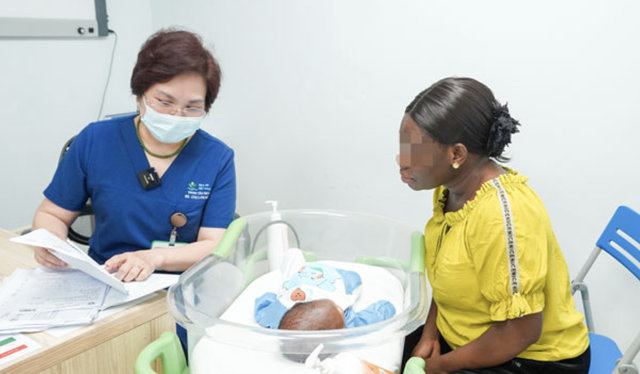
A doctor at Vietnam National Children’s Hospital in Hanoi examines a Ghanaian infant. Photo: Supplied
The newborn developed jaundice immediately after birth, which worsened rapidly within the first 20 hours of life.
Despite intensive phototherapy and tests at a local hospital, his condition did not improve.
On May 27, he was transferred to the Vietnam National Children’s Hospital in Hanoi with dangerously high bilirubin levels and hemoglobin reduced to 98 g/L, indicating severe hemolysis.
Doctors ruled out common ABO and Rh incompatibility since both mother and child had O Rh+ blood.
The baby required an emergency exchange transfusion to treat severe jaundice and anemia, but no suitable blood was found in the hospital’s supply.
Further testing at the Hanoi-based National Institute of Hematology and Blood Transfusion revealed the baby carried the rare Anti-Fy3 antibody, linked to the Duffy-null blood group.
While awaiting the results, the medical team continued intensive phototherapy and administered medication to slow red blood cell destruction and improve cell survival.
After confirming the diagnosis, doctors tested both parents in search of a compatible donor.
The father’s blood was incompatible, while the mother, recovering from a cesarean section with anemia, could not donate.
As the baby’s condition deteriorated, doctors launched an urgent appeal for O blood donors, particularly among the African community in Vietnam, where Duffy-null blood is more common.
Within two days, 25 volunteers came forward, including 22 of African origin and three Vietnamese.
Two African donors were found to be compatible. Their blood was processed, screened, and transfused under strict monitoring.
The infant received the lifesaving transfusion on the third day after admission.
The baby’s condition improved rapidly, with jaundice subsiding, healthy skin color returning, and normal feeding restored.
The child was discharged after seven days of treatment.
According to doctors, the Duffy blood group system, regulated by the ACKR1 gene, includes five major antigens, namely Fya, Fyb, Fy3, Fy5 and Fy6.
Anti-Fy3 antibodies are extremely rare in Asians and Europeans but occur in 68-90 percent of Africans.
Unlike Rh incompatibility, there is no preventive treatment for Duffy-related hemolysis during pregnancy, making early detection and timely intervention critical.
Doctors emphasized that neonatal jaundice should never be ignored, as it can stem from multiple causes.
Parents are urged to seek immediate medical care if jaundice appears early or progresses quickly.








Max: 1500 characters
There are no comments yet. Be the first to comment.