


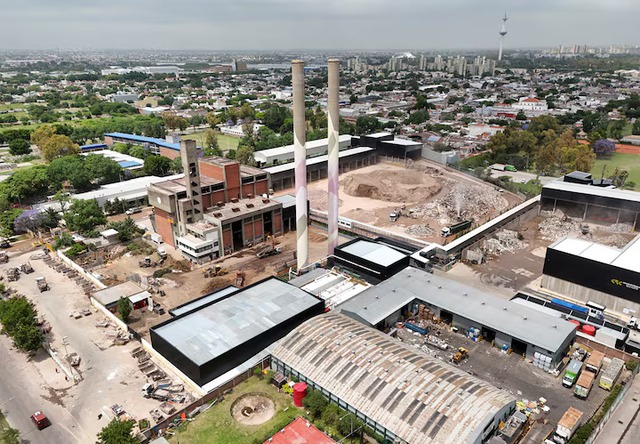
A drone view shows a recycling center, part of a city program to curb methane emissions through improved waste management, with Buenos Aires producing over 1.1 million tons of trash annually, 30% of it organic but less than 3% recovered and most ending up at the CEAMSE Norte III landfill identified as a global methane ‘super-emitter’, according to Delterra, a nonprofit organization working on waste reduction, in Buenos Aires, Argentina, November 20, 2025. REUTERS/Francisco Loureiro
-- An ETS sets a cap on the amount of CO2 emissions that a sector, or group of sectors, can produce. Under most schemes the cap decreases each year, to ensure emissions fall over time.
-- Some countries are using ETSs to help meet climate targets and generate revenues by auctioning carbon permits.
-- The 2025 revenues were up from around $70 billion in 2024 due to higher average carbon prices.
-- Some 41 emissions trading systems are now in force worldwide, covering 26% of global greenhouse gas emissions, the report said.
-- 16 countries have a national ETS including Australia, China, Mexico and the United Kingdom.
-- Three new national systems — Japan, India and Vietnam — are launching in 2026, with a further 16 systems at various stages of development globally.
-- As with previous years the European Union’s ETS saw the bulk of revenues in 2025 at $48.9 billion.








Max: 1500 characters
There are no comments yet. Be the first to comment.