


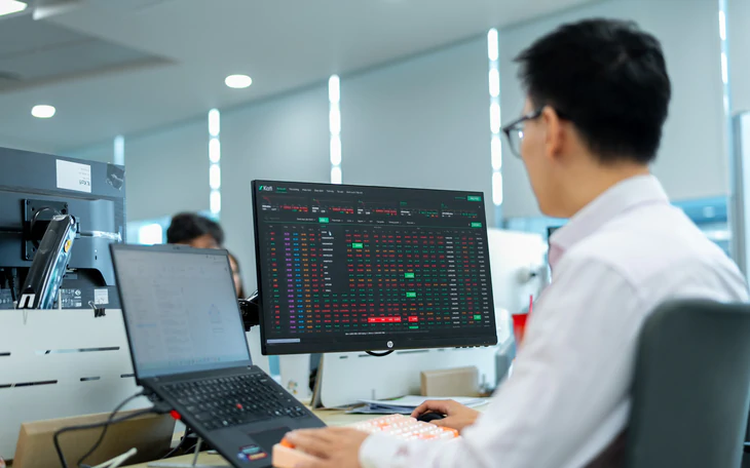
Vietnamese stocks enter a new phase ahead of the market upgrade. Photo: Huu Hanh / Tuoi Tre
Starting September 21, Vietnam will officially move from frontier-market status to secondary emerging-market status under the FTSE Russell classification.
At the same time, 27 Vietnamese stocks will be added to the FTSE Global All Cap Index, including large-cap stocks VCB, VIC and VHM; mid-cap stocks BID, HPG and VPB; and 21 small-cap stocks such as FPT, MSN, VNM, SSI, VRE, VIX, VCI and VND.
Their inclusion in the FTSE Global All Cap Index marks a notable development, as Vietnamese stocks will begin appearing in indices widely used by global funds to allocate capital.
When money flows into or out of these funds, their allocations to Vietnamese stocks may also be adjusted.
FTSE Russell has divided Vietnam’s inclusion in its global index system into four phases, starting with 10 percent of the investable weight in September 2026, followed by an additional 20 percent in March 2027, 35 percent in June 2027 and the remaining 35 percent in September 2027.
MBS Research estimates that the first phase alone could generate around US$180 million in net purchases by ETFs, while total passive inflows related to the 27 stocks could reach approximately $1.8 billion over the following year.
Among the funds that use FTSE indices as benchmarks are several products with very large asset bases.
For example, the Vanguard FTSE Emerging Markets ETF (VWO) manages around $127.3 billion in net assets and tracks an index covering large-, mid- and small-cap stocks in emerging markets.
The Vanguard Total International Stock ETF (VXUS), with around $164.9 billion in net assets, invests in thousands of companies outside the U.S.



The fund tracks the FTSE Global All Cap ex-US Index, meaning that Vietnam’s inclusion in the Global All Cap system will bring Vietnamese stocks within the investment universe tracked by the fund.
The Vanguard Total World Stock ETF (VT), with around $81.9 billion in net assets, tracks the FTSE Global All Cap Index. The index covers more than 98 percent of the investable market capitalization of global equities, ranging from large companies to small ones.
On a narrower scale, the Vanguard FTSE All-World ex-US ETF (VEU) has around $70.4 billion in assets and focuses on large- and mid-cap companies outside the U.S.
The Schwab Emerging Markets Equity ETF (SCHE), with around $13.1 billion in assets, tracks the FTSE Emerging Index and holds more than 2,200 stocks in emerging markets.
A common feature of these funds is that investors do not have to specifically choose Vietnam to gain exposure to Vietnamese stocks. Once the domestic market becomes part of global indices, Vietnam will also enter the broader capital-allocation process of these international portfolios.
Vietnam’s share of global fund assets remains small
The five funds have combined net assets of around $458 billion, but only a small portion of those assets could be allocated to Vietnamese stocks.
In the first phase, FTSE Russell expects Vietnam to account for around 0.049 percent of the FTSE Emerging All Cap Index and 0.031 percent of the FTSE Emerging Index.
The allocation to individual stocks will also depend on each stock’s weighting in the index, the size of the fund and inflows and outflows at any given time.
The way funds track their benchmarks also varies. Some funds may buy nearly the entire index portfolio, while others may select only representative stocks to achieve performance and volatility close to those of the benchmark.
The key change lies in the flow of capital after the upgrade. Previously appearing mainly in products dedicated to Vietnam or frontier markets, Vietnamese stocks will increasingly become part of global portfolios whose capital flows can rise or fall with investment activity worldwide.
Capital allocation continues through September 2027
According to FTSE Russell’s schedule, the September changes will be implemented after the market closes on September 18 and take effect at the start of trading on September 21.
This will also mark Vietnam’s official entry into the FTSE Global Equity Index Series as a secondary emerging market.
The process will continue through September 2027 and be carried out in four phases, giving funds time to adjust their portfolios. After each phase, FTSE Russell will assess funds’ ability to track the index before proceeding with the next increase in Vietnam’s weighting.
The approximately $180 million in net purchases estimated by MBS Research for September 2026 represent only the first part of the process.
The remainder of the estimated $1.8 billion is expected to be allocated gradually as Vietnam’s weighting increases through index reviews in 2027.








Max: 1500 characters
There are no comments yet. Be the first to comment.