


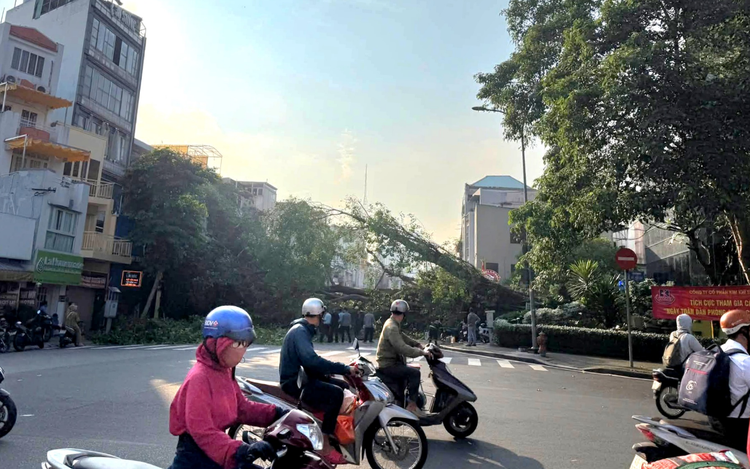
A tree topples across Dinh Tien Hoang Street, Ho Chi Minh City, October 7, 2026. Photo: Hai Trieu / Tuoi Tre
A mature tree more than 20 meters tall, with a broad canopy, was uprooted at the intersection of Dinh Tien Hoang and Vo Thi Sau Streets in Ho Chi Minh City, blocking almost the entire roadway on Wednesday morning.
A motorcyclist sustained minor injuries, while traffic congestion spread across surrounding streets during rush hour.
Preliminary reports indicated that there was no rain or strong wind when the tree fell.
The tree stood within the grounds of a building and was not under the management of Ho Chi Minh City Greenery Parks Company.
I read nearly all the comments that followed the incident.
When a large tree falls onto a road, two familiar reactions emerge.
People mourn the loss of a tree that may have stood for decades, while worrying that the next one could fall on someone.
Both reactions are understandable.
However, if every incident leads us back to the same two extremes – ’protect trees at all costs’ or ‘cut them down to prevent disasters’ – we will continue to overlook the more important question of urban governance over the suitable locations and sizes of trees.
A tree in a forest is not the same as one standing beside a busy stream of motorbikes.
Also, an old tree in a spacious park is different from one growing along a narrow sidewalk.
Although both are trees, their risk profiles and management requirements can be entirely different.
As such, urban greenery cannot be managed through the simplistic principle that every tree must be preserved.
A street tree is not a miniature forest.
Nor does a tree’s size automatically make it suitable for every location.
I understand the affection Ho Chi Minh City residents have for the city’s centuries-old trees, whose presence has become part of the urban memory.
These trees provide shade, ease the heat radiating from concrete buildings, and, perhaps most importantly, preserve a piece of the city’s identity in an environment that changes by the day.
Yet as street trees are so important, we must recognize them as part of the city’s infrastructure.
They stand on sidewalks, beneath which lie water supply and drainage systems and other utilities.
Above them may run power and telecommunications lines, while buildings stand nearby, pedestrians walk beneath their canopies, and traffic flows continuously along the adjacent roads.
A large tree in such a setting is more than a living organism.
It is also a physical component of the urban environment that can pose risks if its structural integrity deteriorates.
This does not mean that large trees are inherently dangerous, much less that mature trees should be removed from cities.
The government’s Decree No. 258/2025 classifies trees more than 50 years old as a category of greenery requiring conservation.
Because large and centuries-old trees have significant value, their health, location, and structural safety must be assessed with particular care.
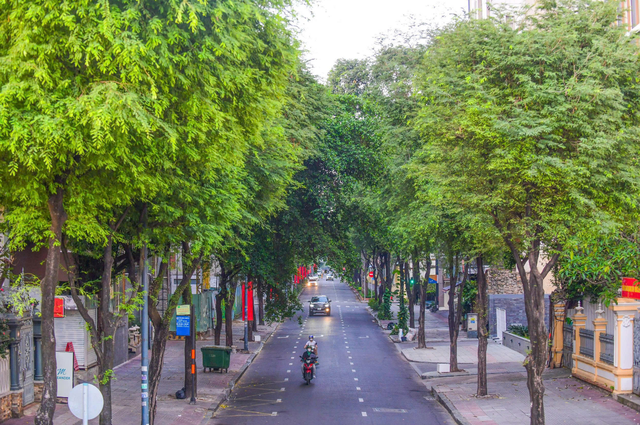
Trees line both sides of Ly Tu Trong Street in Ho Chi Minh City. Photo: Quang Dinh / Tuoi Tre
Taller trees do not necessarily provide more shade
One paradox of urban greenery is that a taller tree does not necessarily provide more effective shade.
A tree’s effectiveness in an urban environment cannot be measured simply by its height.
What matters is where its canopy sits, how wide and dense it is, and how much solar radiation it blocks in the places people actually use.
Research into urban microclimates shows that canopy diameter, foliage density, the height at which branches begin, and the tree’s position within the geometry of a street can all influence shade provision and thermal comfort.
A very tall tree with a canopy positioned too high or extending away from the area that needs shade may offer less protection to pedestrians than a shorter tree with a broad, dense canopy planted in the right place.
The challenge of urban tree management, therefore, is not simply to plant the largest trees possible.
A tree whose canopy is suited to its surroundings may provide more effective direct shade for pedestrians and road surfaces than a taller tree whose foliage falls outside the area requiring protection.
In other words, we should ask not only ‘How tall is this tree?’ but also ‘Where does its shade fall?’
Trees also have life cycles, and their care cannot rely on visual inspections alone.
The decree establishes requirements for the management, maintenance, and protection of urban greenery, as well as measures to address trees that pose potential hazards.
For trees in public spaces, annual pruning is also required to help ensure safety, particularly during the rainy season.
Properly executed pruning is not the opposite of tree preservation.
In many cases, it is an essential part of protecting both trees and people.
Conversely, improper pruning techniques or prolonged neglect can increase the risks that trees pose.
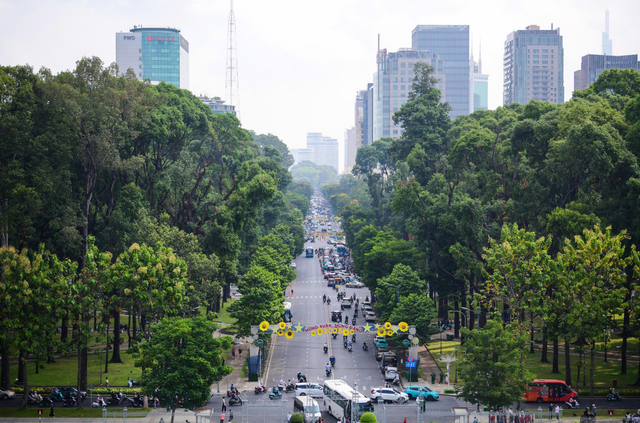
Trees line both sides of Le Duan Street in downtown Ho Chi Minh City. Photo: Quang Dinh / Tuoi Tre
Urban greenery is more than rows of street trees
When a large tree must be replaced since its health has deteriorated or it poses a safety risk, the first reaction is often sadness.
However, protecting a city’s greenery does not necessarily mean preserving every individual tree at all costs.
A tree that is unsuitable for its current location can be replaced with a species or a tree of a size better suited to the surrounding environment.
What we need to protect over the long term is not each individual tree, but the green functions the city depends on: providing shade, reducing heat exposure, improving the urban microclimate, supporting biodiversity, and creating attractive public spaces.
In a densely built city, large trees may be appropriate for parks and other sufficiently spacious areas, while smaller or more suitable species may be better choices for streets.
Meanwhile, cities can expand their greenery through green roofs, courtyards, balconies, light wells, community gardens, and climbing plants in suitable locations.
Seen from above, a city’s greenery is not defined by a single row of trees or a handful of old specimens.
It is the combined effect of parks, bodies of water, home gardens, courtyards, green roofs, and countless small patches of vegetation scattered among concrete buildings.
That is why I believe the debate between ‘preserving trees at all costs’ and ‘cutting them down for safety’ is far too simplistic.
Whenever a large tree falls, causing injuries and traffic disruption, the question should not stop at, ‘When will a new tree be planted?’
We should also ask: 'Why did the old tree fall? Was it suitable for that location? What criteria will guide the selection of its replacement? And who will be responsible for maintaining that tree over the next several decades?'
A mature city does not manage its greenery through affection for trees alone.
It must also rely on data, planning, professional expertise, and accountability.
As with every other form of infrastructure, the goal is not to preserve everything at all costs.
It is to plant the right trees in the right places, choose appropriate species, maintain them properly, and replace them at the right time.
* This text is authored in Vietnamese by Trinh Phuong Quan, who has a master’s degree in civil and environmental engineering from Stanford University, California and a master’s in integrated sustainable design from the National University of Singapore. Tuoi Tre News translated his piece.








Max: 1500 characters
There are no comments yet. Be the first to comment.