


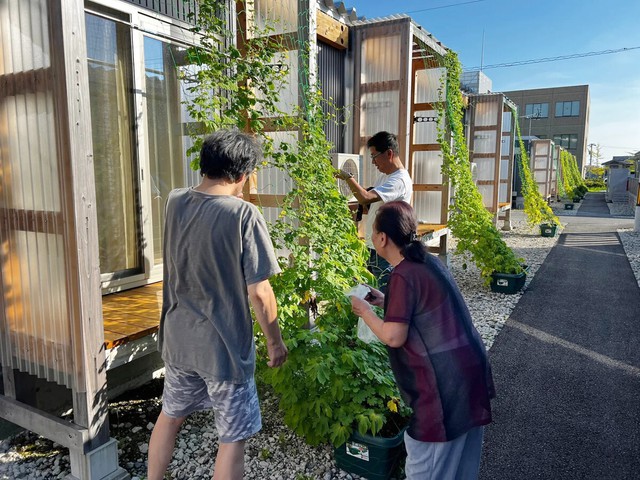
Yuji Suzuki (right back), head of Midori no Curtain Oendan, a Tokyo NPO promoting a 'green curtain' initiative, in work in August 2025 in the city of Nanao, Ishikawa Prefecture, central Japan, which was hit hard by the January 2024 powerful earthquake. Photo: Courtesy of the NPO
Nonprofit organization Midori no Curtain Oendan in Tokyo's Itabashi Ward has promoted the 'green curtain' initiative in temporary housing for people affected by natural disasters.
Green curtains cool the areas shaded by the vines by utilizing the plant mechanism of water being sucked up by the roots and released as moisture from the back of the leaves.
A real estate development company involved in the initiative has measured the effects of the mechanism on a sunny August day, finding that the temperature topped 50 degrees Celsius on an apartment balcony exposed to direct sunlight shortly past noon but stood at 32-38 degrees in an area shaded by green curtains.
According to Yuji Suzuki, 58, chairman of the company and head of the NPO, students at an elementary school in Itabashi Ward began to grow vines to create green curtains in 2003, with the real estate firm supporting their efforts.
The movement spread later as part of environmental education, leading to the establishment of the NPO in 2007.
The March 2011 major earthquake and tsunami in Japan's Tohoku northeastern region and a subsequent triple reactor meltdown at Tokyo Electric Power Company Holdings Inc.'s Fukushima No. 1 nuclear power station raised awareness of the importance of power-saving around the country, with scheduled blackouts carried out in Tokyo reflecting electricity shortages caused by the disasters.
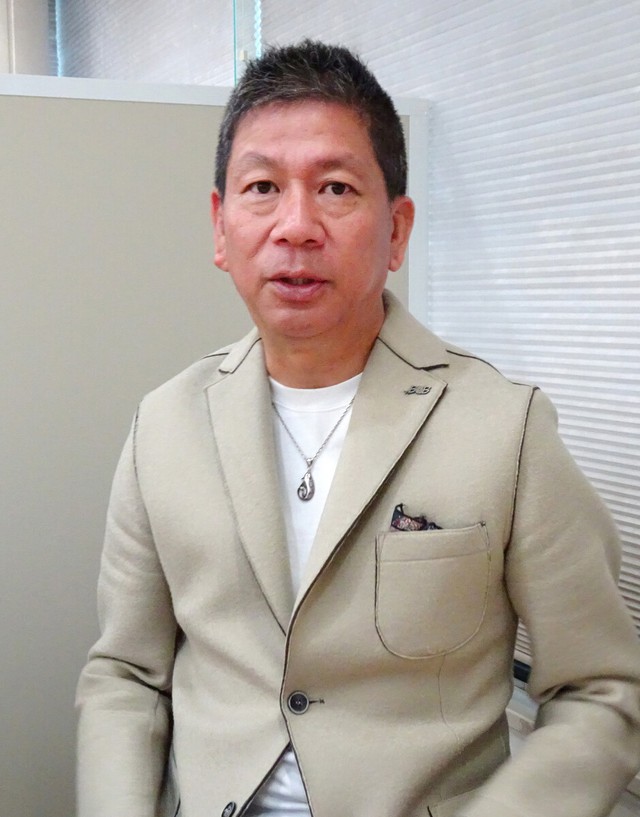
Yuji Suzuki, head of Midori no Curtain Oendan, a Tokyo NPO working to promote a 'green curtain' initiative, speaks in an interview May 22, 2026. Photo: Jiji Press
Many temporary houses built after the natural and nuclear disasters had thinner insulation than standard homes.
The real estate firm came forward to offer support with the green curtain initiative, with Suzuki saying, "It would be a further tragedy if disaster-afflicted people get heatstroke."
The initiative gained traction, and about 21 million yen had been donated to the NPO by December 2016.
Green curtains were installed at about 20,000 temporary houses, primarily in Iwate, Miyagi, and Fukushima prefectures, all in Tohoku, thanks partly to the labor provided by around 1,000 volunteers.
Residents expressed gratitude not only for the cooling effects but also for being able to communicate with others living in temporary houses, including by talking with each other when watering the plants.
After the powerful Noto Peninsula earthquake in Ishikawa Prefecture, central Japan, in January 2024, green curtains were installed at 1,356 houses in four municipalities, including the city of Nanao, by 2025.
In May this year, the NPO also provided support at temporary housing for victims of forest fires in the city of Ofunato in Iwate.
To support disaster-affected areas, the NPO emphasizes the importance of social exchanges, such as setting up places for interactions where affected people can share their feelings and thoughts.
Noting that the term green curtain is increasingly recognized in society, Suzuki said, "I hope that creating green curtains will become part of culture."









Max: 1500 characters
There are no comments yet. Be the first to comment.