


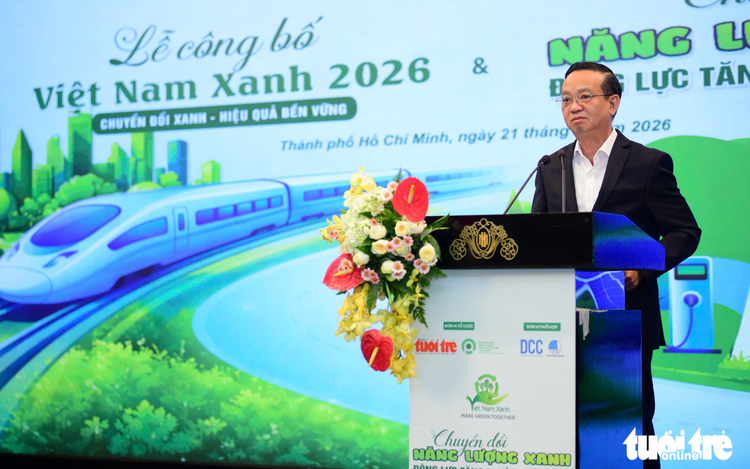
Vice-chairman of the Ho Chi Minh City People’s Committee Bui Minh Thanh speaks at the conference titled ‘Green Energy Transition - The Driver of Sustainable Growth,’ April 21, 2026. Photo: Quang Dinh / Tuoi Tre
A conference titled ‘Green Energy Transition - The Driver of Sustainable Growth’ was co-organized on Tuesday in the city by the Ministry of Trade and Industry, the municipal administration, and Tuoi Tre (Youth) newspaper, marking the launch of the ‘Green Vietnam 2026’ campaign.
Speaking at the conference, vice-chairman of the Ho Chi Minh City People’s Committee Bui Minh Thanh congratulated the launch of the initiative and praised the significance of the conference.
He said that green transition is no longer an option but a prerequisite for the city to maintain its role as Vietnam’s economic locomotive and strengthen its competitiveness in the new era.
Accelerating energy transformation
Opening the conference, Deputy Editor-in-Chief of Tuoi Tre Tran Xuan Toan said the event marks the beginning of the ‘Green Vietnam 2026’ project.
The initiative aims to connect policymakers, businesses, and the community to accelerate Vietnam’s green transformation, particularly in the energy sector.
He noted that in the context of global uncertainty and geopolitical risks affecting energy supply chains, Vietnam faces an urgent need to restructure its energy system toward sustainability and reduced dependence on fossil fuels.
Green energy transition is no longer a trend but an inevitable requirement tied to national energy security and economic competitiveness, Toan said.
Vietnam is committed to achieving net-zero emissions by 2050 at COP26, while actively expanding renewable energy sources such as wind, solar, and biomass.
However, challenges remain in terms of institutional frameworks, infrastructure, and financial capacity.
With the right strategy and collective effort, Vietnam could not only follow global trends but also potentially lead in certain sectors.
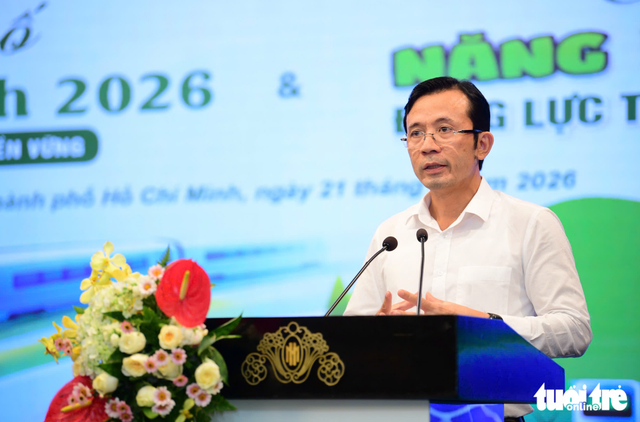
Deputy Editor-in-Chief of Tuoi Tre (Youth) newspaper Tran Xuan Toan delivers his speech at the conference titled ‘Green Energy Transition - The Driver of Sustainable Growth,’ April 21, 2026. Photo: Quang Dinh / Tuoi Tre
Green energy as pillar of Ho Chi Minh City’s development
Vice-chairman Thanh stressed that energy transition plays a central role in the broader green transformation strategy.
The city is pursuing major directions such as expanding renewable energy, promoting efficient energy use, and researching emerging technologies including green hydrogen and green ammonia, with the long-term goal of achieving net-zero emissions by 2050.
In the transport sector alone, Ho Chi Minh City aims for 100 percent of public transport vehicles to use clean energy by 2030.
The city is also developing a comprehensive green transition plan for the 2025-35 period, consisting of 10 pillars and 76 specific targets, with estimated total funding needs of around VND900 trillion (US$34.2 billion).
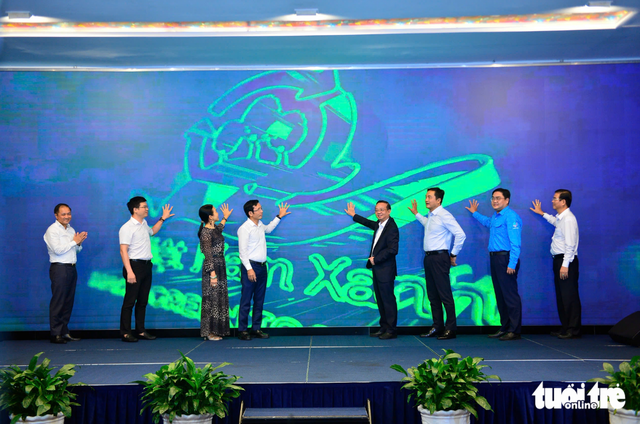
Representatives make a symbolic gesture to launch the ‘Green Vietnam 2026’ initiative in Ho Chi Minh City, April 21, 2026. Photo: Quang Dinh / Tuoi Tre
Reaffirming the city’s strategic direction, Thanh stated that energy transition is one of the three key pillars of Ho Chi Minh City’s long-term development strategy, alongside digital transformation and innovation.
He stated that global competition is increasingly shaped by energy, technology, and environmental factors, requiring major cities not just to adapt but to proactively lead.
“The city will continue to support businesses, accelerate institutional reform, and prioritize resources for green projects, with the goal of becoming a green transformation hub in Southeast Asia,” he said.
Through the conference, he expected participating experts and businesses to put forward practical solutions and policy recommendations to support implementation.


Attendees at the conference titled ‘Green Energy Transition - The Driver of Sustainable Growth,’ April 21, 2026. Photo: Quang Dinh / Tuoi Tre
Lessons from global, local success stories
A typical example for successful energy transformation is a case of Denmark, which successfully transitioned from fossil fuel dependence in the 1970s to wind energy generation.
Wind power accounts for more than half of Denmark’s electricity production, supporting both energy security and strong industrial growth through companies such as Vestas.
In Vietnam, dairy giant Vinamilk was cited as a notable example of corporate-led green transition.
The company has invested in solar energy systems at farms and factories and implemented circular economy models to reduce emissions and optimize production.
Several of its farms have achieved eco-farm standards, demonstrating that green transition is not only feasible but also economically beneficial, enhancing brand value and helping Vietnamese products meet increasingly strict international environmental standards.
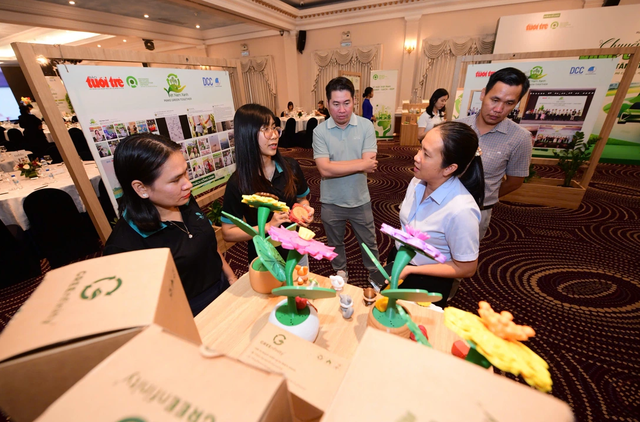
Green energy transition is no longer a trend but an inevitable requirement tied to national energy security and economic competitiveness. Photo: Quang Dinh / Tuoi Tre








Max: 1500 characters
There are no comments yet. Be the first to comment.