


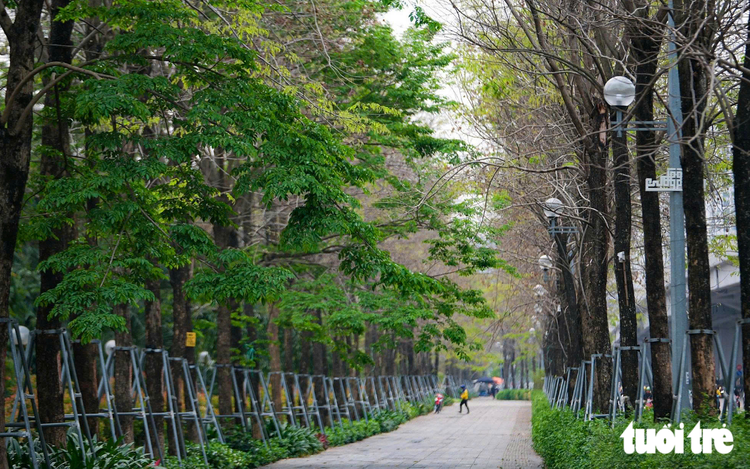
Trees line both sides of Pham Van Dong Street, Hanoi. Photo: Nam Tran / Tuoi Tre
The Hanoi People’s Committee has approved a scheme on the management and development of the capital’s green spaces, parks, flower gardens and water bodies, which outlines plans to reorganize the city’s street greenery.
The city currently has more than 1,000 roads and streets featuring a wide variety of tree species.
Planting multiple species along the same street has resulted in inconsistent landscapes and made maintenance, pruning and management more challenging.
To address the issue, the city plans to establish one dominant shade-tree species for each street, with no more than two species permitted in special cases.
Trees will be standardized in terms of species, height, canopy shape and spacing to create continuous rows and give each street a distinctive character.
Tree selection will depend on street and pavement widths, architectural features, traffic density and the function of each area.
On narrow streets in the historic inner city, the city will prioritize moderately tall trees with compact canopies and deep root systems to prevent damage to pavements and underground infrastructure.
Major roads, boulevards and ring roads will feature broad-canopied trees that provide ample shade, tolerate pollution and help reduce urban heat.
On commercial streets, shade trees will be combined with low-growing ornamental plants to ensure shopfronts remain visible and businesses can operate without obstruction.
In residential areas, priority will be given to trees that shed relatively little fruit and foliage, produce no unpleasant odours and have balanced trunks and canopies.
Historic sites, the Old Quarter and cultural spaces will feature species associated with Hanoi’s collective memory and urban identity.
Trees that create a dignified and cohesive landscape will be planted at administrative and political centers, as well as major squares.
In new urban areas, the city will favor fast-growing trees that are easy to maintain.
Meanwhile, industrial zones and major transport corridors will prioritize species capable of trapping dust, reducing noise and withstanding harsh environmental conditions.
The city said established trees that are closely associated with Hanoi’s history and urban landscape would be prioritized for preservation.
Replacement would be considered only when trees were no longer suitable in terms of safety, ecological conditions or the overall landscape.
The city would also restrict the arbitrary introduction of species outside the approved list.
Apart from shade trees, pavements and road medians may feature shrubs, grass and ornamental flowers arranged in layers, provided they do not detract from the dominant tree species.
Squares, major intersections and parks may accommodate a wider variety of trees to create visual highlights, subject to approved landscape designs.
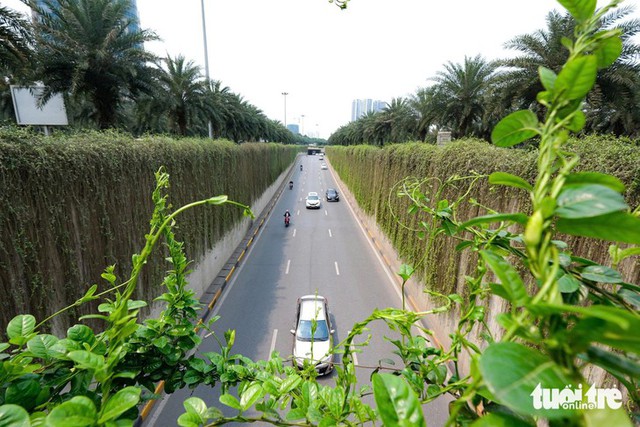
Lush green trees line Thang Long Boulevard in Hanoi, Vietnam. Photo: Nam Tran / Tuoi Tre
6 landscape categories for Hanoi’s streets
The scheme divides major streets in downtown Hanoi into six landscape categories, each with specific guidelines for tree selection.
Streets of memory
In the Ba Dinh-Hoan Kiem area, the city will prioritize the preservation of mature trees, including dracontomelon, bischofia javanica, millettia ichthyochtona, chisocheton paniculatus and black ironwood.
On Phan Dinh Phung Street, the existing dracontomelon trees will be retained along the section from Mai Xuan Thuong Street to Cua Bac Street, while bischofia javanica trees will remain along the section from Cua Bac Street to Hang Dau Street.
Hoang Dieu Street is planned to feature chisocheton paniculatus and millettia ichthyochtona as its dominant species.
On Dien Bien Phu Street, sterculia and black ironwood will be planted, with seasonal flowers and low-growing shrubs added to create a dignified landscape around historic sites.
Heritage lakeside green corridors
Streets surrounding Hoan Kiem Lake, including Hang Khay, Le Thai To and Dinh Tien Hoang, will feature barringtonia acutangula, dracontomelon and queen's crepe-myrtle trees.
Thanh Nien Street, which runs between West Lake and Truc Bach Lake, will retain flamboyant and white bauhinia trees as its dominant species.
Political and ceremonial routes
In the Ba Dinh area, streets will prioritize trees with balanced forms to create a formal and dignified setting.
Hung Vuong Street will feature resin trees as its dominant species, complemented by ornamental grass.
Hoang Van Thu Street will mainly use sterculia trees.
Nguyen Tri Phuong Street will retain dracontomelon trees along its pavements, while sterculia and yellow bells will be planted on the central median.
Cultural and residential streets in the inner city
This category prioritizes the preservation of tree species that have become defining features of individual streets.
Tran Hung Dao and Hai Ba Trung Streets will retain dracontomelon and bischofia javanica trees, complemented by shrubs and low-growing flowers.
Nguyen Du Street is planned to feature blackboard trees as its dominant species, while Quan Su Street will use dracontomelon and queen’s crepe-myrtle trees.
Commercial and service corridors
On Ba Trieu and Hue Streets, the planned species include dracontomelon, barringtonia and chukrasia tabularis.
Along the Cau Giay-Xuan Thuy corridor, which is served by an elevated urban railway, the city plans to plant small-leaved banyan trees and queen’s crepe-myrtles.
Major transport corridors and gateway routes
Major roads and gateways will prioritize trees that provide substantial shade, tolerate challenging environmental conditions and create a cohesive landscape along long stretches of road.
Vo Chi Cong and Vo Nguyen Giap Streets are planned to feature pterocarpus macrocarpus, camphor and resin trees.
Thang Long Boulevard will feature sterculia, chukrasia tabularis and mango trees along its pavements.
On Nguyen Trai Street, existing trees are planned to be replaced with pterocarpus macrocarpus to increase shade and improve the streetscape.








Max: 1500 characters
There are no comments yet. Be the first to comment.