


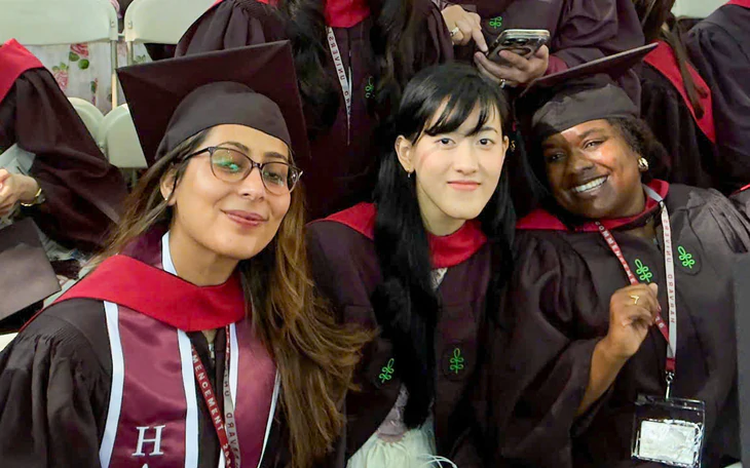
Nguyen Do Thu Phuong (C) at her master’s graduation ceremony at Harvard Medical School. Photo: Supplied
Instead, it showed stories she had brought back from Sa Pa, a mountain town in northern Vietnam: Hmong girls marrying at a young age and carrying burdens that did not appear in any medical record.
Phuong, 25, from Bao Loc in Vietnam’s Lam Dong Province, began to cry.
“Everyone was very supportive and applauded to comfort me,” she recalled.
After the defense, her adviser told her the research topic was difficult and that almost no one had studied that community in Sa Pa.
In May, Phuong graduated with a master’s degree in global health delivery from Harvard Medical School, becoming the youngest student in the program. She graduated with a perfect GPA of 4.0.
Christina Lively, associate director of education programs at the Harvard Medical School Department of Global Health and Social Medicine, described Phuong as hardworking and dedicated, saying she had made clear progress in her research abilities during her two years in the program.
Phuong is a former student of Bao Loc High School for the Gifted. In 2020, she received a full scholarship to study nursing at VinUniversity in Hanoi.
She later enrolled in a second degree in foreign trade economics at Foreign Trade University in the Vietnamese capital.
She traveled about 50 kilometers between the two universities each day, sometimes spending two to three hours in traffic.
During her second and third years of university, Phuong’s grades fell to the bottom of her class. She frequently skipped classes and was unsure where she would go after graduation.
“At that time, I didn’t think I was falling behind because I lacked ability, but because I was overwhelmed,” she said.
A turning point came after she emailed Nguyen Hoang Long, then director of VinUniversity’s nursing program, who had awarded her the full scholarship.
She still remembers his response: “If you continue like this, it would be a great pity for you.”
Phuong began reassessing herself and planning a new academic path.
At the end of her third year, she went to Sa Pa as a volunteer teacher, teaching English to Hmong children.
For nearly two months, she lived and ate alongside local residents and saw first-hand what she had previously known only through television: intelligent, eager-to-learn children whose opportunities were limited by economic circumstances, language, gender, and distance.
“If I don’t do something now, it may take another five, 10 or 20 years before someone truly pays attention to them and takes action for them,” Phuong said.
After the trip, she began learning about Harvard’s global health delivery program as she prepared for graduate school.
She realized the field gave a precise name to a question that had emerged during her time in Sa Pa, not simply “What is good health care?” but “Why does good health care still not reach some communities?”

Nguyen Do Thu Phuong while volunteering as an English teacher for Hmong children in Sa Pa, Vietnam. Photo: Supplied
Returning to Vietnam
Phuong abandoned her initial plan to study health care management because she wanted to find answers to questions about her generation that had taken shape during her time with young Hmong women in Sa Pa.
Her application to Harvard Medical School listed a 3.46 GPA on a 4.0 scale, significantly below the program’s overall academic profile. But her research proposal, developed from her time in Sa Pa, persuaded the admissions committee.
After graduation, Phuong had an opportunity to remain at Harvard Medical School as a teaching assistant, combining research with further training in teaching, a common path in the field.
She spent a month considering the offer.
“In the long term, I don’t see my future abroad in the next five or 10 years,” Phuong said.
“In the coming years, I still want to be in Vietnam, close to my family, and work for marginalized communities, especially women and ethnic minorities.”
Phuong said there are opportunities for growth wherever one lives. But she does not place a high value on material wealth or prestige, and she is happiest when she is close to her family.
For her, spending years away from her family to advance her career overseas would be an exchange that is not worth the cost.
Her biggest concern about returning was losing her professional support network.
During her two years at Harvard, she had four advisers. Her main thesis instructor is originally from Lam Dong and was born in Da Lat, a popular tourist town in the highland province.
During the month she spent weighing her options, Phuong emailed all four advisers to ask whether they would continue supervising her if she returned to Vietnam and conducted follow-up research on her thesis topic.
All four agreed.
Among the job offers she received after graduation, Phuong said she paid more attention to whether a workplace provided conditions for research than to salary.
She ultimately accepted a management trainee position at VinUniversity, the institution that had awarded her the full scholarship before she went to the United States.
“I’m quite lucky that my current workplace still gives me the conditions to continue doing research, but not everyone who studies abroad and returns to Vietnam can find a similar opportunity,” she said.
“Returning or staying abroad should not be the only measure of patriotism.”
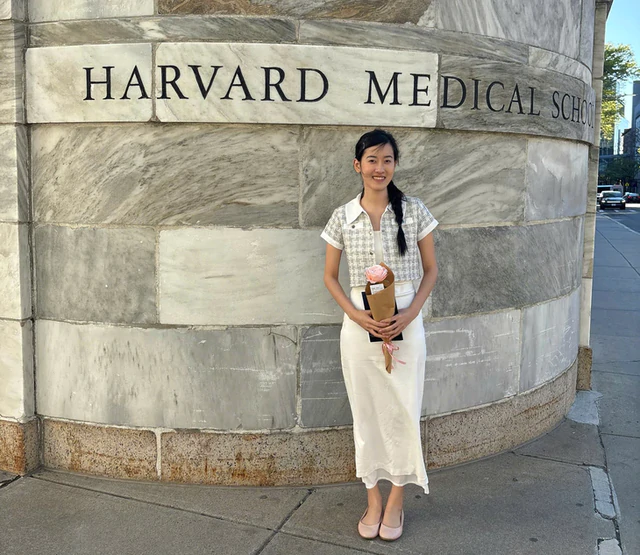
Nguyen Do Thu Phuong immediately after defending her master’s thesis in global health delivery at Harvard Medical School. Photo: Supplied
Understanding the people involved
Her master’s thesis examined the mental health of young Hmong women in Sa Pa in connection with early marriage.
She said a single thesis cannot fully answer a problem rooted in such a long historical and cultural context.
But each serious study can serve as a link in a process that gradually addresses the problem.
Her first priority is to listen respectfully to the voices of young Hmong women.
“Many policies fail to meet expectations not because of a lack of goodwill, but because we haven’t understood what the people involved need or fear,” she said.
After returning to Vietnam, Phuong began a follow-up study based on her thesis, with the support of the same four professors who supervised her during her studies in the United States.








Max: 1500 characters
There are no comments yet. Be the first to comment.