


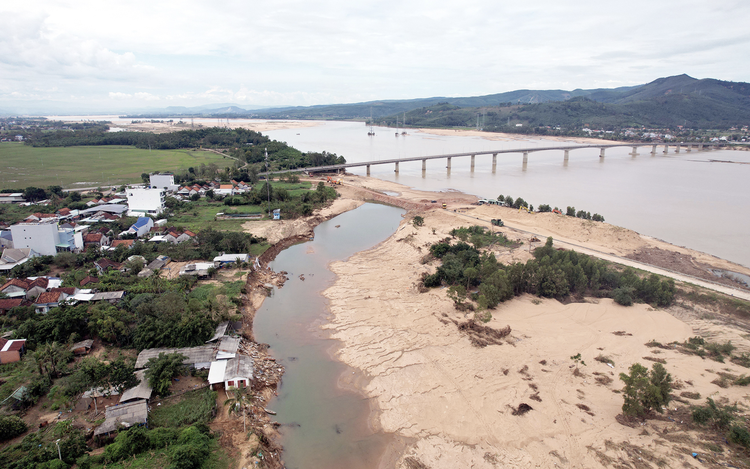
The flood on the Ba River carves out a new channel, some 1.5km long and 100m wide, near a residential area in Dak Lak Province, Vietnam.
What remains is a devastated landscape, a shaken population, and a long road to rebuilding.
The new Dak Lak Province was formed by merging the old province with the former Phu Yen Province on July 1.
On Saturday, Bai Dieu Hamlet in Son Hoa Commune, located near the spillway of the Song Ba Ha hydropower plant, still resembled a disaster zone.
Roads were shredded, rice-field embankments simply vanished, and houses that had stood for decades collapsed.
Fifty-two-year-old Truong Thi Phuong burst into tears and pointed to an empty space where her home once stood.
On the night of November 19, as waters surged from the confluence of the Song Hinh and Song Ba Ha spillways, she narrowly escaped the torrent that swallowed her house.
Similarly, Truong Van Mot, a 84-year-old resident of Dong Hoa Hamlet, Son Hoa Commune, recalled water from the Ba River roaring into the community with terrifying speed.
He remained shaken with fear.
In his lifetime, he had never witnessed a flood as violent, he said.
The water climbed rapidly, within minutes it reached his roof.
His home was completely destroyed, leaving behind only rubble.
The flood inundated 4,038 houses in Son Hoa Commune and caused 507 structures to collapse or sustain major damage, including 38 that were entirely swept away.
Local authorities estimated losses in homes, equipment, and property at more than VND500 billion (US$19 million).
Bai Dieu Hamlet suffered most severely, described by locals as ‘a battlefield.’
Families took shelter with relatives or under temporary tarps laid over mud.
Along the path into the hamlet, fallen coconut trunks and sheets of metal stuck high in treetops illustrated the sheer force of the water.
Son Hoa Commune chairman So Minh Chien said that such a historic flood inundated thousands of houses.
He described the event as an unprecedented flood, intensified when the hydropower plant released water as upstream flows surged.
The river bent sharply near the residential zone, creating a reverse current that slammed directly into homes and infrastructure.
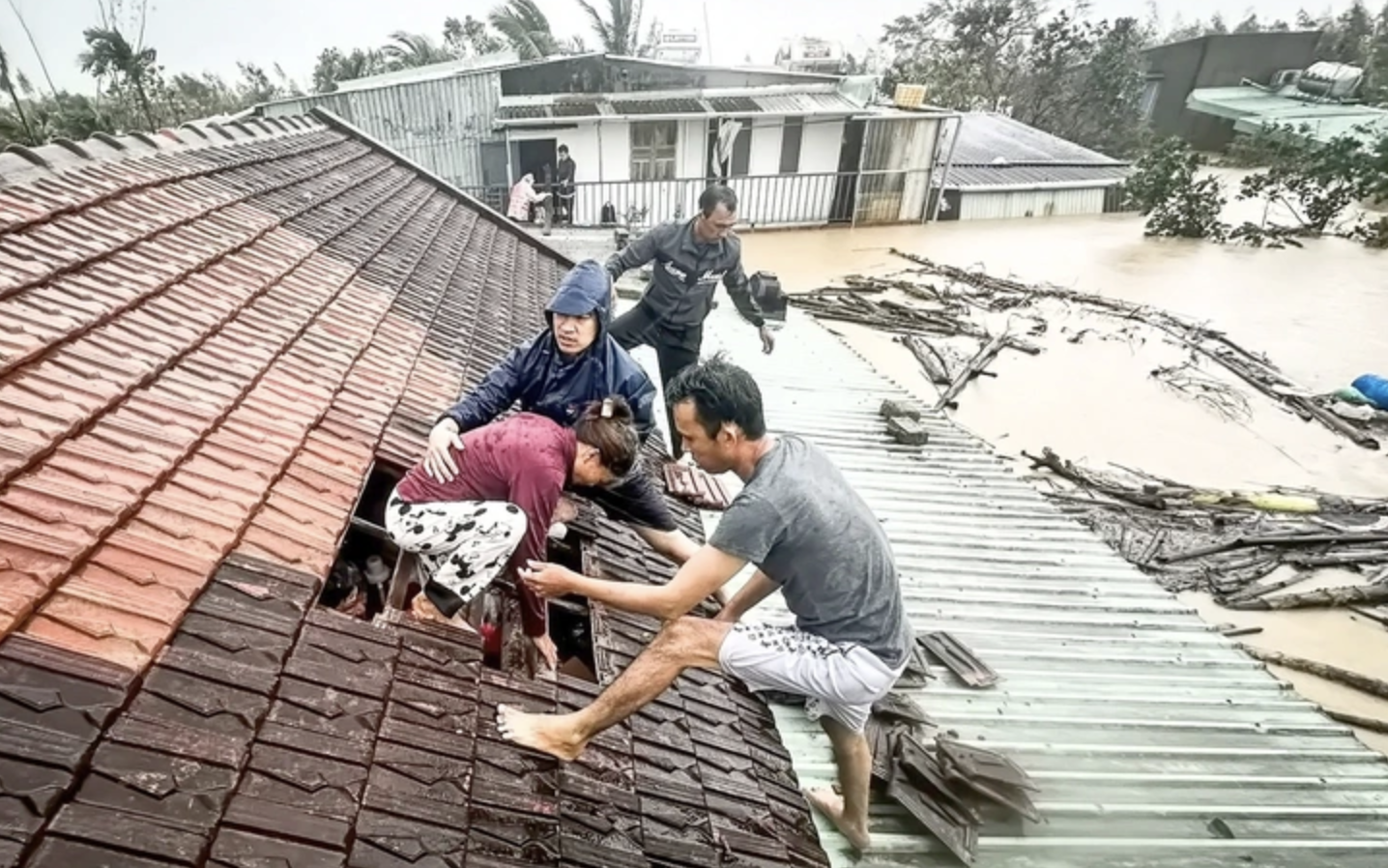
Further downstream, about 10 kilometers from the commune, the areas around Dinh Ong Bridge – Phu Hoa 1 Commune on the left bank and Tay Hoa Commune on the right – also faced severe destruction.
The flood tore apart riverbank embankments, swept through houses, and left behind piles of debris and displaced concrete slabs.
Residents said the pressure of water arriving from upstream was immense.
The flood swept away trucks working at a sand-mining site, destroyed the access road along the Ba River, and carved a new channel roughly 1.5km long and more than 100m wide.
Trenches 3-7 meters deep appeared close to a residential area.
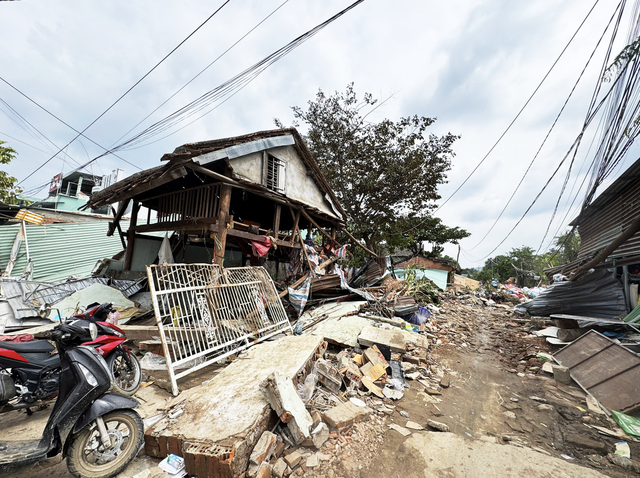
Flood-triggered devastation in Bai Dieu Hamlet, Son Hoa Commune, Dak Lak Province, Vietnam. Photo: Trung Tan / Tuoi Tre
New look at planning amid severe weather
Dang Van Doan, head of Phuoc Thanh Dong Hamlet in Tay Hoa Commune, said many people were still trembling after watching the Ba River ‘create a river’ within their residential area.
In normal years, the highest floodwaters barely reached above the riverbank.
Even though some households had been warned and evacuated, none expected water to be powerful enough to sweep away entire structures, he said.
Doan emphasized that this year’s flood requires authorities to reconsider planning to ensure long-term safety.
Le Van Vi, vice-chairman of Tay Hoa Commune, said the deluge destroyed multiple livestock facilities and dug deep scars through farmland.
While a temporary embankment has been put in place to restore access, the landscape remains visibly ruptured.
The so-called ‘new river’ is not a permanent tributary but a temporary flood channel caused by the hydropower-induced surge, he explained.
The leader of Son Hoa Commune said that the commune will have to evaluate long-term planning.
It has proposed relocating two high-risk zones and establishing a 5.5-hectare resettlement area in Trang Sim for about 270 households.
The plan is still at the proposal stage.
Le Hung, deputy director of the provincial Department of Construction, said that the province has launched a campaign to mobilize military, police, businesses, and volunteers to rebuild homes.
The province is offering VND170 million ($6,450) for each new house and VND40 million ($1,515) for repairs.
In total, 655 homes must be constructed and 1,050 repaired.
Flood-resistant homes will be built in the hardest-hit areas based on two approved designs, Hung said.
The scale of destruction along the Ba River has forced a reassessment of rural planning, transportation networks, and irrigation systems, he stated.








Max: 1500 characters
There are no comments yet. Be the first to comment.