


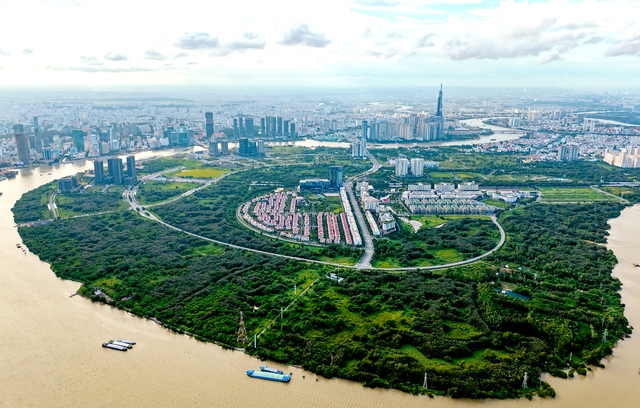
An aerial view of Ho Chi Minh City’s Thu Thiem New Urban Area, where many land plots remain vacant. Photo: Chau Tuan / Tuoi Tre
Ho Chi Minh City officials said the push follows inspection conclusions issued in 2018 and 2019 and subsequent directives from the prime minister, prompting the city to focus on multiple work streams to bring Thu Thiem to completion on schedule.
The original master plan, approved by the prime minister in 1996, divided Thu Thiem into five functional zones.
Later adjustments expanded the area into eight functional zones, while maintaining the core principles of the approved plan.
City leaders stressed that the project has consistently adhered to its planning framework despite revisions to meet evolving development needs.
Unlike conventional real estate projects, Thu Thiem was not designed primarily to generate profit from land sales.
Instead, most of its land is reserved for public and service-oriented developments that the city center lacks or cannot expand further.
These include the Saigon River waterfront park, the city’s central square in Thu Thiem, an International Financial Center, an international convention and exhibition complex, a children’s cultural center, and an ecological park.
The Saigon River waterfront park, once largely unused, has been transformed into a green public space and has become a popular gathering and photo spot for young people, especially in the evenings and during holidays when fireworks displays draw large crowds.
Within the 657-hectare core planning area, land for commercial development accounts for less than 30 percent.
The remaining land is earmarked for strategic and landmark projects intended to drive growth in the eastern part of the city, upgrade Ho Chi Minh City to international urban standards, and accelerate the shift toward a service-based economy.
To meet the 2030 target, the city has established a dedicated task force led by chairman of the Ho Chi Minh City People’s Committee Nguyen Van Duoc, involving vice-chairmen and heads of key departments.
Authorities are fast-tracking investment procedures for the International Financial Center, planning metro lines through Thu Thiem, advancing ecological park and central square projects, and promoting auctions and tenders for available land plots.
Efforts are also underway to resolve outstanding land-use fee issues affecting major investors and projects such as Lotte and Empire City.
Urban planning experts, including Vo Kim Cuong, former deputy chief architect of Ho Chi Minh City, and Ngo Anh Vu, head of the Ho Chi Minh City Urban Planning Institute, acknowledged that while Thu Thiem’s development has followed the approved plan, progress has been slower than expected.
Cuong and Vu said that along the two main corridors through Thu Thiem, Mai Chi Tho, and Luong Dinh Cua Streets, many land parcels remain vacant.
However, they expressed optimism that upcoming flagship projects such as the International Financial Center and transport links will serve as a catalyst, helping fill remaining vacant land and finally realize Thu Thiem’s long-envisioned role as a modern urban core.








Max: 1500 characters
There are no comments yet. Be the first to comment.