


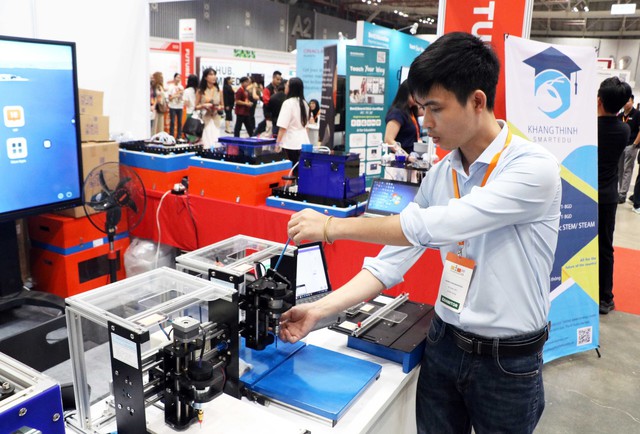
A technology solution is displayed at a recent education technology exhibition in Ho Chi Minh City. Photo: Trong Nhan / Tuoi Tre
Under the program recently approved by the municipal administration, science, technology, and innovation are identified as key drivers for rapid and sustainable economic growth, higher productivity, and stronger competitiveness.
The program targets a business-centered innovation ecosystem, with the central government playing a strategic role in setting priorities, funding key projects, and creating a supportive environment for research and commercialization.
By 2030, the city aims to raise total social spending on research and development to 2-3 percent of its gross regional domestic product, with more than 60 percent coming from non-state sources.
Each year, at least 50 science and technology projects will be launched, with 40 evaluated or completed, and 60 percent of the results applied in practice within 12 months.
Another target is for at least 25 percent of businesses in the city to use research results from universities and institutes in their production and business operations.
In scientific publishing and intellectual property, the city aims to produce at least 3,500 Scopus- and ISI-indexed research papers and file at least 500 intellectual property applications, including 300 patent and utility solution registrations.
Authorities also hope to establish at least five research centers operating at near-international standards.
The strategy will be implemented through six major science and technology programs along with a separate ‘Young Science and Technology Incubator’ initiative.
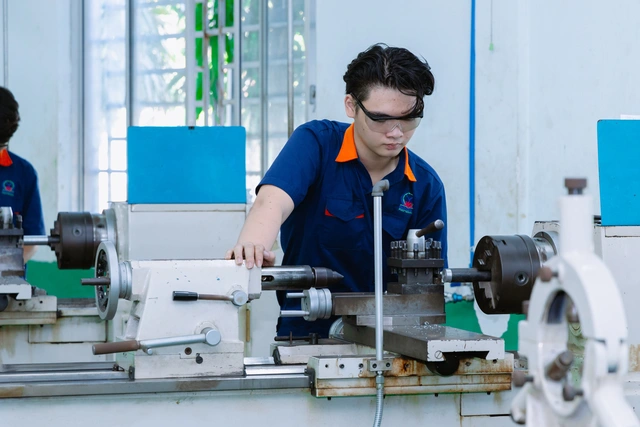
Universities and colleges are identified as key players in Ho Chi Minh City’s plan to become a science and technology hub. Photo: Khoa Le
In digital transformation and smart city development, the city plans to focus on artificial intelligence, big data, Edge AI, blockchain, the Internet of Things, specialized Vietnamese-language virtual assistants for public administration, and shared urban data platforms.
For industrial development and smart manufacturing, the city will prioritize semiconductor technologies, including chip design, packaging and testing, with a focus on AI chips, Internet-of-Things chips, and specialized semiconductor systems.
The city also plans to expand research and applications involving industrial robots, unmanned systems, smart logistics, energy storage technologies, and carbon emission reduction solutions for manufacturing.
The program will also support spin-offs, start-ups, and small innovative enterprises, while promoting technology transfer, intellectual property development, and pilot projects.
Start-up accelerators will target AI, semiconductors, UAVs, robotics, and biotechnology.
Another highlight is the ‘Young Science and Technology Incubator’ program, designed to train 5,000 young researchers and engineers, with increasing proportions of master’s and doctoral-level talent in priority fields.









Max: 1500 characters
There are no comments yet. Be the first to comment.