


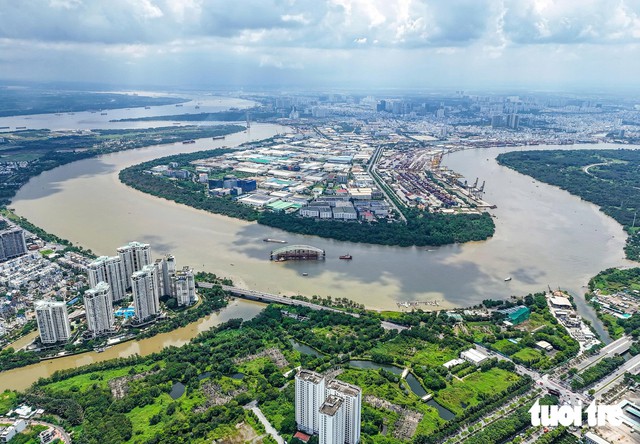
Ho Chi Minh City aims to become a global, modern, smart, dynamic, and innovative metropolis, placing people at the center of its development strategy. Photo: Chau Tuan / Tuoi Tre
The plan was adopted during a special session of the 11th municipal People's Council for the 2026-31 term and will be formally approved by the chairman of the city's People's Committee.
The master plan is expected to shape Ho Chi Minh City's development for decades as it enters a new phase of growth marked by an expanded administrative area, a rising population, and greater demand for regional connectivity and coordination.
It covers the city's entire administrative area of approximately 6,772.59 square kilometers, comprising 168 administrative units, while also examining connections with neighboring Tay Ninh, Dong Nai, Dong Thap, and Lam Dong Provinces, as well as surrounding maritime areas.
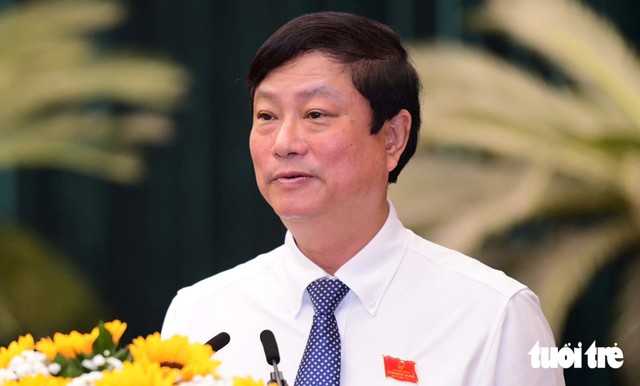
Vo Van Minh, a member of the Party Central Committee, deputy secretary of the Ho Chi Minh City Party Committee, and chairman of the municipal People's Council, speaks at the council session on October 30, 2026. Photo: Quang Dinh / Tuoi Tre
The city's population is projected to reach 18 million by 2030, 25 million by 2045, and more than 27 million by 2050.
Under its long-term vision, Ho Chi Minh City aims to become a smart, modern, and inclusive global metropolis, serving as an international hub for finance, science, technology, innovation, and business.
5 growth poles to reshape urban development
A key feature of the master plan is a shift toward a multi-polar, multi-center urban model built around five growth poles, five strategic connectivity networks, five satellite centers, and 10 development management zones.
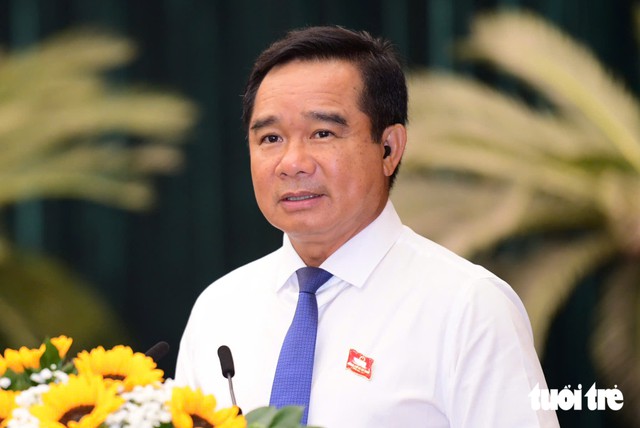
Nguyen Van Duoc, a member of the Party Central Committee, deputy secretary of the Ho Chi Minh City Party Committee, and chairman of the municipal People's Committee, speaks at the council session on October 30, 2026. Photo: Quang Dinh / Tuoi Tre
The five growth poles include an international financial and services center spanning Saigon, Cho Lon, and Thu Thiem; an innovation hub in the east; an industrial and logistics hub in the north; a seaport, free trade, and energy industry hub in the south; and an urban, education, and healthcare hub in the west.
The five satellite centers will be located in Con Dao, Long Hai-Ho Tram, Hoc Mon-Cu Chi, Bau Bang, and Tan Uyen-Bac Tan Uyen.
The plan also calls for greater use of underground, ground-level, and elevated spaces to improve land-use efficiency and strengthen the city's competitiveness.
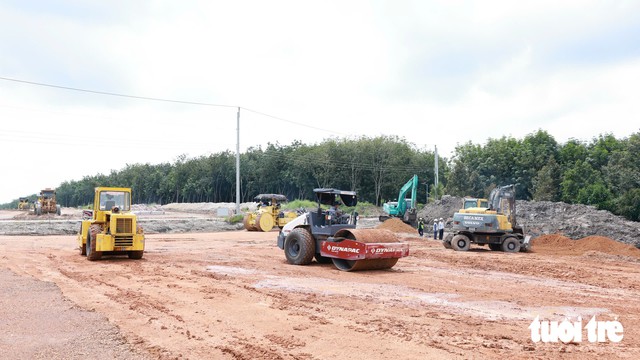
Ho Chi Minh City's master plan for 2025-2050, with a 100-year vision, is expected to lay the foundation for stronger growth in the decades ahead. The photo shows construction of the Ho Chi Minh City–Thu Dau Mot–Chon Thanh Expressway in October 2026. Photo: T.T. / Tuoi Tre
Beyond infrastructure, Ho Chi Minh City aims to become one of Asia's leading centers for higher education, vocational training, science, and technology by 2050.
To support this ambition, the city plans to accommodate around two million students and allocate an additional 1,400-2,000 hectares of land for higher education between 2030 and 2050.
Healthcare development will focus on hospitals at major city gateways, specialized medical clusters, healthcare tourism, preventive care, and digital transformation.
By 2045, the city targets 45 hospital beds and 35 doctors per 10,000 residents, alongside broader social welfare improvements aimed at making it one of the world's most livable cities.
The master plan also envisages special development zones with preferential policies to attract investment, talent, and emerging industries.
To fund its long-term ambitions, Ho Chi Minh City plans to combine public investment with private-sector capital through public-private partnerships, land value capture linked to infrastructure projects, and municipal bonds.
Authorities will prioritize key projects, establish implementation timelines and oversight mechanisms, and use digital technologies to monitor progress.
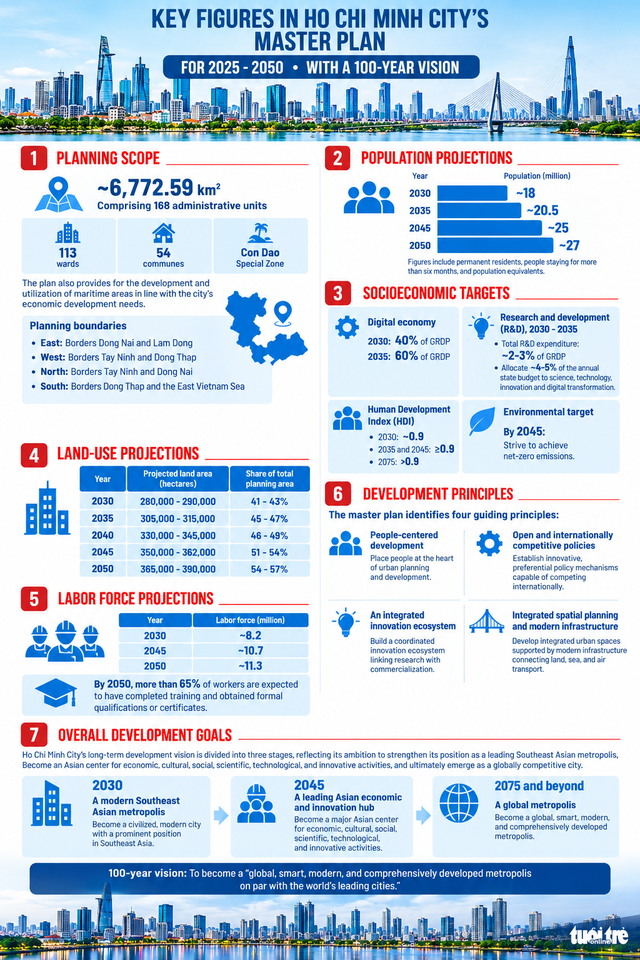
An infographic highlights key figures, development targets, and long-term goals under Ho Chi Minh City's master plan for 2025-2050, with a 100-year vision.


Max: 1500 characters
There are no comments yet. Be the first to comment.