


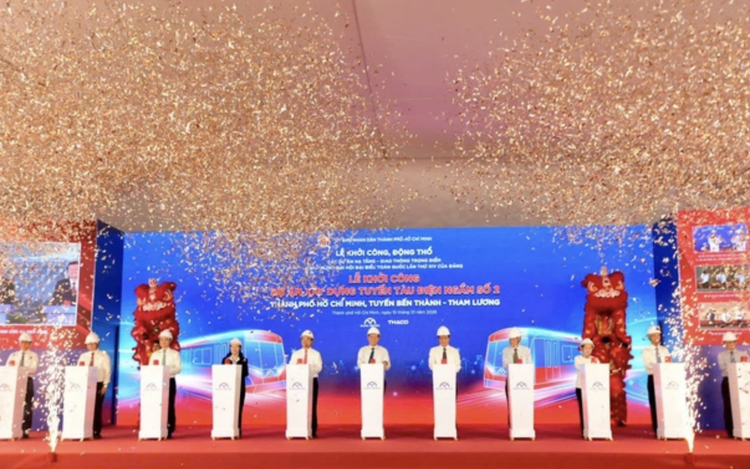
Officials and representatives make a symbolic gesture to break ground on the metro line No. 2 project in Ho Chi Minh City, January 15, 2026. Photo: Le Phan / Tuoi Tre
Key projects include the Ben Thanh-Tham Luong metro line, the city’s second link, the Rach Chiec national sports complex, Phu My 2 Bridge, and Can Gio Bridge.
Rach Chiec national sports complex: regional sports hub
At the eastern gateway of the city, the groundbreaking ceremony for the Rach Chiec national sports complex was held with the attendance of former State President Truong Tan Sang, former permanent member of the Party Central Committee’s Secretariat General Le Hong Anh, Ho Chi Minh City Party secretary Tran Luu Quang, and other officials.
According to the Ho Chi Minh City People’s Committee, the Rach Chiec project is envisioned as a modern national and regional sports center, capable of hosting major domestic and international competitions such as the Southeast Asian Games, Asian Games, and other global sporting events.
It will also serve as a hub for athlete training, sports education, and community fitness activities.
Besides, the project integrates commercial, tourism, and entertainment services, contributing to socio-economic development in eastern Ho Chi Minh City and aiming to become a cultural-sports-tourism destination.
Covering some 186.7 hectares, the project will be developed under a public-private partnership (PPP) model using a build-transfer (BT) contract, with land as payment.
Its total investment is estimated at over VND145.6 trillion (US$5.5 billion).
While the approved implementation period is eight years from the signing of the BT contract, the city and investors are determined to accelerate site clearance and synchronized construction, targeting completion within around five years.
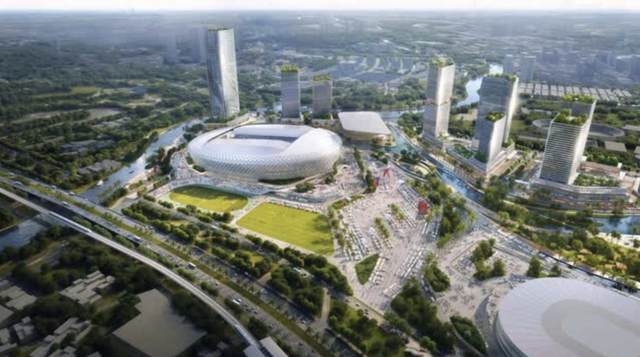
An artist’s impression of the Rach Chiec national sports complex project in Ho Chi Minh City. A highlight of the project is its stadium with a capacity of some 65,000-75,000 seats, an indoor arena for around 18,000 spectators, an aquatic sports center with about 4,000 seats, and a multi-purpose sports center accommodating roughly 10,000 people. Photo: Institute Of Southern Construction Planning
Phu My 2 Bridge: strategic link to Long Thanh Int’l Airport
The municipal administration and Masterise Group held a groundbreaking ceremony for Phu My 2 Bridge, a strategic infrastructure project connecting the city directly to the underway Long Thanh International Airport in neighboring Dong Nai Province.
The bridge will be some 6.3 kilometers long, with eight traffic lanes and a total investment of nearly VND23.2 trillion ($880.6 million).
The project is developed under a BT contract.
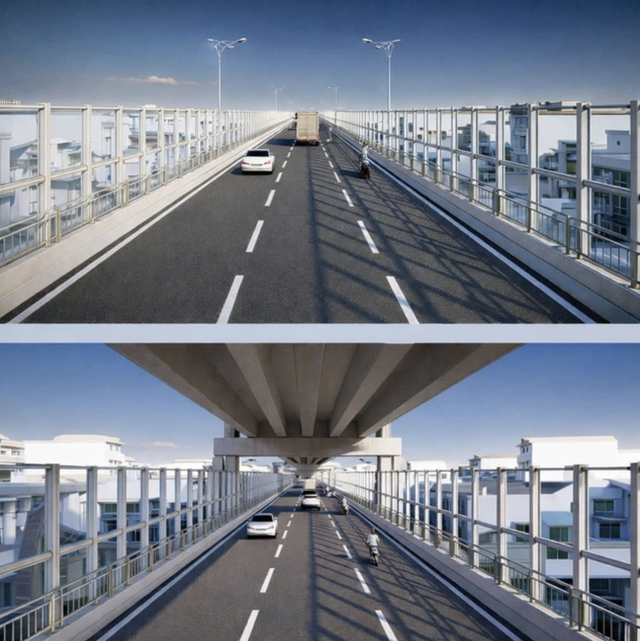
Phu My 2 Bridge is the first project in Ho Chi Minh City to feature multi-level road construction along certain sections, comprising an underground roadway and two elevated levels. Photo: The Ho Chi Minh City Department of Construction
Starting at Nguyen Huu Tho Street in the southern part of the city, the bridge will help ease congestion on the existing Phu My Bridge, National Highway 1, National Highway 51, and Ho Chi Minh City - Long Thanh - Dau Giay Expressway.
It is expected to form a new inter-regional transport axis, reduce travel time and logistics costs, and promote sustainable urban and industrial development in eastern Ho Chi Minh City and the Bien Hoa - Dong Nai area.
Speaking at the ceremony, vice-chairman of the Ho Chi Minh City People’s Committee Hoang Nguyen Dinh emphasized that Phu My 2 Bridge is not merely a transport project, but a symbol of the city’s aspiration to become a modern, well-connected, dynamic, and sustainable metropolis.
The city is committed to close coordination with relevant agencies, contractors, and investors to ensure progress, quality, and transparency, while carrying out site clearance and resettlement in a humane and equitable manner.
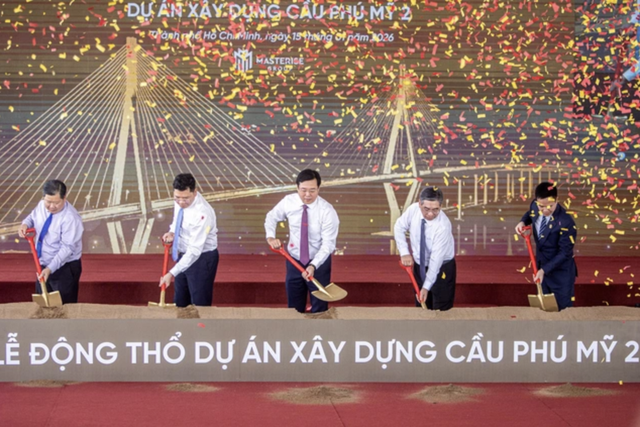
Officials make a symbolic gesture to break ground for the Phu My 2 Bridge project in Ho Chi Minh City, January 15, 2026. Photo: X.A. / Tuoi Tre
Can Gio Bridge: opening the city’s route to the sea
The Ho Chi Minh City People’s Committee and Masterise Group also held a groundbreaking ceremony for Can Gio Bridge.
The bridge will be about 6.3 kilometers long, with six lanes and a total investment of more than VND13.2 trillion ($502.5 million).
Once completed, it is expected to become a new architectural landmark of the city.
Vice-chairman of the municipal administration Nguyen Cong Vinh said the project demonstrates the city’s determination to mobilize social resources for modern, synchronized transport infrastructure, laying a foundation for sustainable growth.
Masterise Group, the investor of the project, is committed to delivering the project with the highest standards, contributing to the city’s infrastructure development.
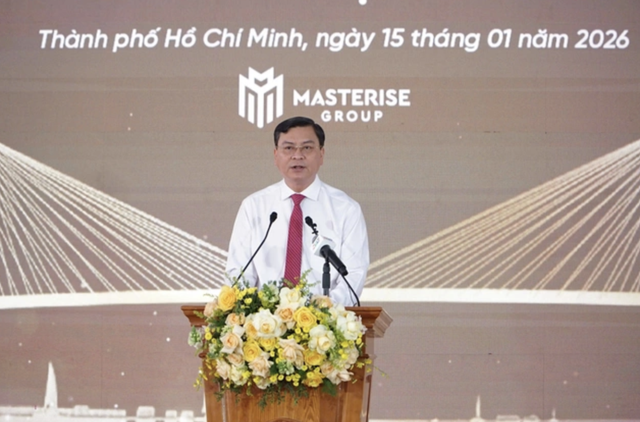
Nguyen Cong Vinh, vice-chairman of the Ho Chi Minh City People’s Committee, speaks at the groundbreaking ceremony for the Can Gio Bridge project, January 15, 2026. Photo: Duc Phu / Tuoi Tre
Highly-anticipated metro line No. 2
The groundbreaking of the Ben Thanh - Tham Luong metro line marked a milestone in Ho Chi Minh City’s urban transport development.
The ceremony was attended by Phan Van Mai, chairman of the National Assembly’s Economic and Financial Committee; Le Quoc Phong, standing deputy secretary of the Ho Chi Minh City Party Committee; Nguyen Van Duoc, chairman of the Ho Chi Minh City People’s Committee; Nguyen Van Dua, former deputy secretary of the municipal Party Committee; former deputy secretary of the municipal Party Committee Vo Thi Dung; and other officials and representatives from Truong Hai Group Corporation, the project’s main contractor.
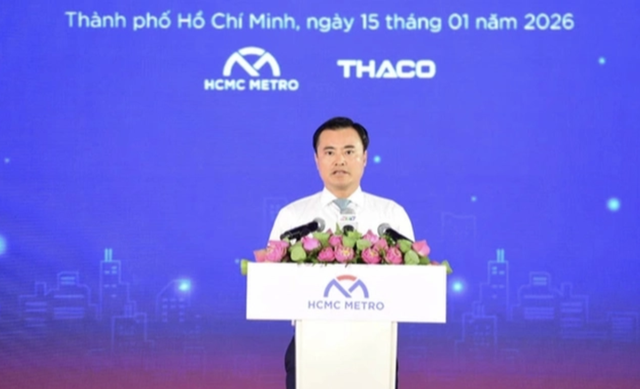
Vice-chairman of the Ho Chi Minh City People’s Committee Bui Xuan Cuong speaks at the groundbreaking ceremony for the metro line No. 2 project, January 15, 2026. Photo: Le Phan / Tuoi Tre
Vice-chairman of the Ho Chi Minh City People’s Committee Bui Xuan Cuong told the ceremony that the city’s rapid urbanization and growing population demand a strong mass transit system, with urban railways as the backbone of public transport.
Metro line No. 2 is especially significant as land clearance has been completed, funding has been secured from the city budget for the 2026-30 period, and special mechanisms have been applied to resolve long-standing procedural and technical bottlenecks.
This is the first project implemented under special mechanisms for urban railway development, reflecting strong decentralization and empowerment from the National Assembly and government.
Metro line No. 2 is positioned as a pioneering project, leading the next phase of urban rail development through advanced mechanisms, transit-oriented development (TOD) planning, and standardized technology and technical regulations that will guide future metro lines across the city.
Cat Lai Bridge: linking Dong Nai and Ho Chi Minh City
Also on Thursday, Dong Nai Province, in coordination with Construction Corporation No. 1 JSC (CC1), broke ground on the Cat Lai Bridge project under a PPP model.
The Cat Lai Bridge project is considered urgent for serving Long Thanh International Airport and improving connectivity with Ho Chi Minh City.
It has a total length of about 11.6 kilometers, including six motorized lanes and two non-motorized lanes.
The project is set to carry a price tag of some VND18.3 trillion ($695 million), excluding construction-period interest.
The bridge will connect Cat Lai Ward in Ho Chi Minh City with Dai Phuoc Commune in Dong Nai.
The project is scheduled to be completed and put into operation in 2029.
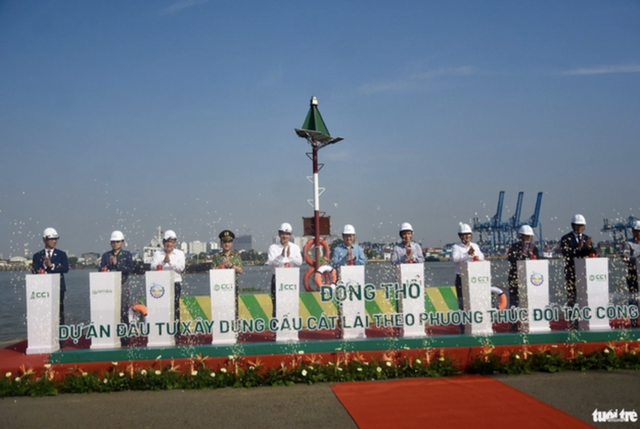
Officials make a symbolic gesture to start work on the Cat Lai Bridge project, January 15, 2026. Photo: A Loc / Tuoi Tre
At the ceremony, CC1 CEO Le Bao Anh highlighted the project’s role in easing congestion at the overloaded Cat Lai Ferry, strengthening regional connectivity, and creating new momentum for socio-economic development in the Southern Key Economic Zone.
Deputy Prime Minister Mai Van Chinh hailed the project as a concrete realization of regional linkage policies and urged close coordination on site clearance and resettlement, ensuring that new living conditions for affected residents are better than before.
On the same occasion, CC1 and Dong Nai Province also started work on the Dong Nai 2 (Long Hung) Bridge project.
Spanning nearly 9.8 kilometers, the bridge will connect Long Phuoc Ward in Ho Chi Minh City with An Phuoc Commune in Dong Nai.
Designed with six motorized lanes and two mixed-use lanes, the project has an estimated investment of nearly VND11.5 trillion ($437.6 million) and is slated for completion in 2028.
Dong Nai also launched several social housing projects, a bridge on National Highway 14, and opened technical traffic on the Dong Nai riverside road, reflecting a broad-based infrastructure push.








Max: 1500 characters
There are no comments yet. Be the first to comment.