


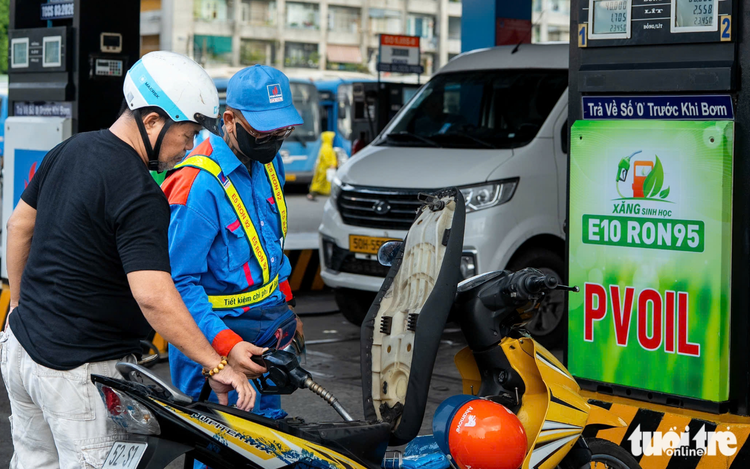
The Ho Chi Minh City People’s Committee has mapped out a comprehensive response plan aimed at ensuring stable supplies of electricity, fuel, and gas under all circumstances. Photo: Huu Hanh / Tuoi Tre
According to Plan No. 213 and assessments by the municipal administration, the main risks to the city’s energy security stem from fluctuations in international supply, disruptions to domestic distribution networks, and limitations in storage, port, and logistics infrastructure.
The administration also identified speculative trading, stockpiling, and the suspension of fuel sales at retail outlets as major concerns that could threaten market stability.
Under the plan, the municipal Department of Industry and Trade is responsible for monitoring developments, assessing risks and advising the municipal administration on activating different emergency response levels.
An early-warning and monitoring mechanism will be established using data collected from businesses, infrastructure operators, specialized agencies, and the administrations of wards, communes, and special zones.
Ho Chi Minh City has identified three levels of risk and developed corresponding response scenarios.
Level 1 applies when the market remains stable and supply chains operate normally, while Level 2 refers to periods of significant market volatility that remain manageable.
Level 3 is classified as an emergency situation when severe shortages or prolonged supply chain disruptions occur.
The transition between response levels will be based on both ‘hard criteria’ and ‘warning indicators,’ including the proportion of fuel stations suspending operations, sharp declines in actual supply volumes, or risks of overload on critical power grids.
In all circumstances, the city will prioritize energy supply to essential sectors such as healthcare, water supply, telecommunications, transportation, logistics, seaports, data centers, and key industrial parks.
In the electricity industry, operators are required to closely monitor demand, proactively implement load-balancing measures, establish backup grid connections, and accelerate the development of key power infrastructure projects.
For fuel and gas distribution, the city has drawn up a list of strategically important retail stations that must maintain uninterrupted operations.
If emergency measures are activated, fuel tankers will receive priority access and flexible traffic arrangements to transport supplies into central areas promptly.
Competent units are in charge of strengthening oversight of retail operations, pricing transparency, product quality and supply availability, and preventing hoarding and restricted sales.
In case of severe market disruption or activation of Level 2 and Level 3 scenarios, the city will coordinate emergency distribution measures while facilitating the movement of fuel and gas tankers into urban areas through flexible traffic management mechanisms.
The municipal administration has assigned police officers and market surveillance officials to intensify inspections and strictly handle violations involving hoarding, restricted sales or the spread of false information that could trigger public anxiety.
In addition, the city plans to expand strategic energy storage infrastructure in key areas including Nha Be, Hiep Phuoc, Long Son and Cai Mep, aiming to boost the resilience of the economy against future energy shocks.








Max: 1500 characters
There are no comments yet. Be the first to comment.