


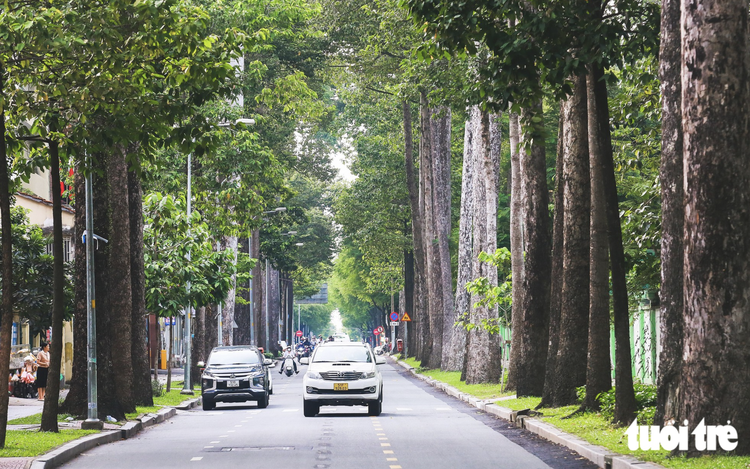
Many rows of large trees along Ho Chi Minh City streets are being preserved to provide shade for residents. Photo: Chau Tuan / Tuoi Tre
Greenery experts have warned that some old trees may appear healthy while their internal structure has weakened.
Even trees in relatively good condition can become vulnerable during thunderstorms and strong winds.
Any replacement, however, needs to be carried out gradually.
A representative of the Center for Traffic and Technical Infrastructure Management, under the municipal Department of Construction, said the city currently manages about 8,000 mature trees.
Around 4,000 of them, mostly in the central area, are decades old and face a relatively high risk of broken branches or uprooting.
Some rows of dipterocarp trees are now around a century old.
As trees age, their ability to produce new shoots declines, making it harder for them to sustain large branches that extend far from the trunk.
According to the representative, about 99 percent of incidents involving fallen trees or broken branches are not caused by cavities inside the trunk.
For uprooted trees, the problem is often linked to damaged root systems.
Roots can be affected by sidewalk excavation, construction work, underground power projects, and concrete paving, all of which restrict root growth.
When the root system weakens while the crown remains large, a tree can be easily uprooted by strong winds.
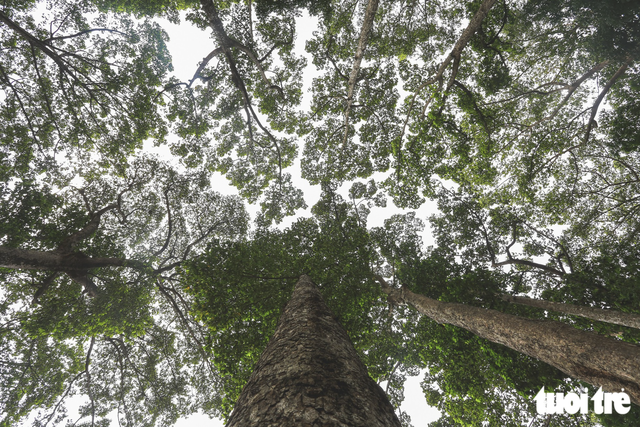
Large trees with broad canopies need to be properly inspected and pruned to reduce the risk of branches breaking during heavy rain. Photo: Chau Tuan / Tuoi Tre
For broken branches, vulnerable points are often found where branches join the trunk or connect with other branches.
These junctions can gradually weaken over time.
High-rise buildings can also alter airflow, creating swirling and twisting forces on tree branches.
During heavy rain and storms, weakened branches may snap.
“Early detection is not simple,” the representative said, noting that some equipment can examine the inside of a trunk but cannot fully assess underground roots or cracks at elevated branch junctions.
As an immediate measure, authorities are reducing tree crowns and lowering the height of high-risk trees to decrease wind resistance.
In the longer term, Ho Chi Minh City plans to deal with about 3,000-4,000 weakened trees over roughly a decade, at a rate of around 300-400 trees a year.
Old trees will be replaced gradually, with new trees planted as others are removed so that entire streets do not suddenly lose their shade.
New plantings will prioritize species whose height and canopy can be more easily controlled in urban streets.
Large trees, meanwhile, are expected to be preserved in parks, ecological areas, and other locations considered suitable for conservation.
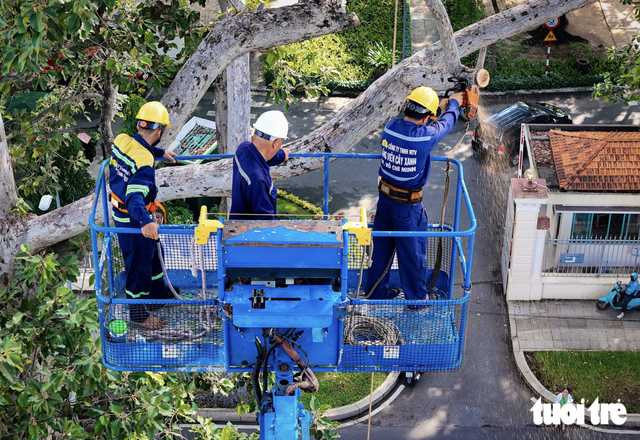
Many mature trees are pruned at Tao Dan Park in Ho Chi Minh City in 2024. Photo: Le Phan / Tuoi Tre
Aging trees, like the elderly
Ho Chi Minh City has many long-established rows of trees along downtown streets such as Tran Quang Khai, An Duong Vuong, and Tran Hung Dao.
With their broad canopies and long branches, these trees have become part of the memories of generations of residents.
Yet their height and size can pose increasing challenges as the city develops and safety requirements become more demanding.
Dr. Dinh Quang Diep of the Vietnam Union of Science and Technology Associations told Tuoi Tre (Youth) online newspaper that the increasing incidence of broken branches and fallen trees in recent years was partly linked to increasingly severe weather, while many trees in Ho Chi Minh City are already very old.
“Old trees break branches or fall, just as elderly people grow weaker with age – the only question is when it will happen,” Dr. Diep said.
Some trees may remain green and healthy-looking on the outside while their branches, trunks or root systems have already weakened.
As a result, visual inspection alone cannot always determine whether a tree is at risk of falling.
As trees grow older, their maintenance also needs to change.
The city should invest in more advanced equipment for inspecting, maintaining and pruning trees, particularly large specimens, Diep said.
Many of the city's trees were planted decades ago, when controlling their height and canopy was not considered as important as it is today.
This reality should be incorporated into modern management practices rather than waiting until trees show obvious signs of danger.
However, Dr. Diep cautioned against assuming that every old tree should immediately be removed as different species have different tolerances for pruning.
Some can have their canopies significantly reduced and still recover well, while others may become weakened or struggle to produce new branches if pruned too severely.
There also needs to be a balance between residents and tree managers.
Residents should understand and accept necessary pruning as a safety measure, while authorities need to determine appropriate timing and pruning methods.
Trees should not be stripped bare during the hot season, when residents still depend on their shade.
In the long term, the doctor said, the city should reclassify its mature trees to determine which can be preserved, which require special care and which can no longer guarantee public safety and therefore need to be replaced.
Trees with particular landscape, historical or heritage value should also be assessed differently from ordinary street trees.
Citywide review of large trees
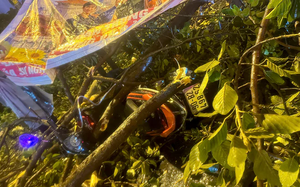
A large tree branch fell onto a bus before bouncing onto the road and hitting a married couple riding a motorbike on An Duong Vuong Street on Friday evening, killing the husband and injuring his wife.
The municipal department said the tree was still fresh and showed no signs of pests or disease.
At the time of the incident, heavy rain, strong gusts, and swirling winds caused the branch to split.
The department has ordered a comprehensive review and detailed inspection of streets lined with large and mature trees, with particular attention to trees considered high-risk.








Max: 1500 characters
There are no comments yet. Be the first to comment.