


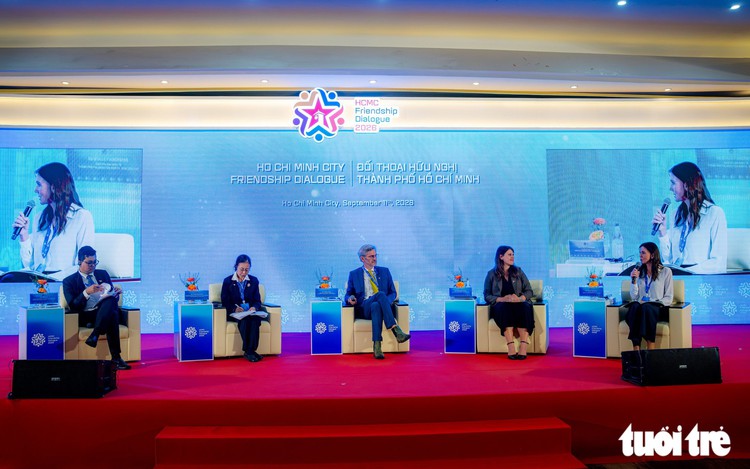
Participants in a panel discussion at the Ho Chi Minh City Friendship Dialogue 2026 in Vung Tau Ward, September 11, 2026. Photo: Ngoc Duc / Tuoi Tre
Organized by the municipal administration from Thursday to Saturday in Vung Tau Ward, with the participation of more than 500 local and international delegates, the dialogue discussed how local governments could foster innovation and encourage businesses to invest in R&D.
Germany: Invest early, connect stakeholders
At a discussion session on Friday, Tobias David, senior adviser and former chief of staff to the mayor of Leipzig, Germany, said cities should not see themselves as innovators but instead act as connectors and facilitators for other parties.
This role requires local governments to make substantial investments early on and wait years to see the results, he said.
Leipzig approved more than €50 million (US$58 million) in 2002 to build BioCity, a technology center and biotechnology business incubator with 20,000 square meters of office and laboratory space on the site of a former fairground in the city center.
Twenty years later, scientist Svante Pääbo, who worked at the facility, received the Nobel Prize in Physiology or Medicine in 2022.
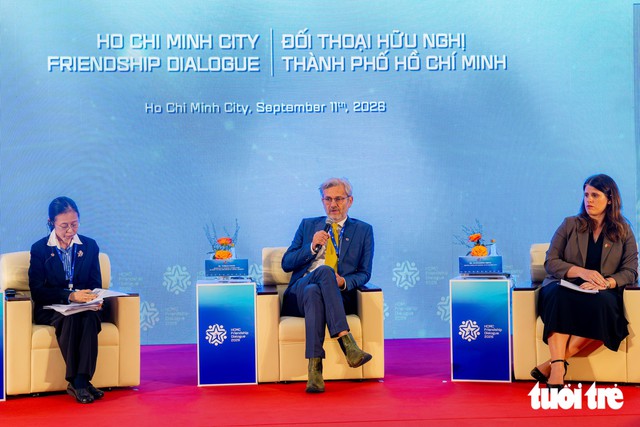
Tobias David (C), senior adviser and former chief of staff to the mayor of Leipzig, Germany, speaks at a panel discussion at the Ho Chi Minh City Friendship Dialogue 2026 in Vung Tau Ward, September 11, 2026. Photo: Ngoc Duc / Tuoi Tre
The investment also generated many other innovation achievements, David said, showing how local governments can provide infrastructure and real-world challenges while businesses develop solutions.
He summarized Leipzig's model as the city connecting stakeholders, public institutions providing infrastructure and practical challenges, and businesses developing solutions.
David also stressed that local governments' role should go beyond signing memorandums of understanding (MoUs).
An MoU can open the door to investment, but it needs to be followed by a clear structure involving legal entities with funding, members and specific responsibilities, he said.
Leipzig has also strengthened its links with Vietnam.
The city has an office on the campus of a university in Ho Chi Minh City and established the German-Vietnamese Hub in August 2026 with co-funding from the city and the state of Saxony.
The hub brings together businesses, state authorities, universities, chambers of commerce, law firms, and consulting companies to facilitate business opportunities between the two sides and support joint R&D before products are brought to the Vietnamese or European markets.
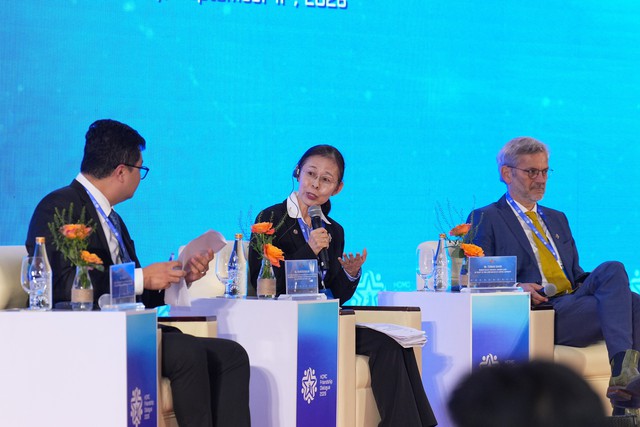
Keiko Murakami (C), deputy director-general for International Policy and Coordination at Japan's Kansai Bureau of Economy, Trade and Industry, speaks at a panel discussion at the Ho Chi Minh City Friendship Dialogue 2026 in Vung Tau Ward, September 11, 2026. Photo: Organizers
Japan: Link funding to cooperation
Japan's Kansai region offers another model, with government funding tied to collaboration among businesses, universities, and public research institutions.
Keiko Murakami, deputy director-general for International Policy and Coordination at the Kansai Bureau of Economy, Trade and Industry, said Japan's Ministry of Economy, Trade and Industry provides up to two-thirds of R&D costs under its GoTech program, while small- and medium-sized enterprises must cover the remaining share themselves.
The requirement is intended to give businesses a sense of ownership and responsibility for project results, rather than simply reduce the government's financial burden, Murakami said.
Companies seeking GoTech funding must also form an alliance with a university or public research institute.
In this way, Japan uses public funding to foster concrete links among research institutes, universities, and businesses instead of relying solely on calls for cooperation, she said.
Tax incentives allowing businesses to deduct part of their R&D costs are another tool, while local governments can employ coordinators specifically tasked with connecting businesses with universities, Murakami added.
The model has also been introduced in Vietnam.
The Kansai Bureau of Economy, Trade and Industry previously supported the development of business-university coordinators in the southern Vietnamese city of Dong Nai, leading to a group that now actively promotes Japanese-Vietnamese business connections.
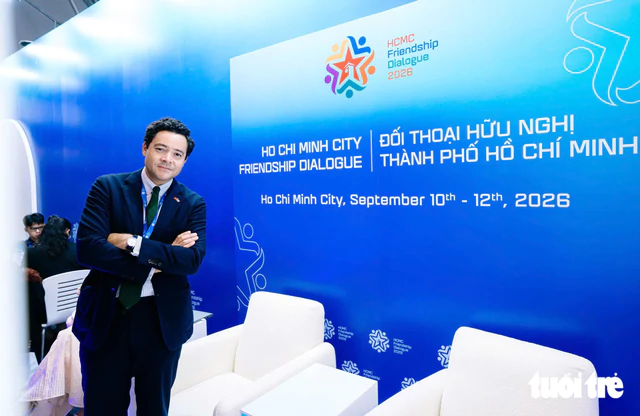
French Consul General Etienne Ranaivoson in Ho Chi Minh City poses for a photo at the Ho Chi Minh City Friendship Dialogue 2026, held from September 10 to 12, 2026 in Vung Tau Ward. Photo: Thanh Hiep / Tuoi Tre
France: Build on existing scientific links
According to French Consul General Etienne Ranaivoson in Ho Chi Minh City, France sees existing scientific and technological links between the two countries as an important asset for further cooperation.
Science and innovation are at the center of the bilateral relationship, Ranaivoson told Tuoi Tre (Youth) online newspaper on the sidelines of the dialogue.
The first channel is direct links between universities in the two countries.
A dual-degree program for training high-level engineers between French engineering schools and the Ho Chi Minh City University of Technology is considered a key component of bilateral scientific cooperation.
The two sides also have joint research programs on sustainable development and efforts to address the root causes of climate change, along with French researchers working in Ho Chi Minh City, Ranaivoson said.
The second channel, which the French diplomat particularly emphasized, is the community of Vietnamese and French-Vietnamese scientists in France.
The community spans older generations and younger people who have recently moved to France, including professors who teach at universities in both Vietnam and France. The community is a valuable asset to both countries.
According to Ranaivoson, the individual career paths of these people help sustain academic and scientific ties between the two countries.
"This is quite distinctive to the relationship between France and Vietnam. France does not have a similar relationship with any other country in the region or the world. It is a valuable asset that should be preserved and further developed," Ranaivoson said.








Max: 1500 characters
There are no comments yet. Be the first to comment.