


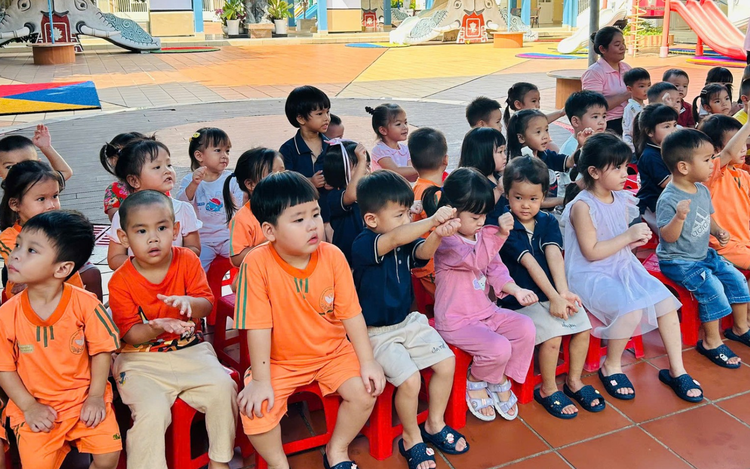
Students at a kindergarten in Ho Chi Minh City. Photo: Thao Thuong / Tuoi Tre
During the ongoing 2026-27 school year, the program is piloted at eligible public preschools as part of a broader strategy to make English a second language in schools.
The three-year pilot will target children aged three to five at public kindergartens, advanced and integrated schools, and other preschools that meet required infrastructure and facility standards.
A key principle of the plan is that participation must be voluntary and based on parental or caregiver consent.
Schools may only organize classes for children whose parents or caregivers have registered them voluntarily.
Participation must not place excessive demands on children or be imposed on families.
The program must also ensure that it does not interfere with the existing preschool education program issued by the Ministry of Education and Training.
Children who do not participate in the pilot must continue to receive the same educational and recreational benefits as other children at their schools.
The program will be funded entirely through contributions from donors, firms and organizations, without using the state budget, and will operate on a non-profit basis.
All related revenues and expenditures outside tuition fees must comply with the financial regulations and guidance of the Ho Chi Minh City Department of Education and Training.
Schools must provide parents with clear and transparent information about all costs before registration.
Learning through play and everyday activities
In terms of curriculum and learning materials, the integrated English pilot must follow the Ministry of Education and Training’s framework for introducing English to preschool children.
Kindergartens use the ‘Integrated English for Preschool’ learning materials that have undergone professional assessment.
The program does not rely on conventional, theory-based instruction.
Instead, it adopts child-centered approaches, including project-based learning and learning through play.
English will be naturally integrated into children’s familiar daily activities.
The frequency of activities should be designed to suit children’s developmental and psychological characteristics.
Children aged 3-4 and 4-5 will have four activities per week, while those aged 5-6 will have six activities per week.
In October last year, the prime minister issued Decision No. 2371 on making English a second language in schools during 2025-35, with a vision to 2045.
The decision provides an important foundation for elevating English from an academic subject to a means of communication.








Max: 1500 characters
There are no comments yet. Be the first to comment.