


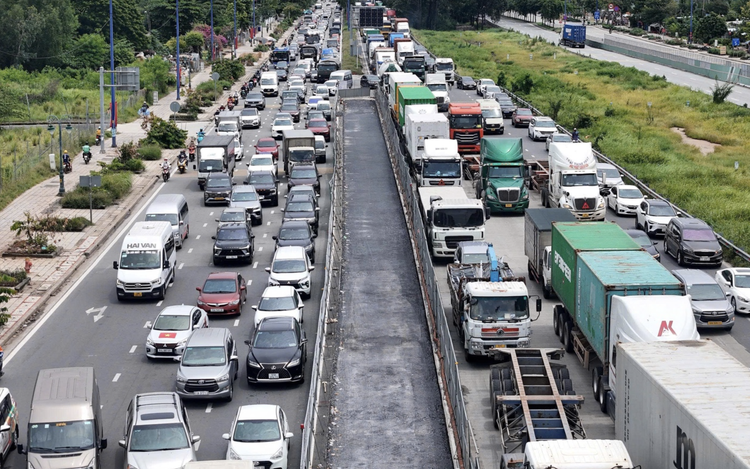
Vehicles snarl up on Mai Chi Tho Boulevard, Ho Chi Minh City. Photo: Van Binh / Tuoi Tre
As part of a national administrative restructuring in July last year, the new Ho Chi Minh City was formed by merging the old city with Ba Ria-Vung Tau and Binh Duong Provinces, raising its population from over 9.9 million to more than 14 million people.
To address congestion hotspots in the city, relevant agencies have submitted a long-term action plan to the municipal administration that aligns with broader strategies to develop high-capacity public transportation and strengthen vehicle emissions control.
The roadmap targets the resolution of five congestion points in 2026, nine more in 2027, and the complete elimination of all 28 hotspots by the end of 2030.
The municipal Department of Construction has categorized congestion-prone areas to tailor solutions to local conditions.
The department aims to carry out several flagship initiatives, including expanding transport infrastructure, promoting public transportation to reduce reliance on private vehicles, and speeding up the development of a metro network capable of carrying large passenger volumes.
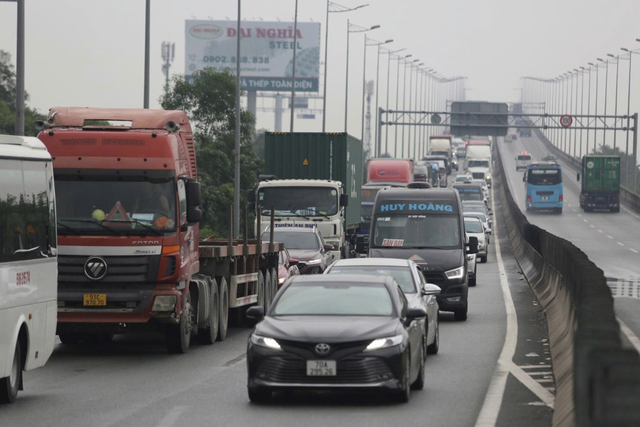
Traffic congestion occurs on Long Thanh Bridge along Ho Chi Minh City-Long Thanh-Dau Giay Expressway. Photo: Van Binh
The department is working with police officers and local authorities to implement non-construction measures, including flexible traffic operations, dynamic signal management, and intelligent transportation systems supported by scientific and technological innovation.
On the infrastructure front, the city has allocated funding to key transportation projects and is preparing to rapidly deploy several additional steel bridges, aiming to complete at least 46 transport projects by 2030.
A more ambitious target involves developing 200 kilometers of urban railway by 2030.
The expansion of the metro system is expected to play a central role in shifting commuters away from private vehicles and easing pressure on major road corridors.
Several innovative traffic management measures introduced in May have already produced encouraging outcomes at some of the city's busiest locations.
Among the most notable examples is Cong Hoa Street, a critical corridor connecting the northwestern gateway with downtown Ho Chi Minh City and Tan Son Nhat International Airport.
Authorities reorganized the roadway by installing steel median barriers to separate the two center lanes from curbside traffic.
Movable barriers were placed at intersections to allow flexible traffic flow during peak periods.
The changes have significantly improved traffic movement, with the long queues that once characterized the corridor largely disappearing.
Similar improvements have been reported along National Highway 51 and around Nguyen Binh Khiem Roundabout.
Transportation experts caution that no single measure can solve Ho Chi Minh City's congestion problem.
Instead, they said that infrastructure expansion, metro development, bus network improvements, intelligent traffic management, and AI-powered operations must be implemented simultaneously.
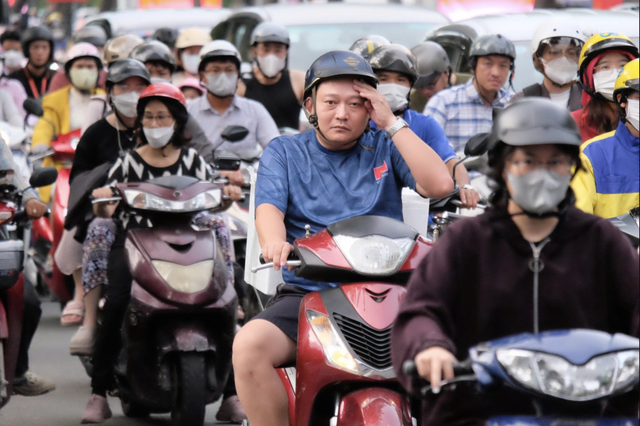
The city has launched plans to develop public transportation, control vehicle emissions, and expand high-capacity transit systems to eliminate 28 traffic congestion hotspots. Photo: Van Binh
Traffic jams cause daily delays for commuters
Since mid-July, major inner-city roads and gateway corridors have continued to experience severe congestion, particularly where road construction projects have reduced available lane capacity.
Heavy traffic is frequently reported along National Highway 1, National Highway 13, An Phu Interchange, Nguyen Tat Thanh Street, Xo Viet Nghe Tinh Street, and streets surrounding Tan Son Nhat International Airport.
During the evening rush hour on July 27, An Phu Interchange, particularly the entrance to Ho Chi Minh City-Long Thanh-Dau Giay Expressway, was overwhelmed by traffic.
Although traffic police continuously adjusted signal timings and directed vehicles, the growing volume arriving from Mai Chi Tho Boulevard and Luong Dinh Cua Street resulted in lengthy delays.
Tour driver Tuan Khai recalled becoming trapped while transporting a family to the coastal tourist destination of Nha Trang.
“Weekend traffic was terrible,” he said.
“We were stuck for more than 15 minutes before entering the expressway. The elderly passengers and children in the vehicle became exhausted waiting.”
Motorcyclist Huynh Thi Ngoc Dong, who commutes daily between Long Truong Ward and Xuan Hoa Ward, described traffic congestion as a persistent obstacle.
“I leave home early every day to avoid being late, but I still get stuck at An Phu Interchange, Hang Xanh Intersection, and Nguyen Binh Khiem Roundabout,” she said.
"The traffic jams make me late for work and late picking up my child.
“It's even worse when it rains. I hope the authorities can expand roads, improve traffic management, and speed up construction projects so road space can be returned to commuters as quickly as possible."








Max: 1500 characters
There are no comments yet. Be the first to comment.