


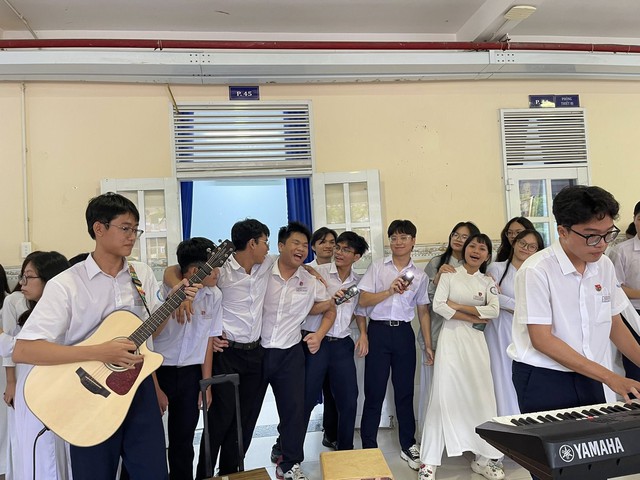
Students participate in phone-free recess at Trinh Hoai Duc High School in Area 2, formerly located in Binh Duong Province and now part of the expanded Ho Chi Minh City. Photo: T.N.
The municipal Department of Education and Training on Tuesday announced a scheme to expand the phone-free recess model across local schools.
The program is meant to promote positive behavior, increase physical activity and face-to-face interaction, and support students’ mental well-being, without imposing outright bans.
The initiative will apply broadly to middle schools, high schools, multi-level schools, continuing education centers, and vocational-continuing education institutions across the city.
Schools are required to develop detailed implementation plans that specify objectives, activities, formats, timelines, resources, task assignments, and coordination mechanisms.
At the core of the model are three groups of recess activities designed to give students meaningful alternatives to passive screen use.
Group 1 focuses on physical and collective activities. Students are encouraged to take part in sports, group games, cultural activities, and school-organized performances.
Group 2 emphasizes quiet activities. Students may choose calmer options such as chess, reading, drawing, resting, or relaxing in designated spaces like benches, gardens, or quiet corners on campus.
Group 3 respects student choice under supervision. Students who need to use mobile phones or electronic devices for learning, research, or organized group entertainment may do so, with teacher permission and only in designated areas.
The department underscored that school administrators or teachers must not confiscate devices or impose punitive measures while implementing the initiative.
Instead, the policy discourages solitary and passive phone use during recess, such as individual gaming, solo social media scrolling, or prolonged video watching without interaction.
Schools were asked to survey students to identify the activities they most want during breaks, ensuring the program reflects student interests and increases participation.
Officials stressed that the goals are behavioral guidance and positive habit formation, not prohibition.
The southern metropolis started trialing the phone-free recess model at 16 middle and high schools and continuing education centers across 16 clusters in October this year.
- REFERENCE MORE








Max: 1500 characters
There are no comments yet. Be the first to comment.