


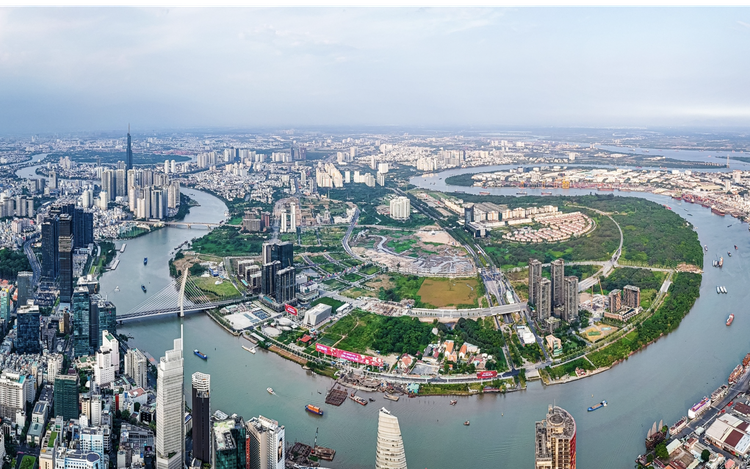
An image shows both banks of the Saigon River, with central Ho Chi Minh City on one side and the Thu Thiem New Urban Area on the opposite bank, where key projects are being implemented, including the Ben Thanh - Thu Thiem section of metro line No. 2, the central square and Ho Chi Minh City administrative center complex, and the renovation of the Ho Chi Minh Museum – Ho Chi Minh City branch. Photo: Chau Tuan / Tuoi Tre
Under the Labor Code, public employees are entitled to two days for the Reunification Day and International Workers’ Day holiday.
In 2026, the two official days off fall on Thursday and Friday. Combined with the weekend, workers will have a four-day break from April 30 to May 3.
The groundbreaking ceremony was held in a hybrid format, with the main site located at the intersection of Nguyen Co Thach and Mai Chi Tho Streets in An Khanh Ward, alongside satellite locations at Nha Rong (Dragon) Wharf in Xom Chieu Ward and Xuan Thoi Son Commune.
The city’s simultaneous launch of projects focuses on large-scale transport infrastructure and public space development.
Key projects include the Ben Thanh - Thu Thiem section of metro line No. 2, a central square and administrative center complex, the renovation of the Ho Chi Minh Museum - Ho Chi Minh City branch, and the International University Urban Area in Xuan Thoi Son Commune.
Also, the city completed procedures to select an investor for the Can Gio international transshipment port.
According to the municipal People’s Committee, the coordinated groundbreaking reflected the city’s determination to mobilize social resources, accelerate strategic infrastructure development, and expand urban space while improving residents’ quality of life.
The projects span multiple sectors, including mass transit infrastructure, civic and administrative spaces, cultural preservation, and historical heritage development, forming part of the city’s vision of a modern, civilized, and dynamic urban center.
The main ceremony at the Thu Thiem New Urban Area in An Khanh Ward began at 9:35 am and was attended by several senior municipal leaders.
Speaking at the event, chairman of the municipal administration Nguyen Van Duoc emphasized recent guidance from Party General Secretary and State President To Lam, highlighting the directive that Ho Chi Minh City must lead the way in turning strategic resolutions into reality, with an emphasis on action, accountability, and public service.
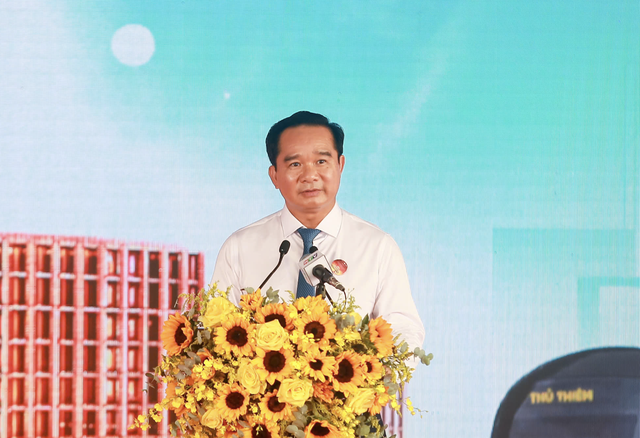
Chairman of the Ho Chi Minh City People’s Committee Nguyen Van Duoc speaks at the groundbreaking ceremony for four major projects, April 29, 2026. Photo: Chau Tuan / Tuoi Tre
He described the simultaneous groundbreaking as a concrete commitment by the city’s leadership and people to build a modern, civilized metropolis with strong development aspirations.
These projects will help shape a megacity with regional and international stature, he said.
Also, they will establish a modern and transparent governance space that better serves the people, a public transport infrastructure system that is highly connected and plays a leading role, and cultural institutions that harmoniously combine contemporary development with the preservation of historical and cultural values.
He also called on investors to ensure quality, progress and efficiency, and urged municipal departments and relevant agencies to adopt more proactive and decisive approaches to avoid delays.
The chairman pledged to accompany stakeholders throughout the entire process, resolving difficulties and obstacles to the end, to firmly pursue administrative reform, to improve the effectiveness and efficiency of public service implementation, and to ensure that no barriers hinder the pace of development.
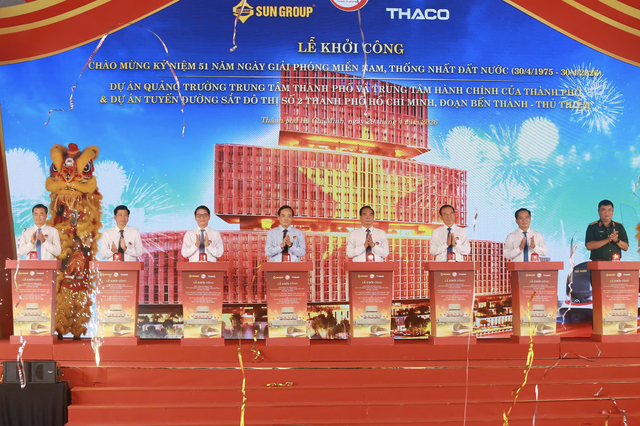
Officials make a symbolic gesture to break ground on four major projects in Ho Chi Minh City, April 29, 2026. Photo: Chau Tuan / Tuoi Tre
Major projects help reshape the city
Among the highlighted developments is the Ben Thanh - Thu Thiem metro stretch, some six kilometers long and fully underground with six stations.
The section will form a key transport axis connecting Tan Son Nhat International Airport, the city center, Thu Thiem, and Long Thanh International Airport in neighboring Dong Nai Province.
The project will be carried out under a public–private partnership model with a total investment of about VND36.7 trillion (US$1.4 billion) and is expected to be completed by the fourth quarter of 2030.
Also in Thu Thiem, the central square and administrative complex spans nearly 47 hectares with an investment of around VND29.6 trillion ($1.1 billion).
It will feature a square, a 30-story administrative building, a 2,000-seat opera house, and a 12-hectare central lake park.
The complex will host major political and cultural events.
The Ho Chi Minh Museum renovation project, located at Nha Rong Wharf, covers more than 1.4 hectares with an investment of some VND 68.7 billion ($2.6 million).
Completion is scheduled for August 2026, with the goal of enhancing the riverside cultural landscape along the Saigon River.
Tran Minh Son, vice-chairman of Sun Group, which is the investor of the project, pledged to complete the project with high architectural and technical standards.
In the city’s northwest, the International University Urban Area in Xuan Thoi Son Commune spans around 880 hectares with a total investment of VND59 trillion ($2.2 billion).
The project is envisioned as a green, ecological, and knowledge-based urban zone, with over 183 hectares for education and research.
Speaking at the ceremony to break ground for the International University Urban Area, Le Khach Hiep, vice-chairman of Vingroup, said that the area is being developed with the aspiration of becoming a new symbol of Vingroup and Vinhomes in the northwestern area of Ho Chi Minh City–a place where large-scale ecological spaces are harmoniously integrated with a global knowledge ecosystem.
The project is expected to contribute to the promotion of science and technology development, innovation, and digital transformation, thereby forming a leading knowledge-based urban area in the region and creating a foundation for long-term, sustainable growth.
The International University Urban Area not only marks a strong transformation in the urban landscape of the northwestern area, but also helps position the area as a breakthrough development hub of the city, attracting sustainable population movement and settlement.
On the same day, Ho Chi Minh City formally approved the investor for the Can Gio international transshipment port, which covers 571 hectares and carries a price tag of nearly VND 128.9 trillion ($4.7 billion).
The port is designed to handle 4.8 million TEU by 2030, developed in two phases, and positioned as a green and smart logistics hub.
Nguyen Le Chon Tam, CEO of Saigon Port JSC, a member of the consortium investing in the Can Gio international transshipment port, highlighted that the Can Gio port is located on a strategic maritime route for both regional and global shipping networks.
Once completed, it is expected to create a breakthrough in Vietnam’s port system development and enhance the country’s position on the global logistics map.








Max: 1500 characters
There are no comments yet. Be the first to comment.