



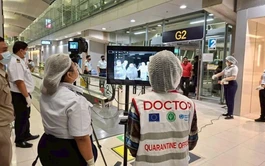
Passengers at Tan Son Nhat International Airport in Ho Chi Minh City, where remote temperature screening is applied to help detect potential Nipah virus cases at an early stage. Photo: Chau Tuan / Tuoi Tre
In line with guidance from the Ministry of Health, the municipal administration on Monday issued a Nipah virus prevention and control plan to enable early detection of suspected infections and protect public health against the virus, which can carry a mortality rate of up to 75 percent.
The move follows recent reports of Nipah virus cases in India and a fatal infection in Bangladesh.
Authorities have tightened disease control measures at entry points as international travel rises ahead of the Lunar New Year holiday, which lasts a week from February 17, and the early 2026 festival season.
Under the plan, surveillance at Tan Son Nhat International Airport and maritime ports will be strengthened while maintaining smooth passenger travel.
Remote temperature screening systems are required to operate continuously to detect arriving passengers with fever and help identify suspected infections at an early stage.
Health authorities are also collecting detailed epidemiological information from travelers showing fever or respiratory symptoms, particularly those arriving from or transiting through areas considered at higher risk for Nipah virus transmission.
The measures are designed to ensure early detection, rapid isolation, and timely handling of suspected or confirmed cases, while protecting public health and frontline medical workers.
Beyond the airport, the city is reinforcing community based surveillance and strengthening rapid response teams at city and ward levels to support epidemiological investigations, monitor close contacts, and control any potential spread.
The healthcare system has been instructed to review preparedness plans, strengthen staffing, and ensure adequate medical supplies to safely receive and treat suspected or confirmed cases.
Medical facilities must strictly follow personal protective measures and infection prevention protocols to minimize risks to healthcare workers.
Public communication efforts are also being expanded to help residents recognize early warning signs and take preventive action, while authorities monitor and address misinformation related to the disease.
The municipal Department of Health has been designated as the standing agency responsible for coordinating epidemiological surveillance at entry points and in the community, organizing treatment pathways, developing response scenarios, and reporting developments.
As part of the coordinated response, food safety authorities are monitoring risks related to food, particularly animal derived products.
Cultural and sports agencies are required to work with health authorities to spread information about Nipah virus disease and adjust plans for large public gatherings if needed.
Nipah virus is classified by the World Health Organization (WHO) as a high-risk pathogen because of its severity and limited treatment options.
The bat-borne zoonotic RNA virus can spread from animals to humans and, in some cases, between people through close contact.
Its incubation period typically ranges from 4 to 14 days.
Infected individuals often first develop fever, headache, muscle pain, vomiting, and sore throat.
Symptoms can progress to dizziness, drowsiness, altered consciousness, and neurological signs of acute encephalitis.
Some patients may also develop severe respiratory illness, including pneumonia and acute respiratory distress.
In severe cases, encephalitis and seizures can lead to coma within 24 to 48 hours.
According to the WHO, previous outbreaks have recorded case fatality rates between 40 and 75 percent.
With no licensed vaccine, no clinically approved antiviral drugs, and no immunotherapy currently available, treatment focuses on supportive care and strict infection control.
Globally, Nipah virus has caused sporadic outbreaks since it was first identified in 1998 among pig farmers in Malaysia and named after the village where the first case was detected.
Beyond Malaysia, cases have since been reported in Bangladesh, India, the Philippines, and Singapore, the WHO said, adding that the southern Indian state of Kerala became a hotspot in 2018.








Max: 1500 characters
There are no comments yet. Be the first to comment.