



Foreign tourists visit the Saigon Central Post Office. Photo: Quang Dinh / Tuoi Tre
"In the coming period, the Department of Tourism will continue to closely coordinate with relevant agencies and local authorities to strengthen reviews and inspections of tourism accommodation business activities across the city," Nguyen Thi Le, deputy head of the Tourism Accommodation Management Division under the Ho Chi Minh City Department of Tourism, said at a press briefing of the city's socio-economic on Thursday.
"This will help ensure timely guidance, corrective measures, and handling of violations in accordance with the law," she added.
Le noted that many travelers today seek longer stays that combine leisure and remote work, with a preference for accommodation offering privacy, flexibility, and a more home-like environment.
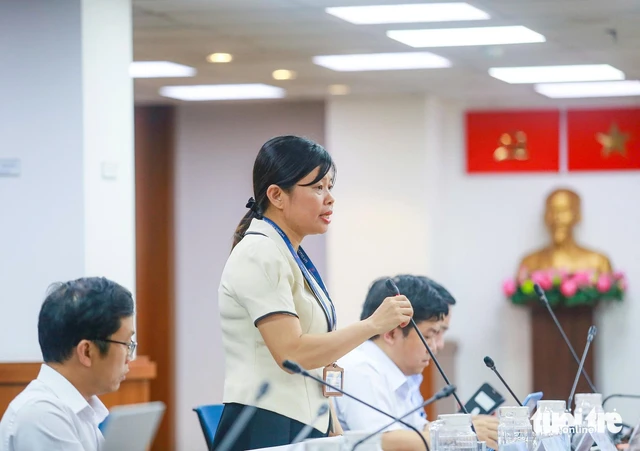
Nguyen Thi Le, deputy head of the Tourism Accommodation Management Division under the Ho Chi Minh City Department of Tourism, speaks at a press briefing on May 14, 2026. Photo: Chau Tuan / Tuoi Tre
As a result, the short-term apartment rental model has become increasingly popular, reflecting both the dynamism of the tourism market and Ho Chi Minh City's growing international integration.
However, the rapid and largely spontaneous development of this model in recent years has created challenges for state management.
These include issues related to business conditions for tourism accommodation services, business registration and taxation, public security and order, fire prevention and safety, residency management, environmental protection, and safeguarding the rights and interests of residents living in apartment buildings.
According to the Ho Chi Minh City Department of Construction, disputes have emerged at several apartment buildings in recent years, including the Ha Do Centrosa apartment complex in Hoa Hung Ward.
The conflicts mainly stemmed from short-term guests overusing shared facilities, affecting building management and operations.
In April 2026, the Ho Chi Minh City People's Committee issued regulations on the management and use of apartment buildings in the city.
Under the new rules, tourist apartment rentals within apartment buildings must register as tourism accommodation establishments and comply with relevant legal requirements.
So far, however, the Department of Tourism has recorded only a limited number of notifications from apartment-based accommodation providers regarding tourism business operations.
Most organizations and individuals are still reviewing legal conditions, completing paperwork, and assessing their ability to meet the new requirements before formally registering under the updated regulations.
The Department of Tourism has proposed accelerating the completion of a synchronized legal framework and called on central authorities to issue clearer guidance to resolve inconsistencies between the Housing Law and the Tourism Law.
In particular, authorities are seeking clearer regulations on apartment rental businesses in urban areas, including which areas may permit tourism apartment operations, what scale of apartment units would be allowed, and whether consent from building management boards or residents should be mandatory.
The city also proposed requiring cross-border booking platforms such as Airbnb, Agoda, and Booking.com to list and accept reservations only from properties that meet legal requirements, including business licenses, tax registration, and relevant tourism approvals.











Max: 1500 characters
There are no comments yet. Be the first to comment.