


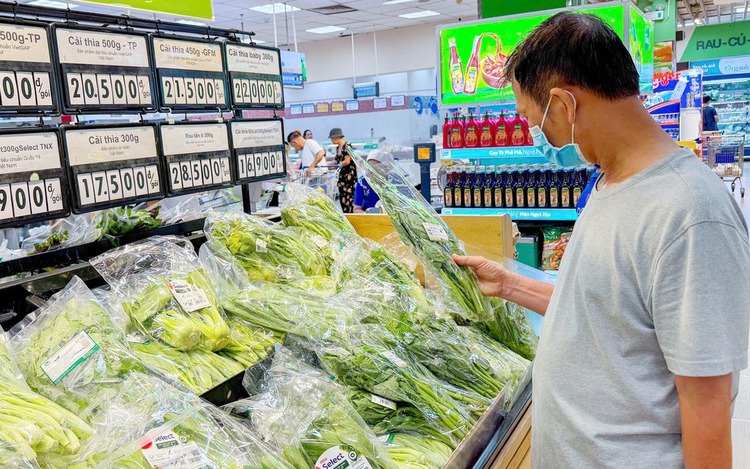
A shopper examines a pack of vegetables labeled with traceability codes that allow consumers to trace their origin at a supermarket in Ho Chi Minh City, southern Vietnam. Photo: Huu Hanh / Tuoi Tre
Under a newly issued directive and a 2026-30 roadmap for strengthening traceability, the city aims to standardize traceability practices, improve interprovincial coordination, and build a centralized database to enhance transparency and food quality control.
While traceability systems have been piloted for years, officials acknowledge that implementation remains uneven, particularly in traditional wholesale markets and for fresh produce, where documentation is still largely manual and fragmented.
Stricter enforcement, tech-based systems
Authorities said the new policy requires stricter enforcement of origin labeling and traceability standards, particularly for high-risk food categories such as pork, poultry and eggs, which account for a significant share of past food safety incidents.
The plan requires supermarkets, convenience stores, and wholesale market operators to accept only products that can be verified through technology-based systems, instead of relying solely on paper invoices and manual declarations.
The 2026–30 roadmap also calls for a unified traceability database linked to the national product and goods traceability portal, enabling data sharing across provinces and throughout the supply chain.
It also strengthens monitoring across the production chain, from breeding and feed to veterinary drug use, slaughtering, transportation and retail, to ensure end-to-end oversight.
Officials said the measures aim to close accountability gaps, improve recall capacity during food safety incidents, and gradually standardize compliance across the system.
However, they noted that traceability remains partly voluntary, limiting effectiveness in a fragmented market dominated by small-scale suppliers and intermediaries.
Wholesale markets struggle with manual records, fragmented traceability
At major wholesale hubs such as Hoc Mon and Thu Duc markets, large volumes of agricultural goods continue to enter the city each night, but traceability remains inconsistent and largely dependent on manual records.
Pork is among the few categories with relatively clear traceability, using ear-tag systems and inspection procedures before entering the market, while vegetables, fruits, and other fresh produce are mostly tracked through handwritten logs and basic invoices.
Traders said produce is often sourced from multiple small farms, collected by intermediaries and consolidated before transport to the city, making it difficult to track the exact origin of each batch.
Some vendors acknowledged that invoices are often generic and do not accurately reflect precise quantities or specific farming locations, especially when goods are mixed from different suppliers.
Informal trading points around wholesale markets further complicate oversight, as many operate with limited monitoring and cannot provide clear origin information when questioned.
At Thu Duc wholesale market, participants said administrative compliance has improved, particularly for taxation purposes, but farm-level traceability remains difficult under current supply chain conditions.
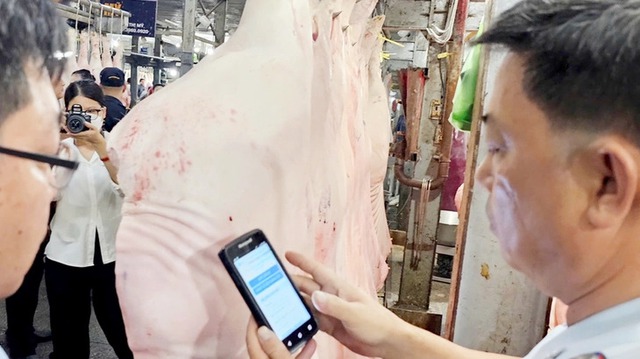
A man uses his smartphone to trace the origin of pork at a wholesale market in Ho Chi Minh City through an identification ring attached to the product. Photo: N. Tri / Tuoi Tre
In the retail sector, supermarkets in Ho Chi Minh City have adopted traceability tools such as QR codes and blockchain-based systems, mainly for packaged and branded products including processed meat, eggs, and dry goods.
These systems provide origin information and, in some cases, details on production processes and distribution history when consumers scan the codes.
However, retailers said such technologies are largely effective only for standardized packaged goods with controlled supply chains, while bulk fresh produce such as vegetables and fruits remains difficult to trace with the same precision.
For loose goods, traceability still relies on supplier invoices and internal records, which can become incomplete or inconsistent when products are aggregated or repackaged from different sources.
Trust gaps, system challenges hinder full traceability adoption
Despite the availability of traceability tools, consumer engagement remains limited, with many shoppers saying they rarely scan QR codes and instead rely on brand familiarity, price and general trust when selecting food products.
Some consumers also questioned the reliability of traceability data, noting that even when information is available, it is difficult to verify whether it reflects actual production conditions.
Industry experts said this trust gap remains a key barrier to building an effective traceability ecosystem, even as digital systems continue to expand.
A food service supplier noted that institutional buyers such as schools are increasingly requiring traceability documentation, but most suppliers still rely on general invoices rather than detailed digital tracking data, raising concerns over oversight gaps and potential inconsistencies in reported inputs.
Officials involved in the city’s traceability program said future plans include integrating artificial intelligence to improve risk detection, enhance data analysis, and provide early warnings of potential food safety threats.
They stressed that technology alone is not sufficient, adding that effective traceability requires close coordination among multiple agencies, including veterinary services, food safety regulators, and market management forces.
Many businesses also remain hesitant to adopt full traceability systems due to added costs and operational complexity, particularly when participation is not yet mandatory.
Despite ongoing initiatives such as responsibility-based labeling and interprovincial supply chain cooperation programs, officials acknowledged that ensuring consistent, end-to-end traceability across Ho Chi Minh City’s complex food distribution system remains a long-term challenge.
This challenge is especially evident in traditional wholesale markets, where informal trading and incomplete record-keeping remain widespread.








Max: 1500 characters
There are no comments yet. Be the first to comment.