


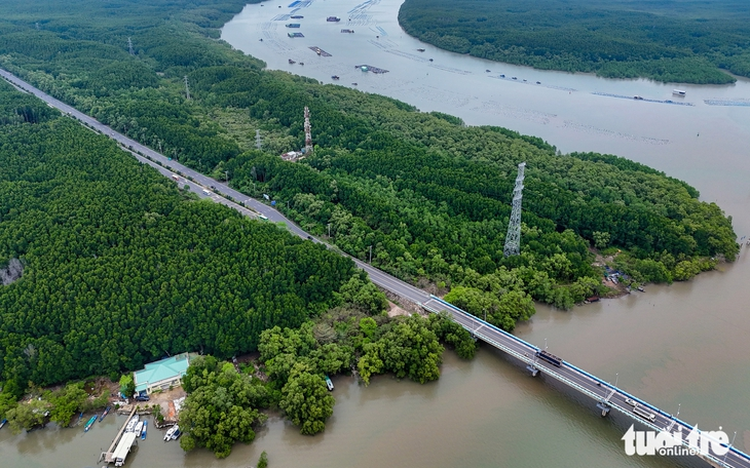
Ho Chi Minh City aims to resolve major environmental hotspots by 2030 and build a clean and healthy living environment by 2045 while working toward net-zero emissions. Photo: Chau Tuan / Tuoi Tre
At a socioeconomic press briefing on Thursday, Ngo Nguyen Ngoc Thanh from the municipal Department of Agriculture and Environment provided details of a draft action program to implement the Party Central Committee’s conclusion on environmental protection and proactive climate change response.
The draft sets a 2030 goal of strengthening environmental governance and climate change response, tightly controlling major sources of pollution, and completely addressing pressing environmental hotspots.
The draft outlines 18 targets across six areas: financial resources for environmental protection, pollution control and environmental quality improvement, nature conservation, disaster prevention and climate change response, greenhouse gas emissions reduction, and green growth.
It proposes higher targets than national benchmarks for solid waste management. In particular, the collection and treatment rate for household solid waste in both urban and rural areas is targeted at 100 percent, while direct landfilling of solid waste would be kept below 10 percent.
The draft identifies nine major groups of tasks centered on three key pillars.
The first focuses on addressing pressing environmental problems, including air pollution, pollution in canals and waterways in the inner city, and the sorting and treatment of solid waste.
The second centers on proactively adapting to climate change and reducing disaster risks.
The third promotes the green transition, circular and low-carbon economies, and greater integration of digital transformation and international environmental cooperation.
The draft also identifies the development of green spaces and urban greenery as a major, long-term task.
This goes beyond targets for green buildings or forest coverage to include expanding parks and tree-covered areas, increasing permeable urban surfaces, and restoring green spaces along canals, waterways and other urban bodies of water.
The management, protection and development of trees and green spaces will be carried out in a coordinated manner and integrated with urban and rural planning, climate change adaptation, and efforts to improve the city’s environmental indicators.








Max: 1500 characters
There are no comments yet. Be the first to comment.