


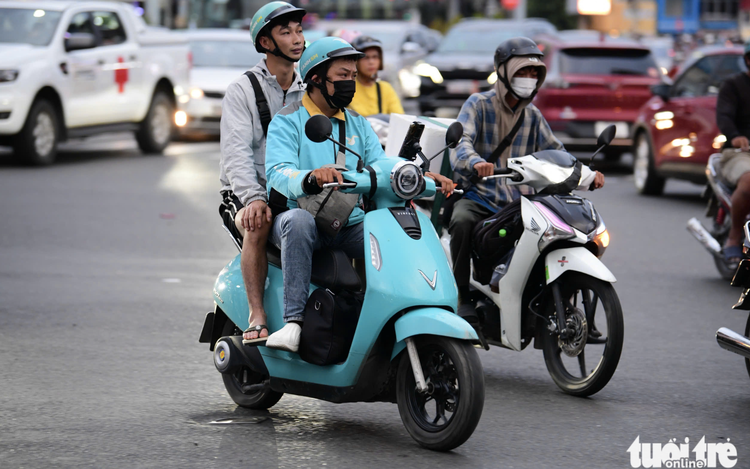
Ho Chi Minh City has an estimated 100,000 electric motorbikes, around 300 fast-charging poles, and some 50 battery-swap points. Photo: Quang Dinh / Tuoi Tre
Over the past few months, the department has received multiple proposals from Great Wealth Trading Service Company and V-Green Global Charging Station Development JSC, seeking to develop electric vehicle charging stations and battery-swap infrastructure.
Under the proposals, charging stations and battery-swap cabinets would be installed at depots, parking areas, bus stations and stops, as well as along sidewalks and near public lighting poles, to serve electric and green-energy vehicles.
The department has coordinated with relevant units to conduct on-site surveys of several sidewalk locations deemed suitable for temporary use for installing battery-swap cabinets for electric motorbikes.
Ho Chi Minh City currently has an estimated 100,000 electric motorbikes, around 300 fast-charging poles, and some 50 battery-swap points.
Existing infrastructure remains insufficient to meet demand.
Meanwhile, international recommendations suggest a ratio of one charging pole or battery-swap cabinet for every 50 electric motorbikes.
Most residents in the city charge electric motorbikes at home or in apartment buildings, posing potential risks related to electrical safety and fire prevention.
According to the department, as Vietnam targets net-zero emissions before 2050 in response to global climate change, demand for electric vehicles, particularly electric motorbikes, is rising rapidly.
As such, developing a public charging and battery-swap infrastructure network has become an urgent requirement.

The department noted that countries such as China and several Southeast Asian nations have successfully deployed an integrated model of charging stations and battery-swap cabinets at streetlight poles and public facilities, as well as on sidewalks.
Based on these considerations, the department proposed the municipal administration approve the temporary use of sidewalks to install e-motorbike battery-swap cabinets at existing public lighting poles, and on sidewalks and median strips, within the protected corridor of road infrastructure.
Fees for sidewalk use would be collected in accordance with Resolution No. 15/2023 of the Ho Chi Minh City People’s Council, which regulates charges for the temporary use of roadways and sidewalks.
The fee collection would be conducted concurrently with the issuance of construction permits.
In addition, the department would serve as the lead unit, coordinating with the city’s Department of Public Security and other relevant agencies to develop and implement installation plans, negotiate locations, issue construction permits, and collect sidewalk-use fees in line with regulations.
The department would also build criteria, conditions, and a list of eligible roads with sidewalks and medians suitable for installation.
All activities must ensure traffic safety, electrical safety, fire prevention and fighting, and urban aesthetics.
The municipal Department of Public Security, the municipal Department of Industry and Trade, Ho Chi Minh City Power Corporation, and ward- and commune-level authorities would be tasked with coordinating and facilitating implementation, including site surveys, design planning, installation, power supply, operation and maintenance, fire safety, and public order.
Firms plan large-scale deployment
Great Wealth had previously proposed installing battery-swap cabinets at existing public lighting poles, committing to deploy 10,000 cabinets along roads with suitable sidewalks.
The firm plans to complete the installation in the first quarter of 2026 to support the city’s green transition for electric motorbikes.
V-Green and Great Wealth also suggested installing battery-swap cabinets on sidewalks.
V-Green pledged to install 10,000 battery-swap cabinets along eligible roads by the end of the first quarter of 2026, aiming to facilitate green mobility for more than 400,000 ride-hailing and delivery drivers in Ho Chi Minh City.
Meanwhile, Great Wealth desires to install battery-swap cabinets on sidewalks near bus stops.
Both companies stated they would fully finance, install, operate, and maintain the systems using their own capital.
They were also committed to relocating or dismantling the facilities at their own expense, without compensation or complaints, when competent authorities require removal, relocation, or suspension of operations.








Max: 1500 characters
There are no comments yet. Be the first to comment.