


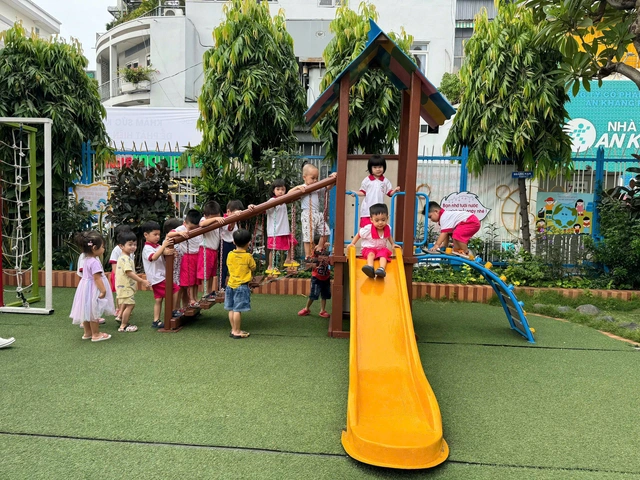
Preschool children play during activity time at Huong Sen Kindergarten in Duc Nhuan Ward, Ho Chi Minh City. Photo: N.T.
According to the southern metropolis’s newly issued plan for improving preschool education quality in urban areas and industrial zones in the 2026-35 period with a vision to 2045, the city will allocate land for new preschool facilities based on approved zoning, especially in new urban areas, resettlement zones, and industrial parks.
The initiative seeks to diversify early education models suited to the city’s population density and local conditions.
The plan highlights the city’s priority to repurpose surplus government buildings, whose space was freed up following a nationwide administrative restructuring drive earlier this year, as new preschool sites.
The city will encourage the growth of non-public preschools and pilot public-private partnership models under the operations-and-management framework, ensuring tuition levels remain affordable for workers.
The plan also outlines several measures to improve care for children aged 6-36 months, such as providing specialized training for teachers, upgrading facilities and teaching equipment, offering financial support for teacher training at private preschools in industrial zones, and giving parent-education materials for worker families.
The city will also encourage businesses to invest in preschools inside industrial parks and provide childcare subsidies for employees.
Additional support may come from international projects and non-governmental organizations to equip classrooms with teaching materials and playground resources.

Children attend a swimming lesson at Huong Sen Kindergarten in Duc Nhuan Ward, Ho Chi Minh City. Photo: N.T.
Tran Thi Dieu Thuy, vice-chairwoman of the city’s administration, said the program will apply to all designated urban areas as well as all industrial parks, export processing zones, high-tech zones, and industrial clusters where worker communities are concentrated.
Beneficiaries include preschool children, school administrators, teachers, staff, parents, and all early-education facilities.
The program aims to guarantee safe, equitable, and high-quality early-education services.
From 2026 to 2030, the city targets full compliance with preschool care and education standards at all urban preschools.
At least 80 percent of children aged 6-36 months who are children of industrial-zone workers and need childcare should have access to preschools. The figure is expected to reach 100 percent in the 2031-35 phase.
For the workforce, the city aims that by 2030, 80 percent of urban preschool administrators and teachers will access digital professional-development resources, while all of the teachers in industrial zones will receive annual training.
To ensure effective implementation, the city asked relevant departments and local administrations to develop localized action plans and integrate early-education goals into annual socio-economic development plans.
The city also emphasizes communication efforts to improve parenting practices and ensure child safety.
The municipal Department of Education and Training was told to coordinate with other agencies and local administrations to monitor progress to ensure synchronized execution. The goal is to expand access to childcare for workers and strengthen social welfare across the city.
Several provinces in the country also adopted similar moves.
In neighboring Dong Nai Province, whose new administrative boundaries include old Dong Nai and Binh Phuoc Provinces, a vacant government building in Binh Phuoc is expected to be transformed into a second campus of Dong Nai University.
This plan was discussed during a meeting held last week between a Dong Nai University delegation and provincial officials, according to VOV.
In the north, the expanded Hung Yen Province, established by merging former Hung Yen and Thai Binh Provinces, in September converted a surplus government building into a new campus for Tran Phu Middle School, helping the local education sector to ease a long-time shortage of classrooms, the Vietnam News Agency reported.
Earlier this year, Vietnam began streamlining its state apparatus and administrative system by merging many ministries and agencies; reducing 64 provinces and cities to 34; ending operations of district-level administrative units; and creating a two-tiered local government model comprising provincial- and ward/commune-level units.









Max: 1500 characters
There are no comments yet. Be the first to comment.