



Nguyen Nguyen Phuong, deputy head of the Ho Chi Minh City Department of Industry and Trade, speaks at a meeting discussing a ‘Green Tick of Responsibility’ model for school kitchens, May 6, 2026. Photo: Nhat Xuan / Tuoi Tre
The plan was announced on Wednesday during a meeting organized by the municipal Department of Industry and Trade to launch the ‘Green Tick of Responsibility’ meal model in schools across the city.
The initiative will mark the next phase of a quality control program that has been implemented in the retail distribution sector since early 2024.
Speaking at the meeting, Nguyen Nguyen Phuong, deputy director of the department, said the program has helped establish higher standards of accountability among businesses and suppliers participating in the food supply chain.
Stricter oversight will become even more critical when the program is applied to schools, he said.
The city aims to build a standardized model that can later be replicated on a larger scale, with clearly defined responsibilities for every stakeholder involved in the supply chain.
Nguyen Minh Hung, deputy head of the department’s trade management office, explained that a ‘Green Tick of Responsibility’ kitchen must fully comply with food safety regulations and maintain strict operational standards throughout the entire food preparation process.
Under the model, all stages, from ingredient procurement and preparation to final meal production, must be monitored transparently in real time.
The system will help ensure tighter control over both input materials and output quantities while minimizing discrepancies in food portions and processing.
The program will also expand the role of schools in food safety supervision.
Accordingly, schools will participate directly in monitoring kitchen operations through surveillance cameras, delivery data, and digital management software.
This approach is expected to give schools access to detailed information on ingredient origins, processing procedures, and meal output instead of relying solely on paper documentation.
The pilot school program is scheduled to begin in May with the participation of all stakeholders across the supply chain.
After the trial period, the city plans to scale up the model to around 100 schools before September.
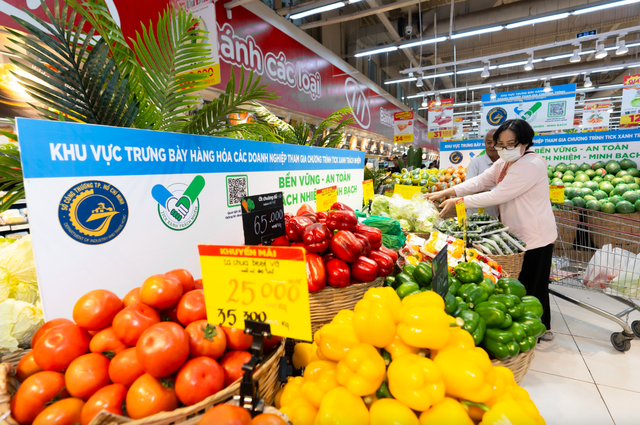
Customers favor products labeled with the ‘Green Tick of Responsibility’ mark. Photo: Tuoi Tre
Food poisoning risks across supply chain
Dao Ha Trung, president of the Ho Chi Minh City High Technology Association, said food poisoning incidents should not be viewed merely as statistics, as they can have severe consequences for public health and even threaten lives, especially those of children.
He noted that studies have identified bacteria such as Salmonella, E. coli, and Botulinum among the leading causes of foodborne illness.
These pathogens can appear during multiple stages of food production and distribution, particularly in meat products and processed foods.
To strengthen prevention measures, Trung proposed five core solutions, including stricter control over input quality, tighter supervision during food processing, improved storage management, transparent data sharing across the supply chain, and the establishment of rapid product recall mechanisms in the event of violations or contamination.
Tran Le Nguyen Khang, deputy head of the SATRA retail system management board, proposed introducing mandatory regulations for food processors and suppliers serving schools.
He said food safety should not depend solely on voluntary responsibility, but instead be supported by enforceable standards requiring full compliance from all parties involved.
He warned that some suppliers may initially possess complete documentation and certifications but later attempt to circumvent regulations by sourcing cheaper ingredients outside approved channels in order to cut costs.
Khang called for more frequent and unannounced inspections, particularly during the ingredient procurement stage, to promptly detect violations.
Business representatives also recommended combining incentives with penalties.
Companies and suppliers that consistently meet standards should be publicly recognized and rewarded, while violators should be publicly identified, placed on warning lists, and regularly monitored.
It is also necessary to introduce mechanisms for corrective action and removal from warning lists if violations are not repeated.








Max: 1500 characters
There are no comments yet. Be the first to comment.