


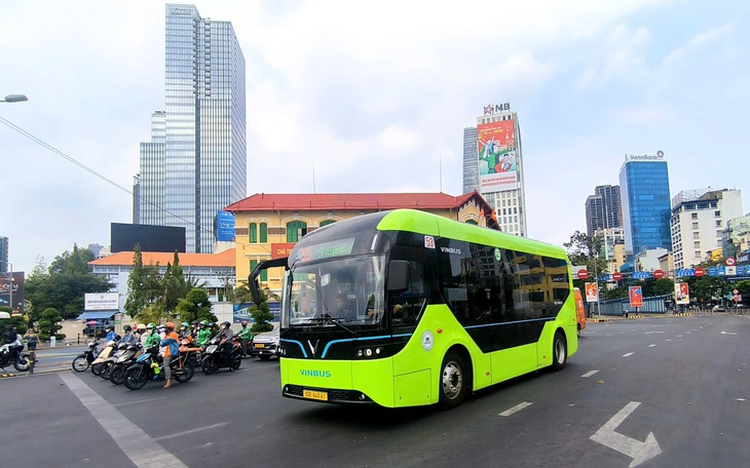
All 134 bus routes currently operating in Ho Chi Minh City will be free of charge from July 1, 2026. Photo: Le Phan / Tuoi Tre
The initiative is meant to encourage greater use of public transportation, improve access to bus services, and support the city’s goals of developing greener transport, reducing traffic congestion, and enhancing the urban living environment.
The fare-free policy will apply to 134 bus routes operating in Ho Chi Minh City, including both subsidized and non-subsidized services.
However, the program will not cover interprovincial bus routes, open-top sightseeing buses serving tourists, airport shuttle services connecting urban and tourism centers with airports, or routes that pass through other provinces or cities and operate in a manner similar to interprovincial services.
As a result, route 172, which connects downtown Ho Chi Minh City with Vung Tau and passes through Dong Nai City, will not be included in the free-fare program. This means the previously announced figure of 135 fare-free routes has been revised to 134.
The policy will be implemented in two phases.
During the first phase, from July 1 to September 30, passengers will be able to ride buses free of charge without any identification or verification requirements.
During this period, the city will focus on public awareness campaigns, encourage residents to use buses, and complete the development of databases, technological infrastructure, and an electronic ticketing system.
Passengers will also be encouraged to verify their identities and have their bus trips recorded to participate in incentive and appreciation programs sponsored by partner organizations.
In the second phase, from October 1 to December 31, the 100-percent fare subsidy will be linked to passenger verification or identification through methods such as citizen identification cards, the VNeID digital identity platform, bank cards, e-wallets, the MultiGo application, or other legally recognized electronic forms.
The city said appropriate arrangements and guidance would be provided for elderly passengers, people with disabilities, children, students, visitors, and other special groups to ensure convenience and effective management.
To ensure the program’s success, Ho Chi Minh City will simultaneously work on improving regulatory mechanisms, securing funding, upgrading service quality and vehicles, expanding bus-related infrastructure, and strengthening connections between different modes of public transportation.
During 2026 and 2027, the city plans to build and upgrade bus stops and shelters to make them more modern, convenient, and user-friendly.
Existing bus stations, including Saigon Bus Station and Cho Lon Bus Station, will also be upgraded.
In addition, the city plans to develop and operate multi-story parking facilities at Cho Lon Bus Station, Saigon Bus Station, Tan Phu Bus Station, and other suitable locations in line with urban planning requirements to enhance the capacity of the public transport system.
Accelerating transition to green buses
Ho Chi Minh City currently operates a fleet of 2,432 buses, including 1,649 electric and green-energy vehicles, which account for 67.8 percent of the total.
The remaining 783 buses run on diesel fuel, representing 32.2 percent of the fleet.
As part of its green transition strategy for public passenger transport, the Department of Construction has developed a roadmap to replace all fossil-fuel-powered buses with electric or other environmentally friendly vehicles.
Under the plan, 624 buses will be converted to electric power in 2026.
By January 1, 2027, all bus services operating in Ho Chi Minh City are expected to run entirely on electricity or green energy.
During 2027 and 2028, the city will continue converting interprovincial bus routes currently using compressed natural gas and other fuels to electric vehicles.
Authorities aim for all buses operating in Ho Chi Minh City to be powered by electricity by January 1, 2029, contributing to the development of a modern, environmentally friendly, and sustainable public transportation system.








Max: 1500 characters
There are no comments yet. Be the first to comment.