


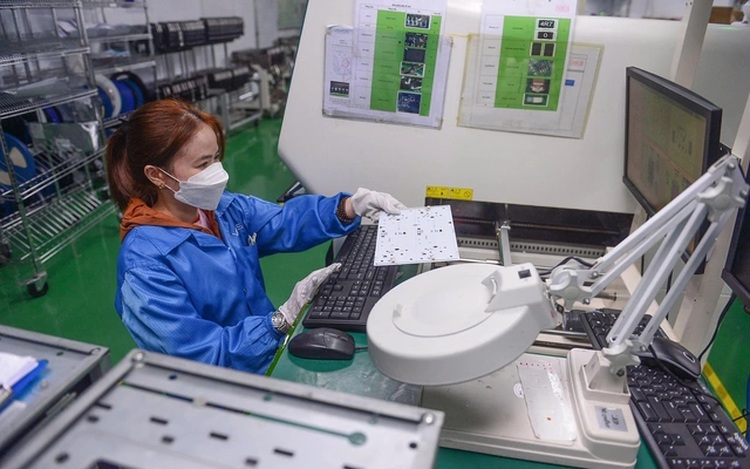
A worker at Vexos, a wholly foreign-owned company located in Tan Thuan Export Processing Zone in Ho Chi Minh City. Photo: Quang Dinh / Tuoi Tre
The plan was highlighted by officials from the Ho Chi Minh City Export Processing and Industrial Zones Authority (HEPZA) at the ‘Industry 4.0 and Smart Supply Chain – A New Driving Force for Ho Chi Minh City’ forum held on Wednesday.
Nguyen Trung Tin, deputy head of HEPZA, said the city’s export processing zones and industrial parks are facing a comprehensive overhaul to move beyond outdated development models.
“Maintaining the old model is no longer feasible. To build smart industrial parks, the city must consider the application of AI, IoT, big data, and automation as essential foundations,” Tin said.
He added that the city aims to transform existing industrial zones into eco-industrial, smart, and multi-functional developments capable of improving productivity, optimizing supply chains, and enhancing resilience against market fluctuations.
Tin also called for stronger linkages between domestic enterprises and foreign-invested companies to increase localization rates and enable Vietnamese firms to participate more deeply in global value chains.
Ho Chi Minh City currently has 17 established export processing zones and industrial parks with a combined area of 3,733 hectares.
According to official data, the zones have reached an occupancy rate of around 80 percent. They host 5,300 investment projects with nearly US$80 billion in registered capital and provide employment for about 920,000 workers.
Tin said the scale of these industrial zones demonstrates their potential contribution to the city’s goal of achieving double-digit economic growth.
Nguyen Thanh Trung, deputy director of the Ho Chi Minh City Department of Finance, said the city faces the challenge of sustaining growth of 10 percent while managing an economy worth more than VND3 quadrillion ($114 billion) and simultaneously restructuring its growth model around science, technology, and innovation.
To achieve this, the city is pursuing both traditional growth drivers and new development engines.
Among the new growth drivers are major infrastructure projects, including Beltway No. 3, metro line No. 2, the Can Gio International Port, logistics development initiatives, and improved regional transportation links.
Authorities are also accelerating plans for new economic spaces such as the Thu Thiem International Financial Center and a free trade zone.
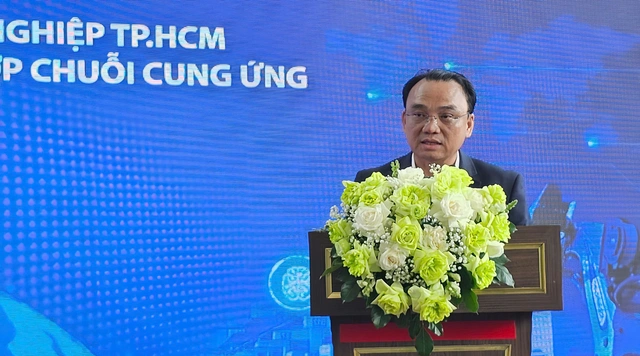
Nguyen Trung Tin, deputy head of the Ho Chi Minh City Export Processing and Industrial Zones Authority, speaks at the ‘Industry 4.0 and Smart Supply Chain – A New Driving Force for Ho Chi Minh City’ forum held on June 17, 2026. Photo: Truong Linh
Le Van Danh, deputy director of the Ho Chi Minh City Department of Industry and Trade, identified transportation infrastructure as one of the major bottlenecks hindering industrial park development.
He noted that inadequate connectivity among industrial parks, seaports, airports, and logistics centers has led to localized congestion, longer transportation times, and higher logistics costs.
Danh proposed reorganizing logistics infrastructure through a multi-tiered system consisting of international and regional logistics hubs, transit and distribution centers, and urban logistics networks.
A key element of this strategy is accelerating the operation of functional zones within Ho Chi Minh City’s planned free trade zone linked to the Cai Mep Ha port area.
Discussing future competitiveness, Robert Linh, director of Vietnam Industry Zone, said industrial parks would no longer compete primarily on land lease rates or labor costs.
“Investors are increasingly concerned with the quality of digital infrastructure, the availability of transparent data, compliance with ESG standards, the quality of business support services, and opportunities to participate in green manufacturing ecosystems,” Linh said.
He called for coordinated policies to attract foreign direct investment, emphasizing cooperation among government agencies, industrial park developers, businesses, and technology solution providers.
“The government plays the role of shaping policy and improving the legal framework; businesses are responsible for implementation; and science and technology organizations support research, technology transfer, and the application of innovative solutions,” he said.
According to HEPZA, the former Ho Chi Minh City area is expected to serve as a center for international finance, trade, innovation, high technology, high-value services, and global supply chain management.
The former Binh Duong area is envisioned as a center for industry, light manufacturing, environmentally friendly industries, high-tech services, smart manufacturing, and domestic logistics.
The former Ba Ria–Vung Tau area is set to become a center for the marine economy, international transshipment ports, logistics, energy, and port-based industries.
Leveraging the advantages of the Cai Mep–Thi Vai port complex, the area is expected to focus on international logistics, clean energy industries, petrochemicals, and maritime services.
Existing industrial parks in the region will be restructured to attract industries, heavy industries linked to the marine economy, oil and gas, clean energy, and big data centers.








Max: 1500 characters
There are no comments yet. Be the first to comment.