


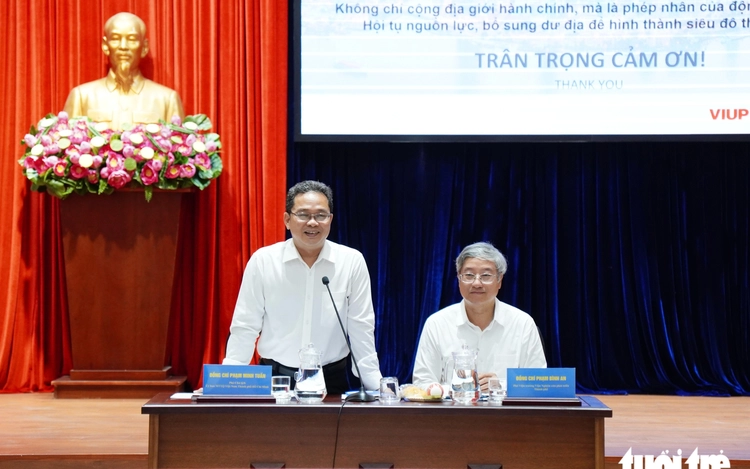
Pham Minh Tuan (L), deputy chairman of the Ho Chi Minh City chapter of the Vietnam Fatherland Front Committee, speaks at a consultation conference on the city's master planning, August 18, 2026. Photo: Ky Phong / Tuoi Tre
The consultation was organized by the Ho Chi Minh City chapter of the Vietnam Fatherland Front Committee (VFFC) to gather public feedback on the draft master plan.
The proposals come as Ho Chi Minh City enters a new planning period following its administrative merger with former Binh Duong and Ba Ria-Vung Tau Provinces under the national administrative restructuring effective on July 1, 2025, according to Pham Minh Tuan, deputy chairman of the Ho Chi Minh City chapter of the VFFC.
The merger has expanded the city's natural area to about 6,772.59 square kilometers, while its population is projected to reach 22-23 million by 2050.
Architect Ngo Viet Nam Son proposed developing TOD corridors along major development axes in the expanded city and integrating them with the 15-minute city model to create distinctive communities suited to local conditions.
Introduced in 2016 by Prof. Carlos Moreno of Sorbonne University in France, the 15-minute city model aims to ensure that residents can access essential services such as schools, healthcare facilities, shops, parks, and recreational areas within a 15-minute walk or bike ride from home.
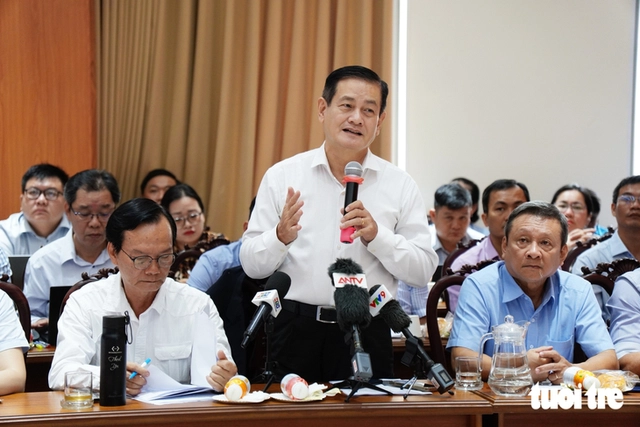
Architect Ngo Viet Nam Son speaks at a consultation conference in Ho Chi Minh City on the city's master planning, August 18, 2026. Photo: Ky Phong / Tuoi Tre
The model can reduce travel time and costs, help curb pollution and foster community ties while encouraging mixed-use development that combines housing, commerce, and services.
As a first step, Son proposed piloting a TOD model along metro line No. 1 and using it as a template for expansion to other parts of the city.
He also suggested defining the city's historic central area around Le Thanh Ton, Cach Mang Thang Tam, and Nguyen Thi Minh Khai Streets and the Nhieu Loc-Thi Nghe Canal, while linking green spaces along both sides of the canal.
The city could also use TOD connections to link economic and financial centers on both sides of the Saigon River, Son said.
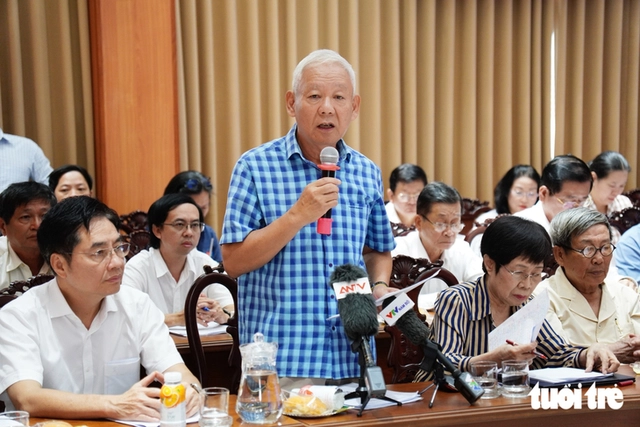
Dr. Tran Van, former deputy chairman of the National Assembly's Finance and Budget Committee, speaks at a consultation conference in Ho Chi Minh City on the city's master planning, August 18, 2026. Photo: Ky Phong / Tuoi Tre
More broadly, Tuan said the city's master plan should provide a strategic framework for reorganizing development space, distributing population and economic functions, and building an integrated transportation and technical infrastructure network.
It should also link an international financial center with high-tech industrial areas, seaports, and logistics systems, and coastal and ecological tourism hubs, he added.
Son called for multimodal transportation and logistics networks to improve connectivity, noting that logistics costs remain high and can in some cases exceed production costs.
A more efficient logistics network could also help reorganize urban areas, he said, suggesting that some functions at Cat Lai Port could be shifted to Cai Mep and Can Gio and connected with a network of ports along the Saigon River to reduce container traffic through urban areas.
Dr. Tran Van, former deputy chairman of the National Assembly's Finance and Budget Committee, said the plan should clearly identify investment needs, the city's capacity to mobilize funding and priorities among major projects.
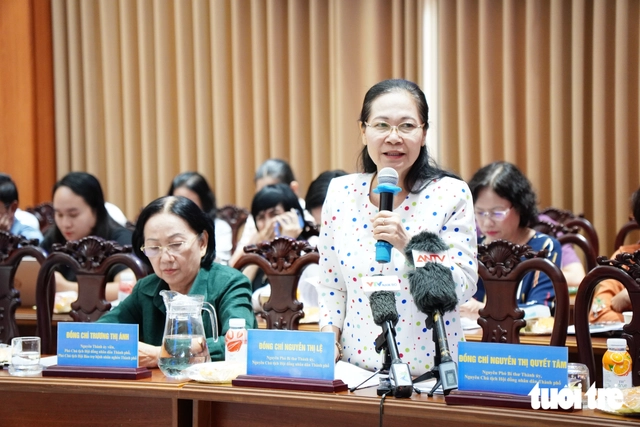
Nguyen Thi Le, former deputy secretary of the Ho Chi Minh City Party Committee and former chairwoman of the municipal People's Council, speaks at a consultation conference on the city's master planning, August 18, 2026. Photo: Ky Phong / Tuoi Tre
The plan should assess capital requirements against the size of the economy, budget revenue capacity and the city's ability to attract investment, Van said.
This is particularly important as the expanded Ho Chi Minh City will have to manage a much larger urban area while pursuing a target of double-digit economic growth, he added.
Prof. Nguyen Van Phuoc, chairman of the municipal Union of Science and Technology Associations, said the plan should classify areas according to their characteristics and resilience.
Areas with greater resilience could accommodate growth poles and strategic infrastructure, while development and population density should be more tightly controlled in areas vulnerable to risks, Phuoc said.
Pham Binh An, deputy director of the Ho Chi Minh City Institute for Development Studies, said 13 comments covering economic, cultural, social and institutional issues were recorded at the consultation.
The feedback will be used to further refine the city's master plan and its 100-year vision, An said.








Max: 1500 characters
There are no comments yet. Be the first to comment.